
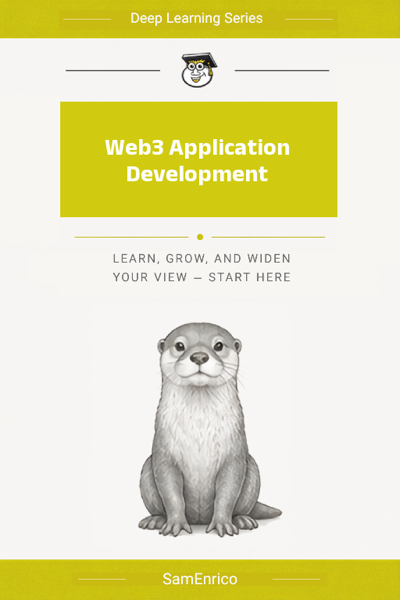
Web3 Application Development
A Coursebook on Web3 Application Development
by Whalen Dayna
A Coursebook on Web3 Application Development
Formats
About this book
Free sample
Chapter 1: The Trust Paradox...--–- Consider the last time you ordered a product from an online marketplace. You did not personally verify that the warehouse existed. You did not audit the payment processor’s database. You did not inspect the seller’s identity documents. Instead, you placed your trust in a chain of intermediaries: the marketplace platform, the payment provider, the shipping carrier, and perhaps your bank.
That system worked most of the time. But every so often, the platform changed its fees overnight, the payment hold lasted too long, or a data breach exposed your personal information. You tolerated these failures because the alternative—transacting directly with a stranger on the internet with no intermediary—seemed reckless. That alternative, however, is precisely what Web3 makes possible.This chapter establishes the philosophical and architectural foundation for everything that follows. It contains no code.
Instead, it answers the single most important question a developer can ask before investing hundreds of hours in a new technology stack: Why does Web3 exist, and why should I care? By the end of this chapter, you will understand not merely the what of blockchain development but the why—the deep motivation that drives thousands of engineers to rebuild the internet from first principles. You will also receive a roadmap for the twelve chapters ahead, so you can see exactly how each piece fits into the larger puzzle of decentralized application development.The Three Ages of the Internet To understand Web3, you must first understand where it came from. The internet did not emerge fully formed; it evolved through distinct eras, each characterized by who could create content, who controlled the infrastructure, and who captured the economic value.Web1: The Read-Only Era (Approximately 1991–2004)The early internet was a library. You visited static web pages—personal homepages, university research directories, corporate brochures—and you consumed information.
Interactivity was minimal. Comments sections did not exist. Social media was a decade away. If you wanted to publish something, you needed to know HTML, secure a web server, and convince an Internet Service Provider to host your files. The…
This is the end of the free sample. Get the eBook to keep going. Buy now
Contents
- Chapter 1
- Chapter 2
- Chapter 3
- Chapter 4
- Chapter 5
- Chapter 6
- Chapter 7
- Chapter 8
- Chapter 9
- Chapter 10
- Chapter 11
- Chapter 12
Details
- Author
- Whalen Dayna
- Publisher
- SamEnrico
- Language
- English
- Genre
- Non-Fiction, Informative, Educational
- Released
- 2026-05-04
- Pages (approx.)
- 150
- Available as
- eBook, Audiobook

Read better in the ZLOADR app
Your eBooks on your phone or tablet. Sign in with your SamEnrico account and start reading.
More by Whalen Dayna
 The Quit Journal MethodWhalen Dayna$11.99
 CrossFit for WomenWhalen Dayna$11.99
 Spaced Repetition MasteryWhalen Dayna$11.99
 Parent Death and Nature HealingWhalen Dayna$11.99
 Napping for High PerformanceWhalen Dayna$11.99
 Child Loss And Social MediaWhalen Dayna$11.99
 The Test Result WaitWhalen Dayna$11.99
 Pain Flare MeditationWhalen Dayna$11.99
 Assertiveness For Stay At Home ParentsWhalen Dayna$11.99
 The Silver Mask of the Moonlit KnightWhalen Dayna$11.99
 The Iron Chancellor: Bismarck's War That Made GermanyWhalen Dayna$11.99
 The Puppet Master: How a Forensic Psychologist Uncovered the Mind of a Serial KillerWhalen Dayna$11.99