
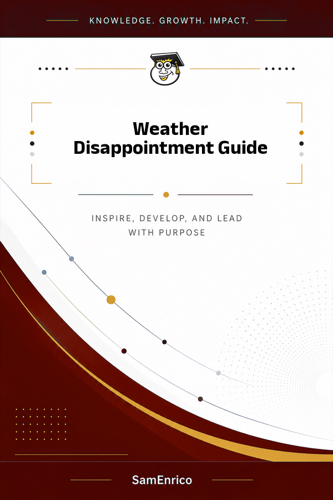
Weather Disappointment Guide eBook
Accepts ruined outdoor plans without bitterness.
by Buss Mariko
Accepts ruined outdoor plans without bitterness.
Formats
Free sample
Chapter 1: The Bitter Forecast--–- The first time I watched a grown woman cry over a weather app, I was sitting in a coffee shop in Portland, Oregon, in late April. She was in her mid-forties, well-dressed, holding a latte that was going cold in her hands. Her phone was face-up on the table. The screen showed a familiar icon: a gray cloud with three diagonal rain lines. She wasn't crying because someone had died.
She wasn't crying because she had lost her job or received bad news from a doctor. She was crying because she had planned a garden party for her mother's seventieth birthday, and the forecast had just shifted from "partly sunny" to "eighty percent chance of thunderstorms." I watched her scroll up and down the hourly breakdown, as if refreshing the page might convince the National Weather Service to change its mind. It did not. She wiped her eyes with a napkin, texted someone "I can't believe this," and walked out into the rain that had not yet started to fall.I tell this story not to mock her. I tell it because she was not being unreasonable.
She was being human.The Architecture of a Broken Promise We do not typically think of weather as something that can make promises. Weather is impersonal. It is the random churn of atmospheric pressure, temperature differentials, and jet streams. It has no intention, no memory, no loyalty. And yet, almost every adult human being has experienced the feeling of being personally betrayed by a thunderstorm.
We say things like "I can't believe this is happening" and "of course it would rain today" and "why does this always happen to me?" These are not statements about meteorology. These are statements about a relationship that we did not realize we were in.The relationship is with an imagined future. Call it Anticipatory Attachment—the human tendency to invest emotional energy into a mental movie of a perfect day that has not yet arrived. We do this constantly. You have a weekend trip planned.
For two weeks beforehand, you have been watching the extended forecast like a hawk. You have been imagining the feeling of sun on your shoulders, the sound of waves, the way the light will look in your photographs. You have been telling your friends about it. You have bought a new hat. In your mind, the day already exists.
It is real. You can almost taste it.Then the forecast changes.The weather has not done anything wrong. It has merely continued to be weather. But your brain does not register it that way. Your brain registers a broken promise.
And here is the crucial psychological insight: the brain does not distinguish easily between a promise made by a person and a promise implied by your own imagination. The same neural circuits that fire when a friend cancels plans at the last minute also fire when a thunderstorm cancels your picnic. You feel stood up. You feel disrespected. You feel, strangely and irrationally, like the sky should have known better.Why Sunny Days Feel Like Moral Victories Let us go deeper.
If bad weather feels like a betrayal, then good weather must feel like a reward. And indeed, we talk about sunny days as if we have earned them. "We got lucky with the weather." "The weather cooperated." "Mother Nature smiled on us." These are not neutral descriptions. They are moral judgments. A sunny day is not just a sunny day.
It is evidence that the universe is on your side. It is proof that you planned well, that you deserved this, that you are one of the good ones.This is absurd, of course. The sun does not shine on the righteous and withhold itself from the wicked. But our brains do not care about absurdity. They care about pattern and meaning.
Evolutionary psychology offers one explanation: for thousands of years, good weather meant survival (ripe crops, safe travel, successful hunting), and bad weather meant danger (failed harvests, flooded shelters, frozen limbs). We are the descendants of people who took weather personally. The ones who shrugged and said "oh well, it's just rain" did not always live to pass on their genes. The ones who anxiously scanned the horizon, who read every cloud as a threat, who treated clear skies as a blessing—those are our ancestors. Their anxiety kept them alive.But we no longer live in that world.
We have radar and forecasts and indoor plumbing and climate control. The survival threat is gone, but the emotional architecture remains. We are still scanning the horizon. We are still treating sunny days as victories and rainy days as failures. And because we live in an age of social media, we are also performing these victories and failures for an audience.
The highlight reel of a perfect beach day gets fifty likes. The photo of a washed-out campsite gets a pity emoji. The message is clear: good weather equals good person. Bad weather equals bad luck, bad planning, bad life.No wonder we feel betrayed.The Cost of the Invisible Contract Here is what makes weather disappointment so uniquely painful, compared to other forms of disappointment. When a friend cancels plans, you can be angry at the friend.
When a restaurant loses your reservation, you can complain to the manager. When a flight is delayed, you can blame the airline. There is a target for your frustration. There is someone to negotiate with, someone who might apologize, someone who might offer compensation. With weather, there is no one.
The sky does not apologize. The wind does not offer a refund. The rain does not care that you had a non-refundable deposit on that beach house.You are left with a very clean, very cold, very uncomfortable truth: no one owes you good weather. Not the universe, not God, not the National Oceanic and Atmospheric Administration. You have signed an invisible contract that the other party never agreed to.
You promised yourself a perfect day. The sky made no such promise. And now you are holding the sky accountable for a deal it never made.This is the core of weather bitterness. It is not the rain that makes you angry. It is the gap between what you expected and what you received.
And that gap was created entirely by you.I realize that sounds harsh. Let me soften it. The gap was not created by you because you are foolish or entitled. The gap was created by you because you are human. Anticipatory Attachment is not a character flaw.
It is a feature of how our brains work. We imagine future pleasures because imagining them gives us dopamine in the present. That is not broken. That is beautiful. But the same mechanism that gives us the pleasure of anticipation also sets us up for the pain of disappointment when reality fails to match the movie in our heads.The Social Media Amplification Loop We cannot discuss modern weather disappointment without discussing the role of social media.
Twenty years ago, if your weekend camping trip was rained out, you grumbled to your partner, maybe called a friend…
This is the end of the free sample. Get the eBook to keep going. Buy now
About this book
Details
- Author
- Buss Mariko
- Publisher
- SamEnrico
- Language
- English
- Genre
- Non-Fiction, Self-Help, Weather
- Released
- 2026-06-06
- Pages (approx.)
- 124
- Available as
- eBook, Audiobook

Read better in the ZLOADR app
Your eBooks on your phone or tablet. Sign in with your SamEnrico account and start reading.
More by Buss Mariko
 Purpose Driven Without BurnoutBuss Mariko$11.99
 Put Call Ratio SentimentBuss Mariko$11.99
 Caregiver Burnout for Diabetes CareBuss Mariko$11.99
 Stonewall Jackson: The Enigmatic Tactician of the ConfederacyBuss Mariko$11.99
 How to Become a Lumber EstimatorBuss Mariko$11.99
 UN Communication Careers HandbookBuss Mariko$12.99
 Penalty TimekeepingBuss Mariko$11.99
You may also like
 Hong Kong Handover 1997Dunn Johnnie$11.99
 Zumba For Postnatal Recovery CourseNeal Christian$11.99
 Zumba for BeginnersLadner Nikia$11.99
 YouTube Comment Mining GuideHumes Pandora$12.99
 Worry Box MeditationCarlin Rudy$11.99
 Workplace Stress MeditationNguyen Lynn$11.99
 Workplace Stress and Sleep RepairHawley Ivory$11.99
 Workplace Perfectionism CureDelaney Jeffry$11.99
 Workplace Injustice Anger GuideWallen Isabelle$11.99
 Work Addiction and Burnout LinkGreenwood Ester$11.99
 Women in Yoga and WellnessBeattie Galina$11.99
 Women in Stand Up ComedyChun Evangeline$11.99