
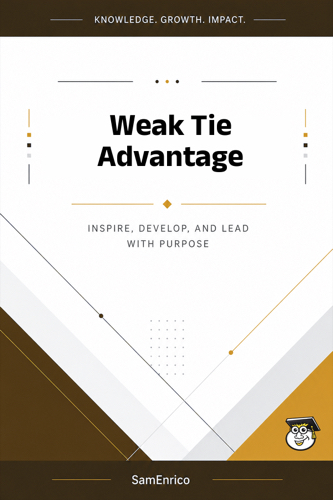
Non-FictionSelf-HelpSocial Networks
Weak Tie Advantage eBook
Leverage casual acquaintances for unexpected oppor
Leverage casual acquaintances for unexpected opportunities and information.
Formats
Free sample
Chapter 1: The Best Friend Paradox--–- Sarah Chen had been job hunting for eleven months. She had done everything right: updated her Linked In profile, attended three industry conferences, and asked every close friend and family member for leads. Her husband had asked his entire team. Her college roommate had shared her resume with her company’s HR department. Her former boss had written a glowing recommendation.
Nothing worked. Fifty-seven applications. Fourteen first-round interviews. Zero offers.Then one afternoon, she sent a casual email to someone she barely remembered – a woman named Priya who had sat two rows behind her in a marketing certification course four years earlier. They had never spoken outside of class.
They had never exchanged personal stories. Priya was, by every definition, a casual acquaintance. Sarah’s email was simple: “Hi Priya, I know it’s been a while. I’m looking for a role in brand strategy and remembered you worked at Nestle. Any advice?”Priya replied within six hours.
She didn’t have a job opening, but she knew someone who did. That someone was looking for exactly Sarah’s skill set. Two weeks later, Sarah had an offer.The person who changed Sarah’s career was not her husband, not her best friend, not her former boss. It was a woman she barely knew. And that is the best friend paradox: the people who love you most are often the least able to help you.This is not a criticism of your closest relationships.
Your best friends and family provide something irreplaceable – emotional safety, unconditional support, and a sense of belonging. But when it comes to new information, unexpected opportunities, and career breakthroughs, your strong ties are often blind spots, not bridges. They know what you know. They see what you see. They are stuck in the same information loop.The people who will change your life are the ones you barely know.A Revolution That Was Almost Never Published In 1970, a young sociologist named Mark Granovetter submitted a paper to the American Sociological Review.
His argument was simple and, at the time, heretical: the most valuable connections in your network are not your close friends but your casual acquaintances. He called this “the strength of weak ties.”The journal rejected it. The reviewers found it counterintuitive. Everyone knew, they said, that strong relationships were the ones that mattered. Close friends, family, trusted colleagues – these were the people who helped you find jobs, survive crises, and get ahead.
Granovetter’s claim that acquaintances could be more useful than friends seemed not just wrong but almost absurd.Granovetter revised the paper and resubmitted it. Rejected again. He revised again. Finally, in 1973, the paper was published in a different journal, the American Journal of Sociology. It went on to become one of the most cited social science papers of all time.
What Granovetter discovered, through interviews with hundreds of professional and technical workers, was this: 56 percent of people found their current jobs through a personal connection, but the majority of those connections were weak ties – people they saw occasionally or rarely. Only 17 percent found jobs through close friends or family.Think about that for a moment. The common assumption is that your best friend will help you find your next job. The data says the opposite. Your best friend is statistically less likely to be useful than the person you barely know.Granovetter’s insight was not just a curiosity of 1970s labor markets.
In 2022, a team of researchers from Linked In, MIT, Harvard, and Stanford published a massive replication study analyzing twenty million users over five years. They confirmed Granovetter’s finding and extended it in a crucial way. The researchers discovered that “moderately weak ties” – people with about ten mutual friends – were the single strongest predictor of job mobility. Not strangers. Not best friends.
People in the middle.The study found that when you have exactly ten mutual friends with someone, your likelihood of changing jobs through that connection is significantly higher than if you have one mutual friend or twenty. Fewer than five mutual friends, and the connection feels unfamiliar and untrustworthy. More than fifteen, and the information becomes redundant. The sweet spot is the moderate tie – someone you know well enough to feel comfortable reaching out to, but not so well that you already know everything they know.This is the missing middle of your network. And almost everyone ignores it.The Two Kinds of Capital To understand why weak ties matter more than you think, you need to understand the difference between two kinds of social capital: bonding capital and bridging capital.Bonding capital is the trust, emotional support, and reciprocity you share with your strongest relationships – your spouse, your best friend, your siblings, your mentor.
Bonding capital is essential for getting through difficult times. When you are sick, your partner takes care of you. When you are grieving, your best friend shows up. When you need honest feedback, your close colleague tells you the truth. Bonding capital is the safety net of human connection.But bonding capital has a hidden cost: redundancy.
Your strong ties know the same people you know, read the same news you read, and move in the same circles you move in. Asking your best friend for job leads is like asking yourself. They are your echo chamber – comforting, familiar, and ultimately limited.Bridging capital is different. Bridging capital is the novel information, access to new networks, and unexpected opportunities that come from connections who move in different social worlds. Your friend who works in a different industry.
Your former classmate who moved to a different city. Your college roommate’s cousin who you met once at a party. These are bridges – connections that span structural holes in your network.The research on bridging capital is striking. In one study of venture capital investors, researchers found that the most successful investors were not the ones with the deepest relationships but the ones with the broadest, most diverse networks. Each additional industry sector represented in an investor’s network increased their returns by a measurable margin.
The investors who only knew other investors missed the best deals. The investors who knew operators, academics, and technologists found them.In another study of M&A bankers, researchers found that those who relied only on their inner-circle contacts consistently missed “off-market” deals – opportunities that were never publicly listed. Those who actively cultivated weak ties across different sectors – technology, logistics, real estate, healthcare – uncovered three times more opportunities. The most successful bankers had networks that looked less like a dense cluster and more like a sparse web spanning unrelated industries.You see the pattern. Strong ties give you comfort.
Weak ties give you access. The former makes you feel safe. The latter makes you successful.The Myth of the Cold Pitch Here is where most people get weak ties wrong. When they hear “weak ties,” they think of cold messaging strangers on Linked In. That is not what this book is about.
And it almost never works.Granovetter’s original insight, confirmed by every major study since, is that weak ties are not strangers. They are acquaintances – people with whom you…
This is the end of the free sample. Get the eBook to keep going. Buy now
About this book
Details
- Author
- Vargas Shelia
- Publisher
- SamEnrico
- Language
- English
- Genre
- Non-Fiction, Self-Help, Social Networks
- Released
- 2026-06-09
- Pages (approx.)
- 135
- Available as
- eBook, Audiobook

Read better in the ZLOADR app
Your eBooks on your phone or tablet. Sign in with your SamEnrico account and start reading.
More by Vargas Shelia
 Fitness Training Priority GuideVargas Shelia$11.99
 Fellini Dream and RealityVargas Shelia$11.99
 Animal Crossing Daily ChoresVargas Shelia$11.99
 Uber Driver Expense Tracking AppsVargas Shelia$11.99
 Understanding Mental Deficiency-epilepsy-endocrine DisordersVargas Shelia$17.99
 Ultimate Handbook Guide to Xinxiang : (China) Travel GuideVargas Shelia$11.99
 Rocking Chair CraftVargas Shelia$11.99
 World Bank Employment GuideVargas Shelia$12.99
 Project Management Shortcut KeysVargas Shelia$12.99
You may also like
 Hong Kong Handover 1997Dunn Johnnie$11.99
 Zumba For Postnatal Recovery CourseNeal Christian$11.99
 Zumba for BeginnersLadner Nikia$11.99
 YouTube Comment Mining GuideHumes Pandora$12.99
 Worry Box MeditationCarlin Rudy$11.99
 Workplace Stress MeditationNguyen Lynn$11.99
 Workplace Stress and Sleep RepairHawley Ivory$11.99
 Workplace Perfectionism CureDelaney Jeffry$11.99
 Workplace Injustice Anger GuideWallen Isabelle$11.99
 Work Addiction and Burnout LinkGreenwood Ester$11.99
 Women in Yoga and WellnessBeattie Galina$11.99
 Women in Stand Up ComedyChun Evangeline$11.99