
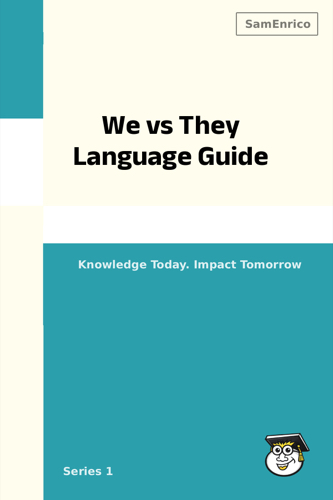
We vs They Language Guide eBook
Use inclusive pronouns to build coalition.
Use inclusive pronouns to build coalition.
Formats
Free sample
Chapter 1: The Three-Letter Lie--You have been lied to by a word you use hundreds of times a day.It is not a four-letter word. It is not a political slogan. It is not a conspiracy theory or a hidden agenda. It is a three-letter pronoun that sits in your mouth like a pebble, harmless and small, while it quietly rewires the brains of everyone who hears it.That word is "they."And the lie is this: that "they" is neutral. That "they" is just a convenient way to refer to people who are not in the room.
That "they" does not carry weight, does not carry judgment, does not carry the quiet, insidious implication that the person you are talking about is somehow less trustworthy, less human, less deserving of your attention than the people you call "we."The research is clear, and it is unsettling. When psychologists at the University of California, Berkeley, asked subjects to read sentences containing the word "they" referring to an unnamed group of people, those subjects consistently rated the unnamed group as more threatening, more dishonest, and more aggressive than groups referred to by a specific noun like "the neighbors" or "the city council." The same people. The same actions. Only the pronoun changed. And with it, the entire emotional landscape of the sentence shifted.This chapter is not about politics.
It is not about being "politically correct." It is about the cold, hard, peer-reviewed science of how your brain processes three-letter words without your permission. It is about the difference between the "they" that builds walls and the "we" that builds bridges. And it is about the first, most fundamental step in transforming not just your language, but your relationships, your workplace, and your ability to function in a world that is desperate for connection.Welcome to the hidden power of pronouns.The Neuroscience of a Single Syllable Let us start with a thought experiment.Imagine you are walking down a crowded city street. You hear someone behind you say, loudly, "They are coming." Without turning around, your heart rate increases slightly. Your peripheral vision widens.
Your palms might grow clammy. You have no idea who "they" are, what "they" want, or why "they" are coming. But your brain has already classified "they" as a potential threat.Now imagine you hear someone say, "The parade is coming." No threat response. Or "Our friends are coming." Positive anticipation. Or "The police are coming." Neutral to context-dependent.
The difference is not in the event. The difference is in the specificity. And the most dangerous specificity of all is none at all.This is not pop psychology. This is functional magnetic resonance imaging data.In a landmark study published in the Journal of Cognitive Neuroscience, researchers placed subjects in an MRI scanner and read them sentences containing different pronouns. When subjects heard "we" or "us" in a sentence referring to their own group, the ventral striatum — a region associated with reward, pleasure, and social bonding — lit up like a Christmas tree.
When subjects heard "they" referring to an outgroup, the amygdala and anterior cingulate cortex — regions associated with threat detection, fear, and pain processing — activated instead.The same subjects. The same scanner. The same neutral sentences. Only the pronoun changed.Your brain is not a computer running neutral calculations. Your brain is a survival machine that evolved over hundreds of thousands of years to sort the world into two categories as quickly as possible: things that will help me live, and things that might kill me.
Everything else is detail. And pronouns are the shortcuts your brain uses to make that split-second categorization."We" means safety. "They" means danger.You did not choose this wiring. Your ancestors did, on the savannas of Africa, where the difference between "us" (the tribe) and "them" (the rival tribe, the predators, the unknown) was literally the difference between life and death. But you are not on the savanna anymore.
You are in a conference room, a classroom, a family dinner, a comment section. And your ancient, well-meaning, deeply flawed brain is still treating "they" like a lion in the grass.The I/We Gap: Why Leaders Who Say "We" Win Let us move from the brain to the boardroom.For years, organizational psychologists have studied what makes some leaders more effective than others. Intelligence matters. Charisma matters. Experience matters.
But one of the strongest predictors of a leader's success is something far simpler: the ratio of "we" to "I" in their daily speech.Consider the data from a study of 150 project teams at a Fortune 500 technology company. Researchers recorded team meetings for three months, then transcribed and analyzed every pronoun used by team leaders. They found that teams whose leaders used "we" at least twice as often as "I" had 40 percent higher cooperation scores, 35 percent faster conflict resolution, and significantly lower employee turnover than teams whose leaders used "I" predominantly.Forty percent. Not a rounding error. Not a statistical fluke.
A forty percent increase in cooperation simply from changing one three-letter word.Why does this work? Because "we" does something that "I" and "you" cannot do. "I" creates hierarchy. "I need you to finish this report" says, in effect, "I am the decider, and you are the doer." "You" creates blame. "You did not finish the report" says, "This failure belongs to you alone." But "we" creates shared ownership.
"We need to finish this report" says, "This is our problem, and we will solve it together."Notice what "we" does not do. It does not erase accountability. If the report is late, the team still knows who was responsible for writing it. But "we" changes the emotional context from shame to partnership. And people who feel partnered rather than shamed work harder, stay longer, and solve problems more creatively.A different study, this one from Stanford University, looked at how couples communicate during conflict.
Researchers brought married couples into a lab, asked them to discuss a recurring disagreement, and videotaped the conversations. Then they analyzed the language. The couples who used "we" words ("we need to talk about the budget," "we have been fighting a lot lately") were significantly more likely to report satisfaction with the conversation afterward than couples who used "you" words ("you never listen," "you spend too much money"). The "we" couples also showed lower cortisol levels and returned to baseline heart rate more quickly after the discussion ended.The body knows. The brain knows.
The pronoun is not just a word. It is a physiological event.The Case of the Disappearing "They"Now let us complicate things.If "they" is so dangerous, why do we use it constantly? And what about the singular "they" — as in "Alex forgot their phone"? Is that dangerous too?The answer requires a crucial distinction that most books on this topic fail to make. And because this book is committed to clarity over slogans, we will make it now, clearly and permanently.There are two completely different uses of the word "they" in English.
The first is the vague, antecedent-free "they" that refers to an unnamed, unknown, or unspecified group. This is the "they" of "They are ruining this country." This…
This is the end of the free sample. Get the eBook to keep going. Buy now
About this book
Details
- Author
- Mccarter Lenita
- Publisher
- SamEnrico
- Language
- English
- Genre
- Non-Fiction, Self-Help, Language
- Released
- 2026-06-06
- Pages (approx.)
- 139
- Available as
- eBook, Audiobook

Read better in the ZLOADR app
Your eBooks on your phone or tablet. Sign in with your SamEnrico account and start reading.
More by Mccarter Lenita
 Financial Services Precedent DealsMccarter Lenita$11.99
 Pet Product AddictionMccarter Lenita$11.99
 Verdun Memorial InterpretationMccarter Lenita$11.99
 Gambling Addiction Recovery AffirmationsMccarter Lenita$11.99
 Crampon Techniques GuideMccarter Lenita$11.99
 The Boyfriend TraffickerMccarter Lenita$11.99
 Light Therapy RisksMccarter Lenita$11.99
 The Great Jewel Heist of the British Crown: The Mystery of the Stuart SapphiresMccarter Lenita$11.99
 The Forge of Hephaestus: A Blacksmith’s CurseMccarter Lenita$11.99
 How to Produce Terra CottaMccarter Lenita$11.99
 Service Providers Guide to ExcavatingMccarter Lenita$11.99
 A Collector's Handbook to the Ford Prefect 107eMccarter Lenita$11.99
You may also like
 Hong Kong Handover 1997Dunn Johnnie$11.99
 Zumba For Postnatal Recovery CourseNeal Christian$11.99
 Zumba for BeginnersLadner Nikia$11.99
 YouTube Comment Mining GuideHumes Pandora$12.99
 Worry Box MeditationCarlin Rudy$11.99
 Workplace Stress MeditationNguyen Lynn$11.99
 Workplace Stress and Sleep RepairHawley Ivory$11.99
 Workplace Perfectionism CureDelaney Jeffry$11.99
 Workplace Injustice Anger GuideWallen Isabelle$11.99
 Work Addiction and Burnout LinkGreenwood Ester$11.99
 Women in Yoga and WellnessBeattie Galina$11.99
 Women in Stand Up ComedyChun Evangeline$11.99