
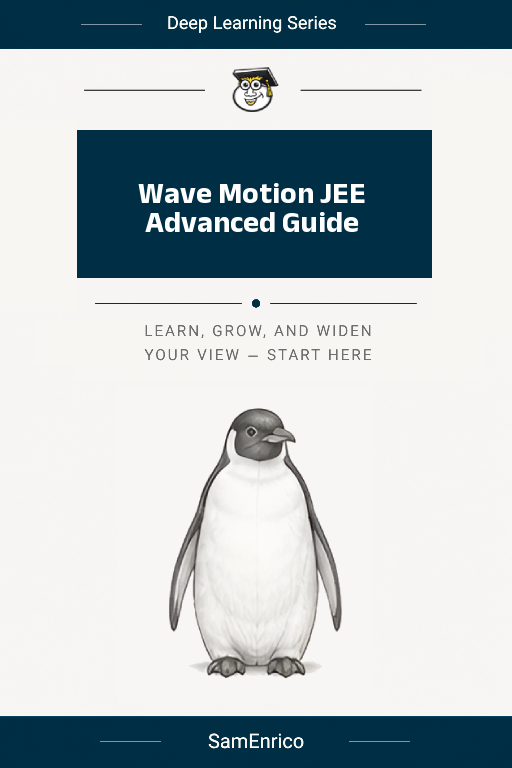
Wave Motion JEE Advanced Guide Audiobook
Solve standing wave Doppler effect and beat freque
by Woo Taisha
Solve standing wave Doppler effect and beat frequency problems using wave equation principles.
Formats
Free sample
Chapter 1: The Unseen Thread...-- In the winter of 1746, a French mathematician named Jean le Rond d’Alembert sat staring at a vibrating violin string. He wasn’t listening to its music. He was chasing something deeper — a hidden pattern that governed every wiggle, every ripple, every wave in the physical world. What he discovered was not just an equation for strings. It was a universal thread connecting seemingly unrelated phenomena: the steady hum of an organ pipe, the rising pitch of a passing ambulance, the rhythmic throb of two mistuned tuning forks.
That thread is the wave equation. And without understanding it, no amount of formula-memorizing will save you on JEE Advanced.Most students enter wave motion like tourists with a phrasebook: they memorize v=fλv = f\lambdav=fλ, plug numbers into Doppler formulas, and hope for the best. But when the exam twists the problem — a moving observer in a standing wave, a source emitting two frequencies, a wind blowing through an organ pipe — the phrasebook fails. The only way to survive is to go back to first principles. This chapter builds that foundation.
It shows that standing waves, Doppler shifts, and beats are not separate topics. They are three costumes worn by the same mathematical entity: the one-dimensional wave equation.By the end of this chapter, you will not merely know the wave equation. You will feel why it must be true. You will derive the speed of a wave from tension and mass density. You will see how simple harmonic motion hides inside every fixed point on a wave.
And you will understand that every problem in this book — from normal modes to Doppler reflections to beating siren — is just a different way of asking: What solves the wave equation under these conditions?1.1 The Physical Origin of the Wave Equation Consider a flexible string stretched along the x‑axis under tension TTT. The string has mass per unit length μ\muμ (linear density). When you pluck it, a small segment between xxx and x+Δxx + \Delta xx+Δx moves vertically. We want to find the equation that governs its vertical displacement y(x,t)y(x,t)y(x,t).Let’s isolate that segment. The tension pulls at both ends, but because the string is curved, the vertical components of tension don’t cancel exactly.
At the left end (xxx), the vertical force is −Tsinθ1-T \sin\theta_1−Tsinθ1 (negative because it pulls downward if the slope is…
This is the end of the free sample. Get the Audiobook to keep going. Buy now
About this book
Details
- Author
- Woo Taisha
- Publisher
- SamEnrico
- Language
- English
- Genre
- Non-Fiction, Student's Shortcut
- Released
- 2026-05-29
- Pages (approx.)
- 134
- Available as
- eBook, Audiobook

Listen in the VoxFlicks app
Audiobooks and audio dramas wherever you go. Sign in with your SamEnrico account and press play.
More by Woo Taisha
 Nobel Laureates In GPS TechnologyWoo Taisha$11.99
 The Nobel Laureate LifespansWoo Taisha$11.99
 The No Spend Anniversary GuideWoo Taisha$11.99
 Body Scan For Trauma SafetyWoo Taisha$11.99
 Arm Crossing as BarrierWoo Taisha$11.99
 Meditation For Panic BeginnersWoo Taisha$11.99
 Sleeping Bear Dunes VanishedWoo Taisha$11.99
 Reid Hoffman LinkedInWoo Taisha$11.99
 Love Letters from the Front: The Secret Plays of Sarah Bernhardt and Victorien SardouWoo Taisha$11.99
 The Harmonies of the Nile: Egypt's Forgotten Maestros of the Pharaonic CourtWoo Taisha$11.99
 The Mineral Guide to AheyliteWoo Taisha$11.99
 How to Become a Briquette-machine OperatorWoo Taisha$11.99
You may also like
 Hong Kong Handover 1997Dunn Johnnie$11.99
 Zumba For Postnatal Recovery CourseNeal Christian$11.99
 Zumba for BeginnersLadner Nikia$11.99
 YouTube Comment Mining GuideHumes Pandora$12.99
 Worry Box MeditationCarlin Rudy$11.99
 Workplace Stress MeditationNguyen Lynn$11.99
 Workplace Stress and Sleep RepairHawley Ivory$11.99
 Workplace Perfectionism CureDelaney Jeffry$11.99
 Workplace Injustice Anger GuideWallen Isabelle$11.99
 Work Addiction and Burnout LinkGreenwood Ester$11.99
 Women in Yoga and WellnessBeattie Galina$11.99
 Women in Stand Up ComedyChun Evangeline$11.99