
Non-FictionInformativeEducational
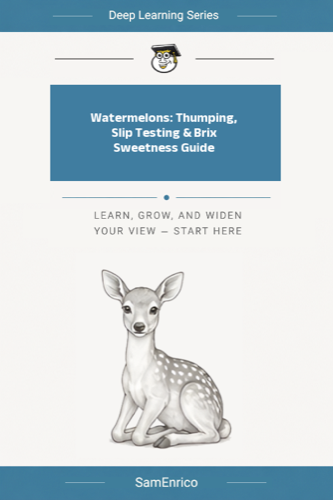
Watermelons: Thumping, Slip Testing & Brix Sweetness Guide
This harvesting publication, published by SamEnric
by Vance Zana
This harvesting publication, published by SamEnrico, covers Watermelons: Thumping, Slip Testing & Brix Sweetness Guide
Formats
About this book
Free sample
Chapter 1: The Hidden Anatomy--Walking through a commercial watermelon field in July, you are surrounded by what appears to be hundreds of identical green orbs. To the untrained eye, every melon looks the same. To the farmer who loses ten percent of his crop annually to guesswork, every melon is a gamble. But beneath that striped rind lies a sophisticated biological system that, once understood, transforms gambling into science. This chapter dissects that system—literally and figuratively—to reveal why watermelons behave the way they do during their final days on the vine and why understanding their anatomy is the difference between a ten-dollar melon and a fifty-cent disappointment.The Watermelon: A Brief Botanical Biography Before we can understand how to pick a perfect watermelon, we must understand what a watermelon actually is.
Botanically speaking, the watermelon (Citrullus lanatus) is a pepo—a type of berry with a thick, leathery rind. It is a member of the Cucurbitaceae family, which includes cucumbers, pumpkins, squash, and cantaloupes. This familial connection explains why many ripeness indicators overlap across these crops, but as we will see in Chapter 4, watermelons diverge from their cousins in one critical respect: they do not slip from the vine.The modern commercial watermelon is the product of thousands of years of selective breeding, beginning in southern Africa, where wild watermelons were small, bitter, and pale-fleshed. Ancient Egyptians cultivated them as a source of water during dry seasons—hence the name. By the time watermelons reached the Mediterranean via trade routes, they had evolved into larger, sweeter fruits.
Today, over 1,200 varieties exist worldwide, ranging from the one-pound "Personal" melons to the hundred-pound "Carolina Cross" giants. Despite this diversity, the fundamental anatomy remains consistent, and understanding that anatomy is your first step toward harvest mastery.External Anatomy: What You See Before You Touch The rind is the watermelon's armor. Composed of three layers—the exocarp (outer skin), mesocarp (white flesh beneath the skin), and endocarp (the boundary between rind and edible flesh)—the rind serves multiple functions. It protects the internal tissue from physical damage, prevents water loss, and defends against pathogens. The…
This is the end of the free sample. Get the eBook to keep going. Buy now
Contents
- Chapter 1
- Chapter 2
- Chapter 3
- Chapter 4
- Chapter 5
- Chapter 6
- Chapter 7
- Chapter 8
- Chapter 9
- Chapter 10
- Chapter 11
- Chapter 12
Details
- Author
- Vance Zana
- Publisher
- SamEnrico
- Language
- English
- Genre
- Non-Fiction, Informative, Educational
- Released
- 2026-06-02
- Pages (approx.)
- 150
- Available as
- eBook, Audiobook

Read better in the ZLOADR app
Your eBooks on your phone or tablet. Sign in with your SamEnrico account and start reading.
More by Vance Zana
 Anki For Real EstateVance Zana$11.99
 Creative OKRs for BusinessVance Zana$11.99
 CrossFit Sandbag TrainingVance Zana$11.99
 Anki for Medical StudentsVance Zana$11.99
 Meditation for Arthritis PainVance Zana$11.99
 The Financial Stress and ChildcareVance Zana$11.99
 Daily Review Habit BuilderVance Zana$11.99
 Colorado Plateau Desert CanyonsVance Zana$11.99
 The Phantom Detective: The Lost Identity of Inspector LegrandVance Zana$11.99
 The Shanghai Swindle: China's Forgotten Ponzi King and the 1920s Financial CollapseVance Zana$11.99
 How to Produce Reaction BallsVance Zana$11.99
 How to Start a Made-up Filter Cloth Business (Beginners Guide)Vance Zana$11.99
You may also like
 Hong Kong Handover 1997Dunn Johnnie$11.99
 Zumba For Postnatal Recovery CourseNeal Christian$11.99
 Zumba for BeginnersLadner Nikia$11.99
 YouTube Comment Mining GuideHumes Pandora$12.99
 Worry Box MeditationCarlin Rudy$11.99
 Workplace Stress MeditationNguyen Lynn$11.99
 Workplace Stress and Sleep RepairHawley Ivory$11.99
 Workplace Perfectionism CureDelaney Jeffry$11.99
 Workplace Injustice Anger GuideWallen Isabelle$11.99
 Work Addiction and Burnout LinkGreenwood Ester$11.99
 Women in Yoga and WellnessBeattie Galina$11.99
 Women in Stand Up ComedyChun Evangeline$11.99