
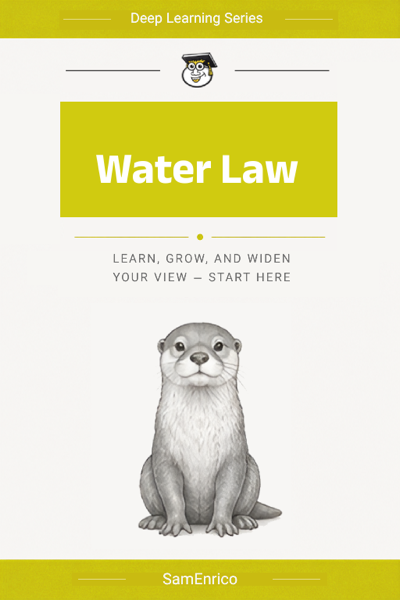
Non-FictionInformativeEducational
Water Law
A Coursebook on Water Law
A Coursebook on Water Law
Formats
About this book
Free sample
Chapter 1: The Silver Lie...--–- On a warm July morning in 2022, Marvin Zimmerman walked the ditch that his grandfather had dug in 1916. The ditch was dry. Not low, not muddy—dry. Cracks ran across its bottom like fractured skin. Ten miles upstream, a junior appropriator with a newer water right was still irrigating alfalfa.
Marvin had the older right. By every law on the books, the water should have been his. But the river had not read the law books. The river had simply stopped flowing.Marvin Zimmerman is not a lawyer. He is a fifth-generation potato farmer in the San Luis Valley of Colorado.
He does not know the difference between riparian rights and prior appropriation, nor does he care. What he knows is that his family has taken water from that creek for 106 years, and this is the first time it has ever gone dry in July. He also knows that the state water engineer told him he could not "call" the river because the aquifer beneath his fields had dropped so low that the creek was now recharging groundwater instead of the other way around. The law said one thing. The hydrology said another.
The hydrology won.This chapter is about why Marvin lost, why the law failed him, and why every single rule in this book—every doctrine, every statute, every Supreme Court decision—was written for a world that no longer exists. If you understand that up front, the rest of the book will make sense. If you do not, you will memorize water law without ever understanding water.The Central Argument of This Book Most water law casebooks begin with a case. This one begins with a confession: American water law is built on a lie. Not a malicious lie, not a conspiracy, but a lie nonetheless—the assumption that water is abundant enough and climate is stable enough that we can allocate rights once and never revisit them.That assumption was reasonable in 1848, when the California Gold Rush began and the first appropriators staked their claims.
It was reasonable in 1908, when the Supreme Court decided Winters v. United States and implied federal reserved water rights…
This is the end of the free sample. Get the eBook to keep going. Buy now
Contents
- Chapter 1
- Chapter 2
- Chapter 3
- Chapter 4
- Chapter 5
- Chapter 6
- Chapter 7
- Chapter 8
- Chapter 9
- Chapter 10
- Chapter 11
- Chapter 12
Details
- Author
- Allred Katrice
- Publisher
- SamEnrico
- Language
- English
- Genre
- Non-Fiction, Informative, Educational
- Released
- 2026-06-02
- Pages (approx.)
- 133
- Available as
- eBook, Audiobook

Read better in the ZLOADR app
Your eBooks on your phone or tablet. Sign in with your SamEnrico account and start reading.
More by Allred Katrice
 Long Term Tobacco Maintenance PlanAllred Katrice$11.99
 Caregiver Support Group FinderAllred Katrice$11.99
 Tariff USMCA Certification GuideAllred Katrice$11.99
 Stress Management for First RespondersAllred Katrice$11.99
 Silk and Steel: The Unseen Empire of the Silk Road's Shadow BrokersAllred Katrice$11.99
 How to Produce Aquarium LightingAllred Katrice$11.99
 DMCA Compliance Terms HandbookAllred Katrice$12.99
 How to Become a Paper StripperAllred Katrice$11.99
You may also like
 Hong Kong Handover 1997Dunn Johnnie$11.99
 Zumba For Postnatal Recovery CourseNeal Christian$11.99
 Zumba for BeginnersLadner Nikia$11.99
 YouTube Comment Mining GuideHumes Pandora$12.99
 Worry Box MeditationCarlin Rudy$11.99
 Workplace Stress MeditationNguyen Lynn$11.99
 Workplace Stress and Sleep RepairHawley Ivory$11.99
 Workplace Perfectionism CureDelaney Jeffry$11.99
 Workplace Injustice Anger GuideWallen Isabelle$11.99
 Work Addiction and Burnout LinkGreenwood Ester$11.99
 Women in Yoga and WellnessBeattie Galina$11.99
 Women in Stand Up ComedyChun Evangeline$11.99