
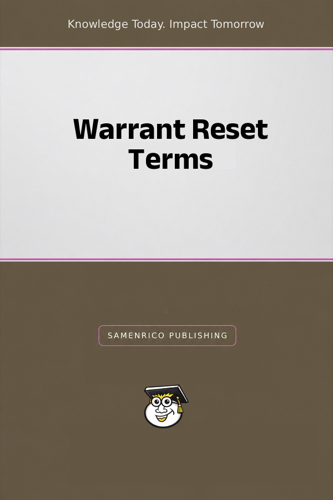
Non-FictionCapital & Valuation RegisterWarrant Reset
Warrant Reset Terms eBook
Explains resetting warrant strike price after down
Explains resetting warrant strike price after down round financing.
Formats
Free sample
Chapter 1: The $10 Million Typo--It was the kind of typo that keeps lawyers awake at three in the morning.A fintech startup called Veridian had raised a Series A at a $40 million valuation, issuing warrants to its lead investor with what everyone believed was a standard weighted average anti-dilution provision. The term sheet said “broad-based weighted average.” The warrant agreement said “narrow-based weighted average.” The difference was a single word. That one-word typo cost the founders $10.2 million when a down round triggered eighteen months later.The founders signed without reading the final warrant agreement. Their lawyer had reviewed the term sheet but not the final closing documents. The investor’s counsel drafted the warrant.
The founders assumed it was boilerplate. It was not. And when the down round came—$20 million valuation, a 50% drop—the narrow-based provision reset the warrants so aggressively that the investor’s stake doubled at the founders’ expense.This is not a cautionary tale about typos. It is a cautionary tale about the invisible economics of warrants. A warrant is not a side letter.
It is not a formality. It is a derivative contract with the same legal force as the preferred stock purchase agreement, and it contains terms that can transfer millions of dollars of value from common shareholders to warrantholders with the stroke of a pen.This chapter is about understanding what a warrant actually is, how it creates value, who bears the cost, and why the concept of “moneyness” is the single most important financial metric you have never tracked. By the time you finish this chapter, you will never look at a warrant agreement the same way again.The Basic Building Blocks: What You Actually Signed A warrant is a contract that gives the holder the right—but not the obligation—to purchase a specific number of shares of a company’s stock at a specific price, within a specific time period. That is the entire concept. Every other complexity is a variation on these three variables.Let us break down each variable using a real example.
Imagine a company called Nova Tech. Nova Tech raises a Series A round at a $30 million pre-money valuation, issuing 6 million shares of preferred stock at $5.00 per share. As part of the deal, the Series A investors receive warrants to purchase an additional 600,000 shares of common stock. The warrant agreement states:Strike price (or exercise price): $5.00 per share Expiration date: 7 years from the closing date Coverage ratio: 10% (600,000 warrant shares divided by 6,000,000 preferred shares)At the moment of issuance, these warrants have zero intrinsic value. The strike price is $5.00.
The current fair market value of the common stock (based on the Series A price) is also $5.00. The warrants are “at-the-money.” There is no immediate profit to be captured.But the warrants have time value. Over the next seven years, Nova Tech’s valuation could rise. If Nova Tech raises a Series B at $10.00 per share, the warrants would become “in-the-money” by $5.00 per share. The holder could exercise the warrants, pay $5.00 per share, receive shares worth $10.00 per share, and capture $5.00 of profit per share—$3 million total on 600,000 shares.
That profit does not come from nowhere. It comes from the dilution of the common shareholders. Without the warrants, the common shareholders would own a larger percentage of Nova Tech. With the warrants exercised, they own less. The warrants transferred value from the common shareholders to the warrantholders.This transfer is not necessarily unfair.
The investors provided capital and took risk. They deserve to be compensated. But the transfer is real, and it is magnified dramatically when the warrant includes an anti-dilution provision that resets the strike price downward after a down round.Moneyness: The Concept That Determines Your Exposure The term “moneyness” describes the relationship between the warrant’s strike price and the current fair market value of the underlying shares. There are exactly three states, and you need to know which state your warrants are in at all times.In-the-money (ITM). The current share price is higher than the strike price.
If your warrant has a strike price of $5.00 and the current price is $8.00, you are in-the-money by $3.00 per share. You have unrealized profit. The company does not owe you this profit yet, but it exists on paper. The deeper in-the-money the warrant, the more value will transfer from common shareholders when the warrant is exercised.At-the-money (ATM). The current share price equals the strike price.
A warrant with a strike price of $5.00 when the current price is $5.00 has no intrinsic value. It is a neutral instrument. But it has time value—the possibility that the price will rise above $5.00 before expiration. Most warrants are issued at-the-money.Out-of-the-money (OTM) or underwater. The current share price is lower than the strike price.
A warrant with a strike price of $5.00 when the current price is $3.00 is out-of-the-money by $2.00 per share. It has no intrinsic value, and exercising it would be economically irrational—you would pay $5.00 for shares worth only $3.00. However, the warrant may have future value if the price rises above $5.00 before expiration.Here is the critical insight: moneyness is not destiny. A warrant that is out-of-the-money today can become in-the-money tomorrow without the company’s value increasing at all. How?
Through an anti-dilution reset triggered by a down round.Consider Veridian, the fintech startup from our opening story. Their warrants had a strike price of $6.00, based on the Series A valuation of $40 million. When the down round arrived at a $20 million valuation, the implied share price dropped to $3.00. The warrants were out-of-the-money by $3.00 per share. But the anti-dilution provision reset the strike price to $3.00—the new, lower price.
Suddenly, warrants that were worthless became at-the-money. And if the company ever recovered to $4.00 per share, those warrants would be in-the-money by $1.00 per share. The recovery value would flow to the warrantholders, not to the common shareholders who stuck with the company through the down round.That is the invisible handcuff. A mechanism that rewards investors for a decline in value.The Two Numbers That Will Haunt You Every warrant agreement contains two numbers that matter more than any others. If you remember nothing else from this chapter, remember these two numbers.The Strike Price.
This is the price per share you must pay to exercise the warrant. In a standard venture financing, the initial strike price is set at the price per share of the concurrent round. This seems fair. The problem is that the strike price is not permanent. Anti-dilution provisions can reset it downward, sometimes dramatically, based on future financings.
A warrant that starts at $6.00 can end up at $3.00, $1.00, or even $0.10, depending on the language of the reset provision. The lower the strike price, the more valuable the warrant becomes to the holder—and the more diluted common shareholders become.The Expiration Date. This is the date after which the warrant becomes void if not exercised. In standard market practice for non-SBIC venture deals, warrants typically expire five to ten years from the date of issuance. This long duration gives warrantholders tremendous leverage.
They do not need to exercise immediately after a reset. They can wait for the company to recover, exercise at the optimal moment, and capture the maximum…
This is the end of the free sample. Get the eBook to keep going. Buy now
About this book
Details
- Author
- Crittenden Sage
- Publisher
- SamEnrico
- Language
- English
- Genre
- Non-Fiction, Capital & Valuation Register, Warrant Reset
- Released
- 2026-06-05
- Pages (approx.)
- 147
- Available as
- eBook, Audiobook

Read better in the ZLOADR app
Your eBooks on your phone or tablet. Sign in with your SamEnrico account and start reading.
More by Crittenden Sage
 Smartwatch Heart Rate CheckCrittenden Sage$11.99
 Sibling Rivalry Parenting GuideCrittenden Sage$11.99
 Kettlebell HIIT WorkoutsCrittenden Sage$11.99
 The Literary Scout: How One Agent Changed Africa’s StorytellingCrittenden Sage$11.99
 Pharmacist TechnicianCrittenden Sage$11.99
 How to Start a Lodging House (local Authority) Business (Beginners Guide)Crittenden Sage$11.99
 Spot Factoring for SMEs WorkbookCrittenden Sage$12.99Spot Factoring for SMEs WorkbookCrittenden Sage$12.99
 How to Produce a Chaff CutterCrittenden Sage$11.99
You may also like
 Hong Kong Handover 1997Dunn Johnnie$11.99
 Zumba For Postnatal Recovery CourseNeal Christian$11.99
 Zumba for BeginnersLadner Nikia$11.99
 YouTube Comment Mining GuideHumes Pandora$12.99
 Worry Box MeditationCarlin Rudy$11.99
 Workplace Stress MeditationNguyen Lynn$11.99
 Workplace Stress and Sleep RepairHawley Ivory$11.99
 Workplace Perfectionism CureDelaney Jeffry$11.99
 Workplace Injustice Anger GuideWallen Isabelle$11.99
 Work Addiction and Burnout LinkGreenwood Ester$11.99
 Women in Yoga and WellnessBeattie Galina$11.99
 Women in Stand Up ComedyChun Evangeline$11.99