
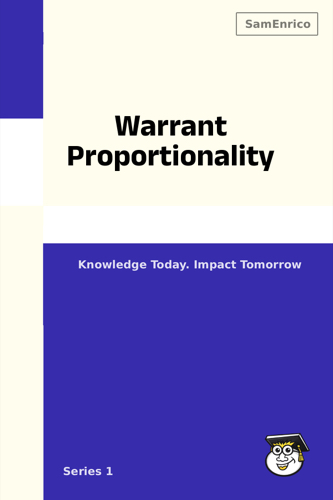
Non-FictionCapital & Valuation RegisterProportionality
Warrant Proportionality eBook
Teaches calculating warrant coverage percentage ve
Teaches calculating warrant coverage percentage versus loan size and valuation caps.
Formats
Free sample
Chapter 1: The $3 Million Mistake--–- Maya Chen had ninety seconds to decide whether to give away 1.5 percent of her company for free.The term sheet sat on her laptop screen, blinking in the afternoon light of her We Work cubicle. Her lawyer had already reviewed it. "Market terms," he'd said in an email. "The warrant coverage is standard at 10 percent. No red flags."Her lead investor had also weighed in.
"Venture debt makes sense here," the partner wrote. "It's non-dilutive compared to raising another equity round."Non-dilutive. That word sat in Maya's brain like a trapdoor. She was twenty-seven years old, had raised $4 million in Series A funding eighteen months ago, and had built her B2B Saa S company, Logi Data, to $2.5 million in annual recurring revenue. The growth was real.
The burn was also real. She needed $3 million to extend her runway through the next twelve months, hire a sales team, and reach the metrics required for a Series B at a $50 million valuation.The venture debt term sheet from Alpine Ridge Lending offered exactly that: $3 million, interest-only payments for two years, then principal amortization over the following two years. The interest rate was 9 percent, which her CFO had calculated as a 12 percent effective IRR for the lender if repaid on schedule. That was fine. What gnawed at her was the single line buried on page seven: "Warrant Coverage: 10 percent of the principal amount at a strike price based on the Company's current 409A valuation."She had read that line six times.
She still didn't fully understand it.The Coffee Shop Intervention Marcus Tse had been a founder twice, a CFO three times, and a board observer on four failed startups before he turned forty-five. He now ran a small advisory practice that specialized in one thing: walking into financing negotiations ten minutes before signatures and finding the poison pill.Maya had met him through a Y Combinator alumni dinner. He was the kind of person who ordered black coffee, never touched his phone during conversation, and asked questions that made you realize you had been thinking about your business entirely wrong.When she texted him the term sheet, he replied within four minutes: "Coffee. Tomorrow. 8 a.m.
Don't sign anything."They met at a diner in So Ma that smelled like burnt coffee and desperation, the kind of place where startup dreams went to die quietly. Marcus had already printed the term sheet and marked it up with a red pen. The annotations were密密麻麻, like a surgical diagram."You're about to make a three-million-dollar mistake," he said without preamble.Maya blinked. "My lawyer said it's market.""Your lawyer bills by the hour. He doesn't care if you get diluted into oblivion.
He cares that the deal closes and you pay his invoice." Marcus slid the marked-up term sheet across the table. "Show me your cap table."She pulled up her most recent 409A valuation on her laptop. The company's fair market value was $10 million pre-money, which meant a per-share price of $2.00 given the 5 million shares outstanding on a fully diluted basis.Marcus did the math on a napkin. "Three million loan. Ten percent coverage.
Two-dollar strike price." He wrote: (3,000,000 × 0.10) / 2.00 = 150,000 shares. "The lender gets 150,000 shares. That's 1.5 percent of your company, assuming no other dilution between now and when they exercise."Maya nodded slowly. She knew that number. It didn't sound catastrophic.Marcus saw her expression and leaned forward.
"You're thinking, 'It's only 1.5 percent.' That's what every founder thinks. But here's what you're missing." He turned the napkin over and drew a timeline.The Real Cost of "Free Equity""Warrants are not free," Marcus said. "They are an option contract that gives the lender the right to buy shares at a fixed price in the future. No cash changes hands today, so it feels free. But every warrant is a claim on your company's future value."He drew a second calculation: an exit scenario.
"Let's say you hit your numbers. Eighteen months from now, you raise a Series B at a $50 million pre-money valuation. Two years after that, you sell the company for $200 million."He wrote:Maya's ownership before warrant exercise: 25 percent (after Series B dilution)Warrant holder's 150,000 shares: at a $200 million exit, each share is worth approximately $20 (assuming 10 million fully diluted shares)Warrant profit to lender: 150,000 × $20 = $3 million Maya did the mental math. At a $200 million exit, her personal proceeds before warrants would be roughly $50 million (25 percent of $200 million). After the warrant holder's $3 million slice, she'd be at $47 million."That's not nothing," she admitted.
"But it's 6 percent of my exit. I can live with that."Marcus shook his head. "You're still thinking about it wrong. It's not 6 percent of your exit. It's 100 percent of the interest you could have paid instead."The Lender's IRR Puzzle This was the heart of the matter, and Marcus spent the next twenty minutes explaining it with the patience of a man who had watched founders lose millions to this exact misunderstanding.Venture debt lenders are not banks.
Banks lend against collateral: buildings, inventory, accounts receivable. If you default, they seize the assets. Venture debt lenders have no such protection. Their loans are unsecured, subordinated to equity in many cases, and secured only by a weak claim on intellectual property that is worthless in a liquidation.Therefore, venture debt lenders demand a target Internal Rate of Return of 15 to 20 percent. Interest alone on a 9 percent loan with a four-year term generates roughly 11 to 12 percent IRR if repaid on schedule.
That gap—the difference between 11 percent and 18 percent—is the warrant."The warrant is not a bonus," Marcus said. "It is the entire reason the lender is in the deal. Without it, they would just buy treasuries or put the money in a diversified equity portfolio."He drew a graph on a fresh napkin: a line rising from the loan amount to the exit value, with a wedge labeled "Warrant Value" bridging the gap between the lender's required return and the interest-only return."In your case," he continued, "the lender needs to generate about $1.2 million in additional value from the warrant to hit their 18 percent target. That $1.2 million comes directly out of your exit proceeds. It's not a tax.
It's not a fee. It's equity you are giving away in exchange for a lower interest rate."Maya started to understand the trap. "So I'm trading equity for cash flow today.""Exactly. And the question you have to answer is: is that trade worth it? For some companies, yes.
For others, it's a disaster."The Three Questions Every Founder Must Ask Marcus pulled out a yellow legal pad and wrote three questions.Question One: What is your expected exit valuation?"If your exit is below the strike price, the warrants expire worthless and you've effectively gotten free money. But if your exit is above the strike price—and you're a founder, so you're betting it will be—then the warrants have real cost."He drew a table:Exit Valuation Warrant Value to Lender Maya's Loss$50M (below strike)$0$0$100M$750,000$750,000$200M$1,500,000$1,500,000$500M$3,750,000$3,750,000"The more successful you are, the more you pay. That's the irony. Warrants are a tax on success."Question Two: What is your alternative source of capital?"If you can get a bank loan at 7 percent with…
This is the end of the free sample. Get the eBook to keep going. Buy now
About this book
Details
- Author
- Passmore Bruno
- Publisher
- SamEnrico
- Language
- English
- Genre
- Non-Fiction, Capital & Valuation Register, Proportionality
- Released
- 2026-06-05
- Pages (approx.)
- 133
- Available as
- eBook, Audiobook

Read better in the ZLOADR app
Your eBooks on your phone or tablet. Sign in with your SamEnrico account and start reading.
More by Passmore Bruno
 Golden Child Scapegoat HealingPassmore Bruno$11.99
 Audience Scanning PatternPassmore Bruno$11.99
 Interval Training SciencePassmore Bruno$11.99
 The Eternal Dialogue: Plato’s Academy and the Birth of Western ThoughtPassmore Bruno$11.99
 Personal Vehicle DriverPassmore Bruno$11.99
 How to Produce Ceramic BasecoatPassmore Bruno$11.99
 Factoring Legal Documentation PrimerPassmore Bruno$12.99
 How to Start a Lock Washer Business (Beginners Guide)Passmore Bruno$11.99
You may also like
 Hong Kong Handover 1997Dunn Johnnie$11.99
 Zumba For Postnatal Recovery CourseNeal Christian$11.99
 Zumba for BeginnersLadner Nikia$11.99
 YouTube Comment Mining GuideHumes Pandora$12.99
 Worry Box MeditationCarlin Rudy$11.99
 Workplace Stress MeditationNguyen Lynn$11.99
 Workplace Stress and Sleep RepairHawley Ivory$11.99
 Workplace Perfectionism CureDelaney Jeffry$11.99
 Workplace Injustice Anger GuideWallen Isabelle$11.99
 Work Addiction and Burnout LinkGreenwood Ester$11.99
 Women in Yoga and WellnessBeattie Galina$11.99
 Women in Stand Up ComedyChun Evangeline$11.99