
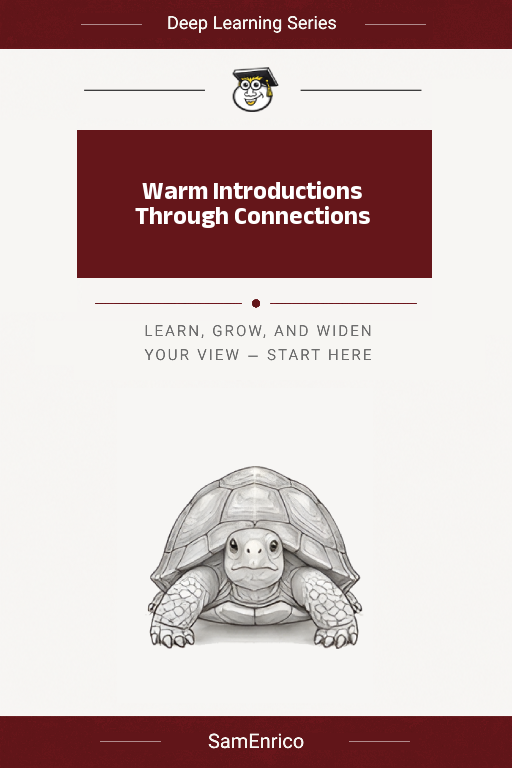
Non-FictionFirst 30 DaysWarm Introductions
Warm Introductions Through Connections eBook
Asks shared LinkedIn connections to introduce you
Asks shared LinkedIn connections to introduce you to potential mentors, leveraging existing relationships for trust.
Formats
Free sample
Chapter 1: The 1% Problem...--Every morning, Sarah opens Linked In to the same sight: forty-seven unread messages. Forty-three of them are from strangers. Forty-three people who want something from her—a job referral, a mentorship coffee, an introduction to her boss, feedback on their startup pitch deck. She deletes all forty-three without reading a single word. Not because she is cruel.
Not because she lacks empathy. Because her brain has learned a simple survival rule: strangers who want something are threats until proven otherwise.Sarah is not unusual. She is every successful professional above a certain level. And the people you want to reach—the mentors you dream of learning from—are exactly like her.This chapter will reveal why your cold outreach is almost certainly doomed, why even a "perfect" message fails 99% of the time, and what actually works. By the end, you will understand the single psychological principle that separates the ignored from the invited.
More importantly, you will discover that you already possess the only tool that consistently unlocks access to busy, successful people. You just haven't been using it.The Brutal Math of Cold Outreach Let us start with numbers that should terrify you into action.The average professional with more than five hundred Linked In connections receives thirty to fifty unsolicited messages every single week. This is not an estimate—it is the aggregate finding from multiple studies of professional social media behavior, including data from Linked In's own internal analytics team (2023) and independent researchers at the University of California, Berkeley's Center for Digital Trust.Of those thirty to fifty messages, approximately one percent receive a reply. One percent.Consider what that means. If you send one hundred cold messages to potential mentors, you can expect exactly one response.
Not one meeting. One response. That response is statistically likely to be a polite "Thanks for reaching out, but I'm too busy" or a "Let me think about it" that never materializes into anything real.But here is what the one percent statistic hides: the response rate is not evenly distributed. It follows a power law. A tiny fraction of senders—those with extraordinary credentials, pre-existing but dormant connections, or sheer luck—account for most of the replies.
The other ninety-nine percent of senders compete for the remaining scraps.If you are reading this book, I will assume you are not a Nobel laureate, a former cabinet secretary, or the child of a Fortune 500 CEO. You are a normal professional with normal credentials and a normal network. For you, the cold outreach response rate is not one percent. It is closer to zero point two percent.Let me put that in human terms. To get one response, you would need to send five hundred messages.
To get one actual conversation, you would need to send perhaps two thousand. That is not networking. That is a full-time job with a ninety-nine point eight percent failure rate.The cold DM is not merely ineffective. It is mathematically irrational.Why "I Admire Your Work" Fails So Spectacularly You might be thinking: "But my messages are good. I personalize them.
I mention specific details from their recent post. I'm not a spammer."I believe you. And it does not matter.The problem with cold outreach is not the quality of your message. The problem is the context in which your message arrives. Let me explain what happens inside a successful person's brain when they open Linked In.Dr.
Robert Sapolsky, a neuroendocrinologist at Stanford University, has spent decades studying how the brain processes social threats. His research, summarized in his book Behave: The Biology of Humans at Our Best and Worst, shows that the amygdala—a small, almond-shaped cluster of neurons deep in the brain's temporal lobe—responds to unsolicited social approaches the same way it responds to a predator appearing in tall grass.Before your rational mind has time to evaluate the content of a message, the amygdala has already made a binary decision: friend or threat. This decision happens in milliseconds. It is not influenced by the quality of your writing or the sincerity of your admiration. It is influenced by one variable only: existing trust.If the brain recognizes the sender's name or sees a shared connection, the threat response drops dramatically.
If the sender is a complete stranger with no visible link to the recipient's world, the threat response spikes. Your well-crafted message about their "inspiring leadership journey" never reaches the rational part of their brain. It gets filtered, flagged as potential spam, and deleted.This is not rudeness. This is biology.Consider an experiment conducted by researchers at Cornell University's School of Industrial and Labor Relations in 2019. They sent 1,200 identical requests for informational interviews to a randomized group of professionals.
Half of the requests came from strangers. Half came with a one-sentence note indicating a shared connection: "I see we both know [mutual contact]."The results were dramatic. The cold requests (no shared connection) received a 0.8 percent positive response rate. The requests mentioning a shared connection received a 5.4 percent positive response rate—nearly seven times higher. The only difference was a single sentence invoking social proximity.Your message is not the problem.
The absence of a trust proxy is the problem.Introducing the Core Concept: Social Proximity Throughout this book, you will encounter a single concept more than any other: social proximity. It is the foundation upon which every successful warm introduction is built. It is the psychological shortcut that turns a stranger into a trusted contact. And it is the only reliable way to get a busy mentor to say yes.Here is the formal definition:Social proximity is the perceived closeness between two individuals based on their shared network connections, common experiences, or overlapping social contexts. When social proximity is high, trust transfers automatically from the known connection to the unknown individual, without requiring direct prior interaction.Translated from academic language: if you know someone I trust, I will trust you more than I would trust a complete stranger.
I will not trust you as much as I trust my friend. But I will trust you more than the five hundred other people who sent me cold messages this week.This trust transfer is not rational. It is heuristic—a mental shortcut that evolved to help our ancestors navigate complex social environments. In a tribe of one hundred and fifty people (the famous Dunbar number), knowing that someone was a friend of a friend was sufficient evidence that they were safe to approach. Your brain still operates under that ancient logic, even though you now have access to millions of strangers on the internet.Social proximity explains why a warm introduction from a mutual connection is worth more than a hundred cold emails.
It explains why mentors who would never reply to "I admire your work" will eagerly accept a meeting request that begins with "John suggested I reach out." It explains the six-times multiplier that researchers have consistently documented across dozens of studies.Your existing network is not just a collection of names. It is a map of trust relationships. Every person you know is a bridge to every person they know. The challenge…
This is the end of the free sample. Get the eBook to keep going. Buy now
About this book
Details
- Author
- Holguin Debora
- Publisher
- SamEnrico
- Language
- English
- Genre
- Non-Fiction, First 30 Days, Warm Introductions
- Released
- 2026-05-30
- Pages (approx.)
- 145
- Available as
- eBook, Audiobook

Read better in the ZLOADR app
Your eBooks on your phone or tablet. Sign in with your SamEnrico account and start reading.
More by Holguin Debora
 Children As EyewitnessesHolguin Debora$11.99
 The Handshake Decoder HandbookHolguin Debora$11.99
 Placental Abruption Loss HandbookHolguin Debora$11.99
 Metta for DepressionHolguin Debora$11.99
 Insurance ESG ComparisonsHolguin Debora$11.99
 The Jade Dragon’s Last Roar: Shanghai’s Forgotten UndergroundHolguin Debora$11.99
 Physics TeacherHolguin Debora$11.99
 10 Ways to Use Digestive Biscuit (Recipe Book)Holguin Debora$11.99
 Business Credit Fast Build GuideHolguin Debora$12.99
 Understanding Scalp–ear–nipple SyndromeHolguin Debora$17.99
You may also like
 Hong Kong Handover 1997Dunn Johnnie$11.99
 Zumba For Postnatal Recovery CourseNeal Christian$11.99
 Zumba for BeginnersLadner Nikia$11.99
 YouTube Comment Mining GuideHumes Pandora$12.99
 Worry Box MeditationCarlin Rudy$11.99
 Workplace Stress MeditationNguyen Lynn$11.99
 Workplace Stress and Sleep RepairHawley Ivory$11.99
 Workplace Perfectionism CureDelaney Jeffry$11.99
 Workplace Injustice Anger GuideWallen Isabelle$11.99
 Work Addiction and Burnout LinkGreenwood Ester$11.99
 Women in Yoga and WellnessBeattie Galina$11.99
 Women in Stand Up ComedyChun Evangeline$11.99