
Non-FictionBiographyJournalism History
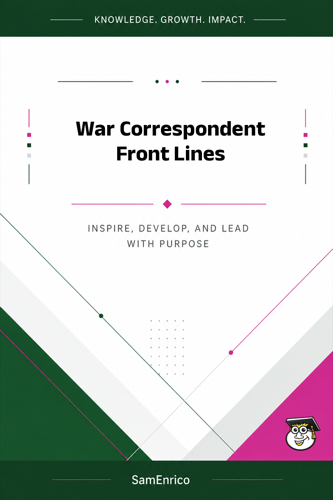
War Correspondent Front Lines eBook
Describes embedding with troops from Normandy to t
by Bolt Eufemia
Describes embedding with troops from Normandy to the Rhine as a journalist.
Formats
Free sample
Chapter 1: The Unready Witness...--–- The letter arrived on a Tuesday, folded into a government envelope that smelled of library dust and bad coffee. I held it for a full minute before opening it, because I already knew what it said. The War Department didn't send envelopes like this one to tell you your application had been denied. They sent postcards for that, flimsy things that tore along the perforations and landed in the trash by noon. This envelope was thick.
This envelope was a door opening.Inside was my accreditation as a war correspondent, valid for the European Theater of Operations, signed by someone whose signature I could not read and whose name I have long since forgotten. What I remember is the date: March 12, 1944. I was twenty-six years old. I had never fired a gun at another human being. I had never been shot at.
I had never seen a dead body that wasn't dressed in a suit and lying in a casket with rouge on its cheeks. I was, by any reasonable measure, entirely unprepared for what I was about to walk into.But I went anyway. That is the thing about young men. They go.The Fraud in the Press Box My name is James Marlowe. In March of 1944, I was a junior correspondent for the Associated Press, assigned to the home front beat.
That meant bond drives in Cleveland, factory shifts in Detroit, and interviews with Gold Star mothers in Boston who had lost sons at Anzio or Tarawa or some other Pacific atoll whose name they could not pronounce. I wrote their stories. I filed them. I collected my paycheck. And every night, alone in my rented room above a deli on West 46th Street, I felt like a fraud.I was not alone in this feeling.
The home front press corps was full of young men my age, burning with ambition and guilt in equal measure. We had all tried to enlist, most of us. I had tried in 1942, walking into an Army recruiting station on Whitehall Street with my birth certificate and a heart full of Hemingway novels. They looked at my feet—flat arches—and my eyes—corrected to 20/20 but not naturally—and my chest—too narrow, they said, though I did not know a chest could be too narrow—and they stamped my file with a classification that kept me out of uniform. 4-F.
Unfit for service. The most humiliating three characters the English language can produce.So I did the next best thing. I became a journalist. I told myself that I would serve with a typewriter instead of a rifle. I told myself that words were weapons.
I told myself a lot of things in those days, most of them lies, because the truth was too simple and too terrible to admit: I wanted to go to war because I was young and stupid and I thought it would make me a man.My editor, a man named Harold Finch who had covered the Great War from a desk in London and never let anyone forget it, tried to talk me out of the accreditation request. He called me into his office on a Friday afternoon, the last light of winter slanting through venetian blinds that needed dusting. His desk was a disaster of wire baskets and coffee rings and a single framed photograph of a woman I assumed was his wife but never asked about."You want to go over there and get yourself killed," he said. Not a question. An observation."No," I said.
"I want to go over there and write.""For what? A byline? You already have a byline. Page twelve, next to the classifieds. That's where your byline lives, Marlowe.
That's its natural habitat.""Page twelve readers deserve to know what's happening."Finch laughed. It was not a kind laugh. It was the laugh of a man who had seen too many young journalists walk through his door with stars in their eyes and then walk out again with their tails between their legs. "You think you're going to be Ernie Pyle," he said. "You think you're going to be the voice of the American soldier.
You're not. You're going to be a man with a notebook who gets in the way and then gets shot, and I'll have to write a letter to your mother explaining that her son died for a paragraph on page twelve."I did not have a good answer to this. I still do not. So I said nothing. I just stood there, in my cheap suit and my scuffed shoes, and waited.Finch sighed.
He pulled a form from his desk drawer and slid it across the blotter. "Fill this out. If the War Department approves you, I won't stand in your way. But I want you to know something, Marlowe. I've been in this business for thirty years.
I've sent a lot of young men to war. Some of them came back. Most of them didn't. And the ones who came back—they weren't the same. Something gets broken.
Something that doesn't heal. You understand what I'm telling you?"I understood. Or I thought I did. I was wrong, of course. You cannot understand something like that until it has happened to you.
That is the cruelest trick of war: it makes liars of all the metaphors.I took the form. I filled it out in the press room that night, typing my answers on a machine that smelled of ink and sweat and the ghosts of a hundred other young journalists who had sat in that same chair and dreamed the same dream. Name. Age. Previous experience.
Languages spoken (English, high school French, a few phrases of German picked up from my father). Next of kin. Signature. Date.I mailed it the next morning. Then I waited.The Bureaucracy of Death The waiting was the worst part, and I say that knowing what came after.
At least in combat, you are moving. At least in combat, you are doing something. Waiting is passive. Waiting is the opposite of action. Waiting is sitting in your rented room above the deli, listening to the landlord argue with his wife about the rent, and wondering if the letter in your hand is a door opening or a door slamming shut.The War Department took six weeks to process my application.
Six weeks of bond drives and factory shifts and Gold Star mothers. Six weeks of feeling the eyes of my colleagues on me, knowing they had all applied too, knowing most of them had been rejected, knowing they resented me for reasons I could not articulate but fully understood. We were all in the same boat, we home front correspondents. We were all drowning in the shallows, watching the real war happen somewhere else.The approval came on March 12. By March 15, I had packed my bags, said goodbye to my landlord, and boarded a train for Boston, where I would catch a troopship to England.
My bags were simple: one duffel, one suitcase, and a leather satchel that contained my typewriter—a Royal portable, bought secondhand from a…
This is the end of the free sample. Get the eBook to keep going. Buy now
About this book
Details
- Author
- Bolt Eufemia
- Publisher
- SamEnrico
- Language
- English
- Genre
- Non-Fiction, Biography, Journalism History
- Released
- 2026-06-09
- Pages (approx.)
- 120
- Available as
- eBook, Audiobook

Read better in the ZLOADR app
Your eBooks on your phone or tablet. Sign in with your SamEnrico account and start reading.
More by Bolt Eufemia
 DFIR Response MetricsBolt Eufemia$11.99
 Meal Prep for BackpackingBolt Eufemia$11.99
 Emotional Regulation WorkbookBolt Eufemia$11.99
 Cleveland Coroner ContradictionsBolt Eufemia$11.99
 Bezos AWS PivotBolt Eufemia$11.99
 Personal Branding Blueprint GuideBolt Eufemia$11.99
 Gluten Sensitivity LinkBolt Eufemia$11.99
 Galactic Guardians: The Secret Lives of Space RocksBolt Eufemia$11.99
 The Navigators of the Indian Ocean: Africa's Ancient SeafarersBolt Eufemia$11.99
 How to Produce Film CamerasBolt Eufemia$11.99
 A Collector's Handbook to the Armstrong Siddeley FourteenBolt Eufemia$11.99
 Madrid Goods Services GuideBolt Eufemia$12.99
You may also like
 Hong Kong Handover 1997Dunn Johnnie$11.99
 Zumba For Postnatal Recovery CourseNeal Christian$11.99
 Zumba for BeginnersLadner Nikia$11.99
 YouTube Comment Mining GuideHumes Pandora$12.99
 Worry Box MeditationCarlin Rudy$11.99
 Workplace Stress MeditationNguyen Lynn$11.99
 Workplace Stress and Sleep RepairHawley Ivory$11.99
 Workplace Perfectionism CureDelaney Jeffry$11.99
 Workplace Injustice Anger GuideWallen Isabelle$11.99
 Work Addiction and Burnout LinkGreenwood Ester$11.99
 Women in Yoga and WellnessBeattie Galina$11.99
 Women in Stand Up ComedyChun Evangeline$11.99