
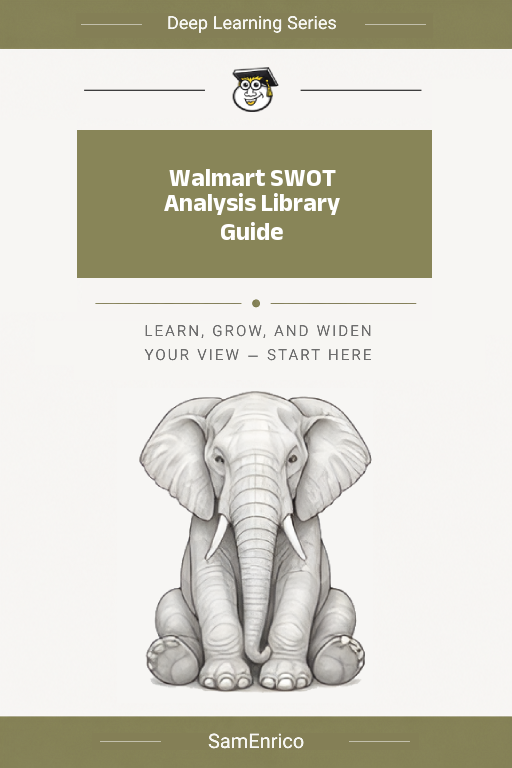
Non-FictionStrategic AtlasRetail Analysis
Walmart SWOT Analysis Library Guide
Evaluate grocery strength, everyday low price mode
Evaluate grocery strength, everyday low price model, e-commerce catch-up, and labor relations for retail giant.
Formats
About this book
Free sample
Chapter 1: The Concrete Satellites...--Every morning, before the first customer pushes a shopping cart through the sliding glass doors of a Walmart Supercenter in Tulsa, Oklahoma, a quiet miracle has already occurred. Sometime between 2:00 AM and 4:00 AM, a fleet of tractor-trailers backed into a loading bay the size of a football field. Within ninety minutes, those trucks were unloaded, their contents sorted, and then reloaded onto smaller trucks that fanned out across a 150-mile radius. By 6:00 AM, a pallet of Goya black beans that had been sitting in a distribution center in Jeffersonville, Georgia, just eighteen hours earlier is now stacked on a shelf in a store that serves a predominantly Hispanic neighborhood. The beans cost Walmart 0.72percan.Theywillsellfor0.72 per can.
They will sell for 0.72percan.Theywillsellfor0.98. The $0.26 difference must cover the building, the lights, the employee at the register, the credit card swipe fee, and still leave a sliver of profit.This is not a story about retail. This is a story about logistics masquerading as a store.When most people think of Walmart, they imagine sprawling parking lots, blue vests, and the distinctive yellow smiley face logo. They think of low prices and the slow death of downtown main streets. But these are surface-level observations.
Beneath the fluorescent lights and the endless aisles of cheap socks and garden hoses lies something far more sophisticated: a machine for moving physical objects across the continent with an efficiency that rivals the United States Postal Service and exceeds that of most military supply chains.The thesis of this chapter is deliberately provocative, but it rests on decades of observable evidence: Walmart's supply chain is more valuable than its brand, its real estate, or even its customer base. If Walmart lost its brand recognition overnight, it could rebuild. If it lost half its stores, it could reopen. But if it lost its supply chain infrastructure—the cross-docking network, the Retail Link data system, the 4,600 physical locations functioning as micro-fulfillment centers—the company would cease to exist within a year. The brand would linger, a hollow shell, but the machine would be dead.Understanding this distinction…
This is the end of the free sample. Get the eBook to keep going. Buy now
Contents
- Chapter 1
- Chapter 2
- Chapter 3
- Chapter 4
- Chapter 5
- Chapter 6
- Chapter 7
- Chapter 8
- Chapter 9
- Chapter 10
- Chapter 11
- Chapter 12
Details
- Author
- Wyman Shameka
- Publisher
- SamEnrico
- Language
- English
- Genre
- Non-Fiction, Strategic Atlas, Retail Analysis
- Released
- 2026-06-01
- Pages (approx.)
- 149
- Available as
- eBook, Audiobook

Read better in the ZLOADR app
Your eBooks on your phone or tablet. Sign in with your SamEnrico account and start reading.
More by Wyman Shameka
 The Accidental Voice ActorWyman Shameka$11.99
 SIMPLE IRA Employer PlanWyman Shameka$11.99
 Loving Kindness for Long COVIDWyman Shameka$11.99
 Homeschool To College Transition WorkbookWyman Shameka$11.99
 Returning to Work After Baby LossWyman Shameka$11.99
 Whispers of the Tide: The Lost Lighthouse Keeper’s SecretWyman Shameka$11.99
 Understanding Neonatal Diabetes MellitusWyman Shameka$17.99
 Fire CaptainWyman Shameka$11.99
 Excel Error Checking for ExamsWyman Shameka$12.99
 How to Start a Outdoor Seating Business (Beginners Guide)Wyman Shameka$11.99
You may also like
 Hong Kong Handover 1997Dunn Johnnie$11.99
 Zumba For Postnatal Recovery CourseNeal Christian$11.99
 Zumba for BeginnersLadner Nikia$11.99
 YouTube Comment Mining GuideHumes Pandora$12.99
 Worry Box MeditationCarlin Rudy$11.99
 Workplace Stress MeditationNguyen Lynn$11.99
 Workplace Stress and Sleep RepairHawley Ivory$11.99
 Workplace Perfectionism CureDelaney Jeffry$11.99
 Workplace Injustice Anger GuideWallen Isabelle$11.99
 Work Addiction and Burnout LinkGreenwood Ester$11.99
 Women in Yoga and WellnessBeattie Galina$11.99
 Women in Stand Up ComedyChun Evangeline$11.99