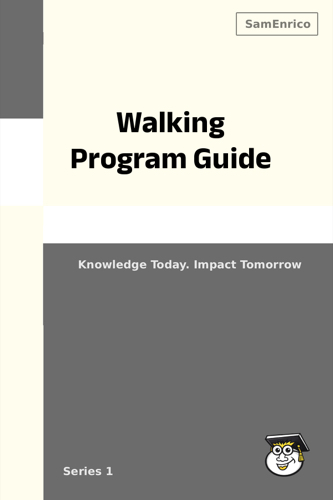
Walking Program Guide eBook
Teaches interval walking for cardiovascular health
Teaches interval walking for cardiovascular health.
Formats
Free sample
Chapter 1: The 10,000-Step Lie--I want you to imagine something.You wake up on a Tuesday morning, pour your coffee, and lace up your walking shoes. You have a routine. You have a step counter on your wrist or your phone. By 9:00 AM, you have already logged 2,500 steps. By lunch, you are at 5,000.
By the time you collapse onto the couch after dinner, that little screen reads 10,347 steps. You have done it again. Another day. Another ten thousand. You are a good walker.
You are a disciplined person.So why are you still out of breath climbing the stairs to your own bedroom?Why does your lower back ache after a fifteen-minute walk around the neighborhood? Why did your doctor look at your blood work and say your cholesterol is creeping up, your blood pressure is borderline, and your blood sugar is not where it should be—and then, in the same sentence, tell you to "keep walking"?Something does not add up. And that is because you have been sold a story. A very old, very successful, and completely unscientific marketing story.The Origin of a Myth The year was 1965. A Japanese company called Yamasa released a new pedometer.
It was a small, clip-on device that counted steps. The company needed a catchy name and a memorable number. They called it the Manpo-kei, which translates roughly to "10,000 steps meter." Why 10,000? Not because of a single clinical trial. Not because researchers had identified 10,000 steps as the magic threshold for heart health.
Because the Japanese character for 10,000 (万) looks a bit like a person walking. It was a visual pun. It was marketing.And it worked. Brilliantly.Over the next five decades, that marketing number calcified into global health dogma. The World Health Organization referenced it.
Fitness trackers built their entire reward systems around it. Your doctor probably recommended it. Your friends compete with you over it. The number 10,000 became synonymous with "healthy walking."But here is the truth that will either make you angry or set you free: There is no scientific basis for 10,000 steps.None.The largest and most rigorous studies on step counting have actually found something very different. A 2019 study published in JAMA Internal Medicine followed nearly 17,000 older women for over four years.
The researchers found that women who walked about 4,400 steps per day had significantly lower mortality rates than women who walked only 2,700 steps. And here is the shocking part: the benefits plateaued around 7,500 steps. Walking more than 7,500 steps did not reduce mortality further. The women walking 12,000 steps were not healthier than the women walking 7,500.Let me say that again. More steps did not mean better health.A 2020 study in The Lancet looked at over 48,000 adults across four continents.
They found that the ideal step count for most adults was between 6,000 and 8,000 steps per day for those over 60, and between 8,000 and 10,000 for those under 60. But critically, they also found that step intensity mattered just as much as step volume. The people who walked faster—who raised their heart rate—had better outcomes than those who took the same number of steps at a leisurely pace.So the problem is not that you are walking. The problem is how you are walking.Volume Versus Intensity: The Great Confusion This is the single most important distinction you will read in this entire book. I want you to write it down, highlight it, or tattoo it on your forearm.
Ready?Volume is how much you walk. Intensity is how hard you walk. Your heart only cares about intensity.Your heart is a muscle. Like your bicep or your quadriceps, it responds to stress by getting stronger. But the heart has a unique demand: it needs to be challenged with increased workload to adapt.
That means raising your heart rate. That means pushing your body into a state where it needs more oxygen than it is currently getting at rest.When you walk at a leisurely pace—the kind of walking where you can chat on the phone, window shop, or listen to a podcast without breathing harder—your heart rate barely rises above resting levels. You are moving your body, which is better than sitting on a couch. Do not misunderstand me. Any walking is better than no walking.
But leisurely walking is not training your heart. It is not improving your VO2 max (the single best predictor of longevity, which we will explore in Chapter 2). It is not increasing your stroke volume. It is not building mitochondrial density in your muscles.Leisurely walking is maintenance at best. At worst, it is a placebo that tricks you into thinking you are getting fit when you are simply...
moving.Let me give you an analogy.Imagine you have a car engine that has been idling in a parking lot for five years. It is rough. It knocks. It has lost its power. You want to restore that engine.
Would you fix it by idling it for an hour every day? Of course not. Idling does not clean the cylinders. It does not improve compression. It does not remove carbon deposits.
You need to drive the car. You need to put it under load. You need to take it up to highway speed.Your heart is that engine. Leisurely steps are idling. Interval walking is the highway.The Short, Hard Effort Paradox Here is what the fitness industry does not want you to know: shorter, harder efforts produce dramatically better cardiovascular results than longer, easier efforts.Let me prove it to you with real data.A landmark study from the University of Western Ontario compared two groups of walkers over six months.
The first group walked for 60 minutes at a steady, moderate pace, five days per week. The second group walked for 20 minutes using an interval protocol: three minutes of easy walking, one minute of hard walking, repeated five times. That is a total of 20 minutes, three days per week.At the end of six months, which group had better cardiovascular fitness?The interval group.Not just slightly better. Significantly better. The interval group improved their VO2 max by 15% compared to 6% in the steady walking group.
They had greater reductions in blood pressure, better blood sugar control, and reported higher adherence rates because their workouts were shorter.Let me do that math for you. The steady walking group spent 300 minutes per week walking (60 minutes x 5 days). The interval group spent 60 minutes per week walking (20 minutes x 3 days). That is 240 fewer minutes per week. And they got better results.If you are someone who feels guilty about not having an hour to walk every day, I want you to release that guilt right now.
It is not helping you. It is based on a lie. You can get superior results in one-fifth of the time. But only if you are willing to walk hard for short bursts.Why Your Body Ignores Leisurely Steps To understand why intensity matters more than volume, you need to understand a concept called the training threshold. Every person has a minimum heart rate they need to reach before their body initiates cardiovascular adaptations.
That threshold is roughly 60-70% of your maximum heart rate.When you walk leisurely, you are likely at 40-50% of your…
This is the end of the free sample. Get the eBook to keep going. Buy now
About this book
Details
- Author
- Tanner Tomiko
- Publisher
- SamEnrico
- Language
- English
- Genre
- Non-Fiction, Health & Wellness, Cardio
- Released
- 2026-06-05
- Pages (approx.)
- 114
- Available as
- eBook, Audiobook

Read better in the ZLOADR app
Your eBooks on your phone or tablet. Sign in with your SamEnrico account and start reading.
More by Tanner Tomiko
 Teamster Pension Fund Looting After HoffaTanner Tomiko$11.99
 Burnout Prevention For Single ParentsTanner Tomiko$11.99
 Yemen War WhistleblowerTanner Tomiko$11.99
 Steemit Rewards Comparison TrapTanner Tomiko$11.99
 Self Esteem for Shift Workers GuideTanner Tomiko$11.99
 OKR Software GuideTanner Tomiko$11.99
 Inflation Financial StressTanner Tomiko$11.99
 The Poisonous Partnership: Canada's Deadly Victorian CoupleTanner Tomiko$11.99
 The Ghosts of Cambrai: The Birth of Blitzkrieg and the Haunted Tanks of 1917Tanner Tomiko$11.99
 How to Produce Rubber Processing MachineryTanner Tomiko$11.99
 Growing Brahea (Hesper Palm)Tanner Tomiko$11.99
 A Collector's Handbook to the Rover 105sTanner Tomiko$11.99