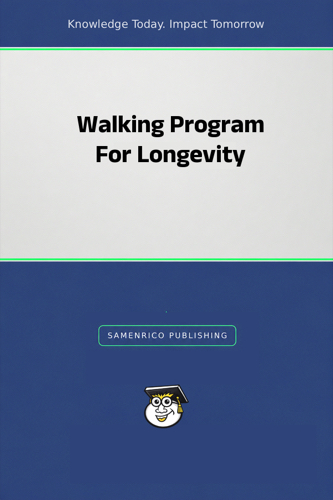
Walking Program For Longevity eBook
Walk 8,000 steps daily to reduce mortality risk fr
Walk 8,000 steps daily to reduce mortality risk from all causes.
Formats
Free sample
Chapter 1: The 8,000-Step Lie--–- The first thing you need to know is that you have been set up to fail. Not by your doctor, not by your fitness app, not by your well-meaning friend who posts daily step counts on social media. You have been set up to fail by a decades-old marketing campaign from a Japanese company that wanted to sell more pedometers. The number 10,000—that gleaming, seemingly scientific threshold that has haunted millions of people who fall short of it every single day—was never based on a single peer-reviewed study, clinical trial, or public health recommendation. It was a marketing gimmick.
And it worked brilliantly.The year was 1965. A Japanese company called Yamasa released a new pedometer. They needed a name that would resonate with consumers, something memorable, something that felt aspirational but achievable. They called it the Manpo-kei. The translation?
"10,000 steps meter." Why 10,000? The number was chosen for a single reason: the Japanese character for 10,000 (万) looks vaguely like a person walking. That is it. That is the entire scientific foundation of the most famous fitness target in human history.For nearly six decades, this arbitrary number has been repeated by doctors, fitness instructors, wellness influencers, and government health campaigns as if it were a law of nature. It appears on every fitness tracker, every smartphone health app, every step challenge at corporations across the world.
And millions of people wake up each day feeling like failures because they cannot reach a number that was invented in a marketing meeting in Osaka in the 1960s.But here is the truth that changes everything: science has finally caught up to the myth. And the science says something extraordinary. You do not need 10,000 steps. You do not need to walk every day. You do not need to walk fast.
You need far less than you have been told, and you can do far less than you fear, and you will still add years to your life.This book is the permission slip you have been waiting for.The Research That Changed Everything In March 2023, a landmark study was published in JAMA Network Open, one of the most prestigious medical journals in the world. Researchers analyzed data from more than 3,100 American adults who wore accelerometers (highly accurate step-tracking devices) for several days. The researchers then followed these participants for nearly a decade, tracking who lived and who died, and from what causes.The findings were stunning. The study asked a simple question: how many days per week do you need to walk 8,000 steps or more to significantly reduce your risk of dying?The answer: one or two days.Let me repeat that because your brain will try to reject it. One or two days per week of walking 8,000 steps is enough to meaningfully lower your risk of death from all causes.
Not seven days. Not five days. Not even three days, although three days is better. One or two days.The data was remarkably clear. Participants who walked 8,000 steps or more on just one or two days per week had a 14.9 percent lower risk of dying during the follow-up period compared to sedentary participants.
Those who walked 8,000 steps three to seven days per week had a 16.5 percent lower risk. The difference between walking two days per week and walking every single day was a mere 1.6 percentage points.Consider what this means. If you walk 8,000 steps on Tuesday and Thursday, and then sit on your couch the other five days, you will reduce your mortality risk by nearly 15 percent. If you add a third day, you will improve that to 16.5 percent. But the person who walks seven days a week is only marginally better off than you.
In statistical terms, the difference is negligible. In practical terms, it is invisible.This is what scientists call a "curvilinear" relationship. The benefits of walking do not increase linearly with every additional day. Instead, they rise sharply at first—going from zero days to one or two days produces the biggest jump—and then they plateau. After three days, you are essentially adding sprinkles to an already excellent ice cream sundae.
Nice to have. Not necessary.The Minimum Effective Dose vs. The Optimal Dose Throughout this book, we will use a framework borrowed from pharmacology: the distinction between the minimum effective dose and the optimal dose.The minimum effective dose is the smallest amount of a treatment that produces a desired effect. Take ibuprofen for a headache. The minimum effective dose might be 200 milligrams, which will relieve the pain for most people.
Taking 400 milligrams might work slightly better or last slightly longer, but 200 milligrams gets the job done.The optimal dose is the amount that produces the maximum benefit without unnecessary excess. For ibuprofen, the optimal dose for a severe headache might be 400 milligrams. But the minimum effective dose is still effective.Walking for longevity works exactly the same way.The minimum effective dose is 8,000 steps on one or two days per week. This single intervention—requiring perhaps two hours of walking total per week—reduces your mortality risk by nearly 15 percent. That is a massive return on a very small investment.The optimal dose is 8,000 steps on three days per week.
This reduces your mortality risk by 16.5 percent. You gain an additional 1.6 percent risk reduction for the effort of adding one more walking day. Whether that trade-off is worth it depends on your schedule, your preferences, and your personality. Some people will find it easy to add a third day. Others will struggle to maintain two days consistently, and the risk of burnout is not worth the tiny additional benefit.Here is what matters most: both doses work.
Both doses are scientifically valid. Both doses should make you feel successful, not inadequate.If you have been trying to walk 10,000 steps every single day and failing, you have been aiming for a dose that is neither minimum nor optimal. You have been aiming for excess. And the science is unambiguous: excess is unnecessary.A Personal Confession Before we go further, I owe you a confession. I was once a step-counting obsessive.
I wore a fitness tracker on my wrist that buzzed every hour if I had not moved enough. I checked my step count before bed each night, and if I was below 10,000, I would pace around my living room like a caged animal until the tracker buzzed its approval. I scheduled my days around walks. I declined social invitations that would interfere with my step count. I felt genuine anxiety when I traveled and could not maintain my "streak."And I was miserable.Not because walking is miserable.
Walking is wonderful. I was miserable because I had turned a joyful, natural human activity into a joyless, unnatural obligation. I was walking for the number, not for myself. And when life inevitably interfered—when I got the flu, when I had a work deadline, when I simply did not feel like walking—I felt like a failure. The tracker did not care that I was exhausted or sick.
The tracker only cared about the number.The data in this book liberated me. When I learned that walking 8,000 steps just two days per week…
This is the end of the free sample. Get the eBook to keep going. Buy now
About this book
Details
- Author
- Edmonds Donnette
- Publisher
- SamEnrico
- Language
- English
- Genre
- Non-Fiction, Health & Wellness, Cardiovascular Health
- Released
- 2026-06-08
- Pages (approx.)
- 151
- Available as
- eBook, Audiobook

Read better in the ZLOADR app
Your eBooks on your phone or tablet. Sign in with your SamEnrico account and start reading.
More by Edmonds Donnette
 Affirmations for High SensitivityEdmonds Donnette$11.99
 Metta for Trauma Survivors GuideEdmonds Donnette$11.99
 Addiction Recovery Relationship GuideEdmonds Donnette$11.99
 Beginner Mindfulness for Financial StressEdmonds Donnette$11.99
 The Last Great Solo: The Psychological Battle of the PacificEdmonds Donnette$11.99
 The Silent Bidding War: How a $100M Free Agent Almost Broke the NBAEdmonds Donnette$11.99
 CCPA For Edtech GuideEdmonds Donnette$12.99
 Turkish Student Safety GuideEdmonds Donnette$12.99
 Understanding Delirium TremensEdmonds Donnette$17.99
 Montessori TeacherEdmonds Donnette$11.99
 How to Become a School-plant ConsultantEdmonds Donnette$11.99