
Non-FictionBusiness BriefMeetingsHealth
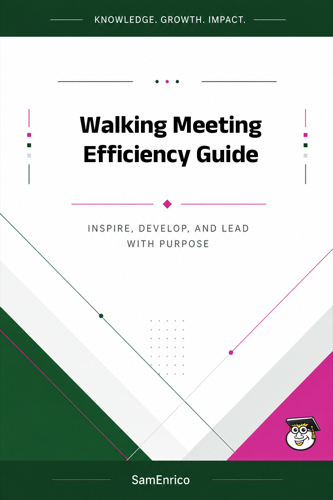
Walking Meeting Efficiency Guide eBook
Combine movement with one on one meetings for heal
by Lyman Danae
Combine movement with one on one meetings for health and productivity.
Formats
Free sample
Chapter 1: The Body’s Betrayal--–- Every morning, millions of professionals walk past the same invitation without recognizing it. They step into elevators, settle into ergonomic chairs, align their monitors at eye level, and prepare for eight hours of seated productivity. The conference room door closes. The meeting begins. And somewhere in the next ninety minutes, their brains begin to drift—not from boredom, though that may also be present, but from biology.
The human body, designed for movement, is quietly staging a protest.The betrayal is not malicious. It is physiological, predictable, and utterly invisible to the people experiencing it. The average office worker spends 73 percent of their workday seated. For managers and knowledge workers who attend multiple one-on-one meetings daily, that percentage often climbs higher. And in those meetings—the check-ins, the performance reviews, the strategic planning sessions—something remarkable happens.
Not remarkable in a good way. Remarkable in the way a slow leak in a tire is remarkable: almost imperceptible until suddenly, catastrophically, you are stranded.This chapter reveals what happens inside the human body and brain during prolonged seated meetings. The evidence is drawn from occupational health research, cognitive neuroscience, and the University of Miami's Walking Meeting Pilot Study, which documented in precise detail how sedentary work environments harm both the people in them and the organizations that depend on those people. The chapter makes no prescriptions yet. It offers no solutions.
It simply presents the problem in its full, uncomfortable clarity. Because before any leader adopts walking meetings, before any manager invites a direct report to step outside, the case for change must rest on evidence. And that evidence begins with a simple question: what are seated meetings doing to us?The Hidden Cost of the Conference Room The conference room is a modern invention, and like many modern inventions, it solves one problem while creating several others. Before the rise of white-collar office work, humans did not spend consecutive hours seated in climate-controlled boxes discussing quarterly projections. They walked.
They stood. They moved while talking, because moving while talking is the biological default. Sitting still for extended periods is the aberration.Yet the aberration has become the norm. The average office worker now spends more than five hours and forty minutes seated each workday, with meeting-heavy roles often exceeding eight hours. The University of Miami's Walking Meeting Pilot Study, which tracked white-collar workers using accelerometers, found that participants accumulated the majority of their sedentary time in two settings: at their desks and in meeting rooms.
Conference rooms, designed to facilitate collaboration and decision-making, were simultaneously manufacturing physical decline.The data is stark. Workers who sit more than eight hours daily with minimal movement breaks face a 147 percent increase in cardiovascular risk compared to those who sit four hours or less. The mechanism is not mysterious. Prolonged sitting reduces blood flow, decreases metabolic rate, and triggers inflammatory markers that damage blood vessels over time. Every hour of seated work adds to a cumulative physiological debt that the body cannot fully repay with evening exercise.
A thirty-minute workout after eight hours of sitting does not erase the damage; it merely mitigates some of it.But the physical harms, while serious, are not the primary concern of this book. The cognitive harms are equally devastating and far more immediate.The Brain on a Chair: What Ninety Minutes Does to Thinking In the 1990s, researchers at the University of Texas discovered something peculiar about blood flow to the brain. When participants remained seated for extended periods, cerebral blood flow velocity decreased steadily. After ninety minutes of uninterrupted sitting, blood flow had dropped by approximately 20 percent. The participants did not notice the change consciously.
They felt slightly sluggish, perhaps a bit unfocused, but attributed it to boredom or fatigue. In reality, their brains were receiving less oxygen and fewer nutrients than they needed for optimal performance.This is not a minor inconvenience. Cognitive processing speed, working memory, and executive function all depend on adequate cerebral blood flow. When blood flow drops, the brain does not shut down—it compensates by prioritizing automatic processes over complex reasoning. Meeting participants become less capable of creative problem-solving, less able to hold multiple variables in mind simultaneously, and more likely to default to familiar solutions rather than generating novel ones.
They do not feel dumber. They simply perform as if they are.The Walking Meeting Pilot Study quantified this effect in a workplace setting. Participants completed cognitive assessments before and after seated meetings lasting sixty to ninety minutes. The results showed consistent declines in alertness, information retention, and problem-solving accuracy. The longer the meeting, the steeper the decline.
And critically, participants were largely unaware of their own diminished capacity. When asked to rate their performance, they rated it as equivalent to their pre-meeting baseline. The brain, it turns out, is a poor judge of its own deterioration.This has profound implications for the 200 to 500 million one-on-one meetings held globally each day. If each of those meetings lasts an average of thirty minutes, and if cognitive performance begins declining measurably within the first hour, then a substantial portion of meeting time is occurring at less than full cognitive capacity. The decisions made in those meetings—hiring choices, strategy adjustments, performance evaluations—are being made by brains operating at a disadvantage.The Afternoon Collapse: Mood and the Circadian-Seated Connection Beyond cognition, seated meetings systematically degrade mood.
The Walking Meeting Pilot Study tracked self-reported mood metrics across the workday and found consistent patterns. Participants began their mornings with relatively stable emotional states. By mid-morning, after the first seated meeting of the day, mood scores had declined slightly. By early afternoon, following a second seated meeting, the decline was substantial. By late afternoon, participants reported feeling significantly more tense, less energetic, and more pessimistic than at any other point in the day.The phenomenon has been replicated in multiple occupational health studies and has earned an informal name among researchers: the afternoon collapse.
It is not simply fatigue, though fatigue plays a role. It is the compound effect of prolonged sitting combined with the cognitive demands of meetings. The body is sedentary, but the brain is working—and working hard. This mismatch between physical stillness and mental effort creates a state of physiological stress that manifests as irritability, withdrawal, and negative affect.The economic implications are staggering. Presenteeism—the state of being physically present at work but mentally disengaged—costs U.S.
employers an estimated $150 billion annually. Sedentary meeting formats directly contribute to this loss. Employees in seated meetings are not merely less productive; they are actively accumulating negative mood states that carry over into the rest of their workday. A thirty-minute seated meeting at 10 AM can impair performance on a completely unrelated task at 2 PM, simply because the residual mood effects persist.The 147 Percent Problem: Cardiovascular Risk in Context Some readers may skim past the statistic about cardiovascular risk. A 147 percent increase sounds alarming but abstract.
To put it in concrete terms: a white-collar worker who sits for more than eight hours daily with minimal movement breaks has approximately the same cardiovascular risk profile as someone who smokes half a pack of cigarettes per day. The…
This is the end of the free sample. Get the eBook to keep going. Buy now
About this book
Details
- Author
- Lyman Danae
- Publisher
- SamEnrico
- Language
- English
- Genre
- Non-Fiction, Business Brief, Meetings, Health
- Released
- 2026-06-09
- Pages (approx.)
- 135
- Available as
- eBook, Audiobook

Read better in the ZLOADR app
Your eBooks on your phone or tablet. Sign in with your SamEnrico account and start reading.
More by Lyman Danae
 Distraction Free FlowLyman Danae$11.99
 Social Eating Pressure GuideLyman Danae$11.99
 Chronic Illness Couples GuideLyman Danae$11.99
 The Drag Along Tag Along GuideLyman Danae$11.99
 The Cartel's Shadow: The Assassination of MarasánLyman Danae$11.99
 Understanding Weismann–netter–stuhl SyndromeLyman Danae$17.99
 Madrid Portfolio ToolsLyman Danae$12.99
 Ghana Startup Tax GuideLyman Danae$12.99
 Store Support AssociateLyman Danae$11.99
 How to Start a Bleach Works Business (Beginners Guide)Lyman Danae$11.99
You may also like
 Hong Kong Handover 1997Dunn Johnnie$11.99
 Zumba For Postnatal Recovery CourseNeal Christian$11.99
 Zumba for BeginnersLadner Nikia$11.99
 YouTube Comment Mining GuideHumes Pandora$12.99
 Worry Box MeditationCarlin Rudy$11.99
 Workplace Stress MeditationNguyen Lynn$11.99
 Workplace Stress and Sleep RepairHawley Ivory$11.99
 Workplace Perfectionism CureDelaney Jeffry$11.99
 Workplace Injustice Anger GuideWallen Isabelle$11.99
 Work Addiction and Burnout LinkGreenwood Ester$11.99
 Women in Yoga and WellnessBeattie Galina$11.99
 Women in Stand Up ComedyChun Evangeline$11.99