
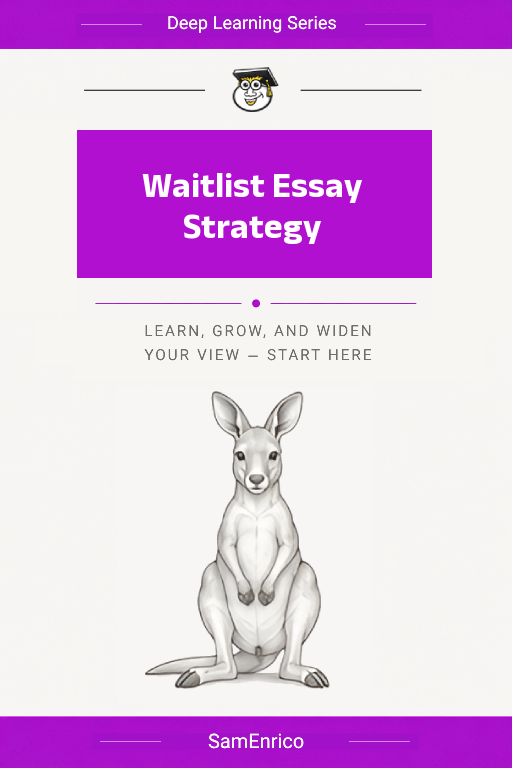
essaysWaitlist GuideLOCI Writing
Waitlist Essay Strategy eBook
Write effective letters of continued interest. Tur
Write effective letters of continued interest. Turn a waitlist decision into an acceptance.
Formats
Free sample
Chapter 1: The Hostage’s Inbox--–- The email arrives on a Tuesday. You open it, heart pounding, and read the words no one wants: “You have been placed on our waitlist.”For a moment, you feel relief. It is not a rejection. The door is still cracked open. Then the confusion sets in.
What does this actually mean? Did you do something wrong? Are you almost good enough but not quite? Should you send them your new grades? Should you write a letter begging for a second look?
Should you wait quietly and hope?You are about to make a mistake that 99% of waitlisted students make. You are about to write a letter of continued interest (LOCI) that will be deleted in under ten seconds.Here is what you need to understand before you write a single word. The person reading your letter is not a gatekeeper sitting on a throne, waiting to be moved by your passion and perseverance. That is a fantasy sold by Hollywood and outdated college guidebooks. The real person on the other side of that screen is a yield manager.
They are stressed, overworked, and terrified of making a mistake that will throw off their enrollment numbers by half a percentage point. They are, in a very real sense, a hostage.And your letter is a cold email to that hostage.This chapter will completely reframe how you think about the waitlist. By the time you finish, you will understand why generic update letters fail, what admissions officers are actually afraid of, and how to position yourself as the solution to their problem rather than another problem to be solved. You will learn the single most important concept in this entire book: the value proposition. And you will write a one-sentence hypothesis that will guide every word you put on the page from this moment forward.But first, you need to understand the prison.The Prison of Yield Let us start with a uncomfortable truth.
Admissions officers do not lose sleep over whether you will be happy at their school. They lose sleep over whether you will actually enroll.This is called yield. Yield is the percentage of admitted students who choose to attend. If a college admits one thousand students and eight hundred enroll, their yield is 80%. That number is everything.
It determines budget allocations, housing assignments, faculty hiring, class sizes, and most importantly, the dean’s perception of the admissions office’s competence.Here is what the public never sees. Every admissions office builds a mathematical model of their incoming class months before any student steps foot on campus. They project exactly how many students they need to admit to hit their enrollment target. If they need a freshman class of 2,000 students and their historical yield is 50%, they admit 4,000 students. That is the math.
It seems simple until you realize that yield is not a fixed number. It fluctuates based on the economy, competitor financial aid packages, weather on admitted students weekend, and a thousand other variables no one can predict.This is where the waitlist comes in. The waitlist is not a purgatory for students who almost made the cut. It is a risk management tool. Admissions officers use it to hedge their bets.
If more admitted students say yes than expected, they take no one from the waitlist. If fewer say yes than expected, they dip into the waitlist to fill the gap. You are not on the waitlist because you are second best. You are on the waitlist because you are insurance. That sounds harsh, but it is actually liberating.
Once you understand that you are a hedge against uncertainty, you can stop writing letters that beg for mercy and start writing letters that reduce uncertainty.Consider the actual numbers. At a typical selective university, the waitlist acceptance rate hovers between 5% and 15%. But those numbers are misleading because they average across all waitlisted students. The reality is that some students on the waitlist have a near-zero chance, while others have a fighting chance if they play their cards right. The difference between these two groups is not measured in GPAs or test scores.
It is measured in how well they solve the admissions office’s yield problem.The Two Letters To understand what works, you first need to understand what fails. Let me show you two letters. Both are real. Both were sent to the same university in the same admissions cycle. One worked.
One did not.Letter A (The Generic Update):Dear Admissions Committee,I am writing to express my continued interest in attending University X. I was recently waitlisted for the fall semester, and I want you to know that University X remains my top choice.Since applying, I have continued to work hard in my classes. I earned an A in AP Calculus and was elected vice president of the debate club. I also completed a volunteer project at the local food bank, logging over forty hours.I understand that you have difficult decisions to make, and I respect whatever decision you reach. I would be honored to be considered for admission if space becomes available.Thank you for your time and consideration.Sincerely,Student ALetter B (The Value Proposition):Dear Admissions Committee,I noticed that last week, Professor Martinez published a study on the relationship between debate training and civic engagement among first-year students.
Her finding that competitive debate correlates with a 40% higher rate of campus leadership participation forced me to rethink my own contributions to your incoming class.You waitlisted me in part, I suspect, because my debate record was strong but my civic engagement section was thin. Since November, I have addressed that gap directly. I was elected vice president of the debate club, where I increased membership by 30% by recruiting from under-resourced high schools. I then took those same recruitment skills to the local food bank, building a volunteer scheduling system that increased weekly participation by forty hours without additional staff.Your first-year class currently has seventeen recruited debaters but only two with documented leadership experience in community organizing. I am the student who fills that gap.
I will deposit within 48 hours of an offer.I look forward to receiving the enrollment link.Sincerely,Student BLetter A was deleted in under ten seconds. Letter B got Student B off the waitlist within three weeks.What is the difference? Letter A asks for a favor. Letter B solves a problem. Letter A lists achievements.
Letter B translates those achievements into attributes that fill a specific institutional gap. Letter A ends with passive gratitude. Letter B ends with an assumptive close that reduces the admissions officer’s risk. Letter A treats the admissions officer as a judge. Letter B treats them as a partner in solving a shared problem.From this moment forward, you will never write a letter like Student A again.The Value Proposition: Your One-Sentence Hypothesis Every successful sales interaction—and yes, your waitlist letter is a sales interaction—begins with a clear value proposition.
A value proposition is a single sentence that answers three questions:What problem do you solve?For whom do you solve it?What specific evidence proves you can solve it?In…
This is the end of the free sample. Get the eBook to keep going. Buy now
About this book
Details
- Author
- Borders Madge
- Publisher
- SamEnrico
- Language
- English
- Genre
- essays, Waitlist Guide, LOCI Writing
- Released
- 2026-05-30
- Pages (approx.)
- 151
- Available as
- eBook, Audiobook

Read better in the ZLOADR app
Your eBooks on your phone or tablet. Sign in with your SamEnrico account and start reading.
More by Borders Madge
 Workplace Alcohol Recovery GuideBorders Madge$11.99
 Project Financial TrackingBorders Madge$11.99
 Orchard Blossom GuideBorders Madge$11.99
 Sleep And Memory Consolidation GuideBorders Madge$11.99
 The Limit Sports Activities GuideBorders Madge$11.99
 The Hitmaker's Gambit: How a British Producer Stole the World's BeatsBorders Madge$11.99
 Regional ControllerBorders Madge$11.99
 General Electric SWOTBorders Madge$12.99
 Understanding Noninsulin-dependent Diabetes Mellitus With DeafnessBorders Madge$17.99
 How to Become a Centrifugal OperatorBorders Madge$11.99
You may also like
 YouTube Video Essay DepthLeon Lala$11.99
 TOEFL Independent Essay GuideMintz Alex$11.99
 Music Theory Essay GuideWilkinson Maisha$11.99
 Expository Essay AI PromptsApplegate Dalia$11.99
 Exam Essay MemorizationMcgovern Johna$11.99
 Compare Contrast Essay PromptsOntiveros Marx$11.99
 College Application Essay GuideSisson Aimee$11.99College Application Essay GuideSisson Aimee$11.99
 The 100 Word Essay ChallengeAli Luciana$11.99
 Journalism Essay PromptsThatcher Williemae$11.99
 Finance Essay PromptsShrader Lamont$11.99
 Cause Effect Essay GPT GuideBland Jacelyn$11.99