
Non-FictionBusiness BriefLegal Guide
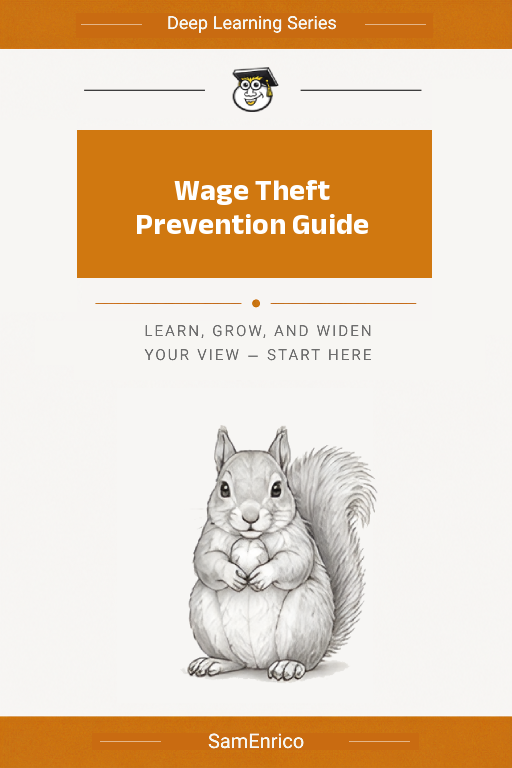
Wage Theft Prevention Guide eBook
Avoid wage theft claims from first employee. Accur
Avoid wage theft claims from first employee. Accurate timekeeping and final pay rules.
Formats
Free sample
Chapter 1: The Unintentional Trap--The first time Sarah lost $54,000, she wasn't being robbed at gunpoint. She wasn't embezzled by a trusted accountant. She wasn't even sued by a disgruntled employee. She lost it because she asked her part-time baker to clean the mixing bowls after clocking out."I thought I was being efficient," Sarah told me three years later, her food truck now a memory. "She was already there.
The bowls needed cleaning. It took fifteen minutes. What was the harm?"The harm was 27,000inbackwagesfor18monthsofunpaidfifteen−minuteshifts,plusanother27,000 in back wages for 18 months of unpaid fifteen-minute shifts, plus another 27,000inbackwagesfor18monthsofunpaidfifteen−minuteshifts,plusanother27,000 in liquidated damages, plus $8,000 in legal fees, plus the death of a business she had spent seven years building. Her employee hadn't filed a complaint out of spite. She had filed because she needed unemployment benefits after Sarah laid her off during a slow season.
The Department of Labor audited the entire two-year history of the business. What Sarah thought was a favor—letting her baker clean up "off the clock" to save payroll—was wage theft. Unintentional, well-meaning, and absolutely illegal.This book exists because of Sarah. And because of Mike, who lost 34,000misclassifyinghiscousinasacontractor.Andbecauseofarestaurantmanagerin Oregonwhocosthisowner34,000 misclassifying his cousin as a contractor. And because of a restaurant manager in Oregon who cost his owner 34,000misclassifyinghiscousinasacontractor.Andbecauseofarestaurantmanagerin Oregonwhocosthisowner50,000 by deleting "late" punches without checking the security footage.
And because of thousands of other small business owners who never intended to steal a dime from their employees but lost everything anyway.The sobering reality is this: most wage theft is not committed by malicious employers. It is committed by disorganized, overwhelmed, well-intentioned people who hire their first employee and assume the rules are flexible. The rules are not flexible. The Department of Labor does not care if you meant well. Your employee's lawyer does not care that you were trying to save money during a slow month.
The only thing that matters is what you did, what you recorded, and what you paid.This chapter introduces the "compliance-first" framework—building systems before problems arise—and the core promise of this book: a low-maintenance payroll defense system that requires just two hours of quarterly attention. By the end of this chapter, you will understand exactly why your first hire is the most dangerous moment in your business life, and why treating payroll compliance with the same seriousness as tax compliance is not paranoia—it is survival.The First Hire Illusion There is a moment, just before you hire your first employee, when everything feels manageable. You have been doing all the work yourself. You are tired. You are growing.
You tell yourself: "I'll just get a little help. Nothing complicated. A few hours a week. We'll figure out the paperwork as we go."That moment is the trap.The first hire creates an illusion of simplicity. Because the tasks are small—fifteen minutes of cleaning, answering a few emails, helping set up for the morning rush—the legal obligations feel equally small.
They are not. The Fair Labor Standards Act (FLSA) does not have a "small employer exemption." It does not have a "we're just getting started" grace period. It does not have a "but they're practically family" exception.When you hire your first employee, you inherit a body of federal law that has been refined over eighty years. You inherit state laws that are often stricter. You inherit recordkeeping requirements, posting requirements, notice requirements, and penalty structures designed for Fortune 500 companies—applied equally to your part-time helper.This is not fair.
It is also not negotiable.Consider what happens the moment your first employee clocks in. You are now responsible for:Accurately tracking every minute of compensable time, including pre-shift setup and post-shift cleanup Classifying the worker correctly as an employee (not an independent contractor) under a multi-factor test Paying at least the federal minimum wage (currently $7.25 per hour, but higher in 30+ states)Paying overtime at 1.5x the regular rate for any hours over 40 in a workweek Providing meal and rest breaks according to your state's laws (or facing premium pay penalties)Maintaining accurate payroll records for three years (or more, depending on your state)Issuing pay stubs with specific information (required in 25+ states)Paying final wages on time upon separation, with waiting time penalties up to 30 days of additional wages Each of these obligations has sub-rules, exceptions, and state-specific variations. Each one has been the subject of successful lawsuits against employers who "didn't know" or "didn't think it applied to them."The first hire illusion tells you that you can learn as you go. Reality tells you that the Department of Labor's statute of limitations is two years for non-willful violations—three years for willful violations—and that a single employee complaint can trigger an audit of your entire payroll history. You cannot "learn as you go" when the learning curve ends in bankruptcy.The $54,000 Bowl of Mixing Bowls Let us return to Sarah.
Her story is worth examining in detail because it contains every element of the unintentional wage theft trap.Sarah ran a small bakery out of a converted food truck. She worked sixty hours a week mixing dough, frosting cakes, and managing social media. After six months, she hired a part-time baker, Maria, to help with the morning shift. Maria worked from 6:00 AM to 10:00 AM, Tuesday through Saturday. Her job was to mix batters, load ovens, and clean the prep area.Sarah was thrilled with Maria.
The bakery was growing. Profits were up. Then came the conversation that destroyed everything."Maria, you've been great," Sarah said one afternoon. "I have an idea. If you stay fifteen minutes after your shift to clean the mixing bowls and sweep the floor, I'll buy you lunch once a week."Maria agreed.
She liked Sarah. She liked the bakery. She didn't think about the fifteen minutes. She cleaned the bowls, swept the floor, and went home. Sarah bought her a sandwich every Friday.
This arrangement continued for eighteen months.Then the slow season hit. Sarah had to lay off Maria. Maria filed for unemployment. The state asked for payroll records. Sarah provided her timesheets, which showed Maria working exactly 4 hours per day, 20 hours per week.
The state asked Maria if those records were accurate. Maria thought about the fifteen minutes of cleaning. "No," she said. "I worked more than that."The state referred the case to the Department of Labor. The DOL audited Sarah's entire two-year history with Maria.
They interviewed Sarah. They interviewed Maria. They examined text messages, security footage, and the inconsistent timesheets.The result: 27,000inunpaidwagesforthe15minutesperday,5daysperweek,72weeksof Maria′semployment(15minutes×5days=75minutesperweek;75minutes×72weeks=90hours;90hours×27,000 in unpaid wages for the 15 minutes per day, 5 days per week, 72 weeks of Maria's employment (15 minutes × 5 days = 75 minutes per week; 75 minutes × 72 weeks = 90 hours; 90 hours × 27,000inunpaidwagesforthe15minutesperday,5daysperweek,72weeksof Maria′semployment(15minutes×5days=75minutesperweek;75minutes×72weeks=90hours;90hours×15 per hour = 1,350inbasewages?No.The DOLcalculatedovertime,penalties,andthefactthatthe15minutesoftenpushed Mariaover40hoursinweekswhensheworkedextrashifts.Theactualunpaidwages,withovertime,cameto1,350 in base wages? No. The DOL calculated overtime, penalties, and the fact that the 15 minutes often pushed Maria over 40 hours in weeks when she worked extra shifts.
The actual unpaid wages, with overtime, came to 1,350inbasewages?No.The DOLcalculatedovertime,penalties,andthefactthatthe15minutesoftenpushed Mariaover40hoursinweekswhensheworkedextrashifts.Theactualunpaidwages,withovertime,cameto27,000). Then liquidated damages equal to the unpaid wages: another…
This is the end of the free sample. Get the eBook to keep going. Buy now
About this book
Details
- Author
- Gomes Rashida
- Publisher
- SamEnrico
- Language
- English
- Genre
- Non-Fiction, Business Brief, Legal Guide
- Released
- 2026-06-01
- Pages (approx.)
- 154
- Available as
- eBook, Audiobook

Read better in the ZLOADR app
Your eBooks on your phone or tablet. Sign in with your SamEnrico account and start reading.
More by Gomes Rashida
 Love Bombing Self ProtectionGomes Rashida$11.99
 King's Assassination LegacyGomes Rashida$11.99
 Email Anger Triggers GuideGomes Rashida$11.99Email Anger Triggers GuideGomes Rashida$11.99
 Cape Town Water Tech GuideGomes Rashida$11.99
 The Retail Therapy Alternate GuideGomes Rashida$11.99
 The Celtic Kings: Forging the Iron Age LegacyGomes Rashida$11.99
 How to Start a Tortilla Manufacturing BusinessGomes Rashida$11.99
 Economic Data Cleaning in ExcelGomes Rashida$12.99
 Understanding Pseudoachondroplastic Dysplasia 1Gomes Rashida$17.99
 Director of Merchant SuccessGomes Rashida$11.99
You may also like
 Hong Kong Handover 1997Dunn Johnnie$11.99
 Zumba For Postnatal Recovery CourseNeal Christian$11.99
 Zumba for BeginnersLadner Nikia$11.99
 YouTube Comment Mining GuideHumes Pandora$12.99
 Worry Box MeditationCarlin Rudy$11.99
 Workplace Stress MeditationNguyen Lynn$11.99
 Workplace Stress and Sleep RepairHawley Ivory$11.99
 Workplace Perfectionism CureDelaney Jeffry$11.99
 Workplace Injustice Anger GuideWallen Isabelle$11.99
 Work Addiction and Burnout LinkGreenwood Ester$11.99
 Women in Yoga and WellnessBeattie Galina$11.99
 Women in Stand Up ComedyChun Evangeline$11.99