
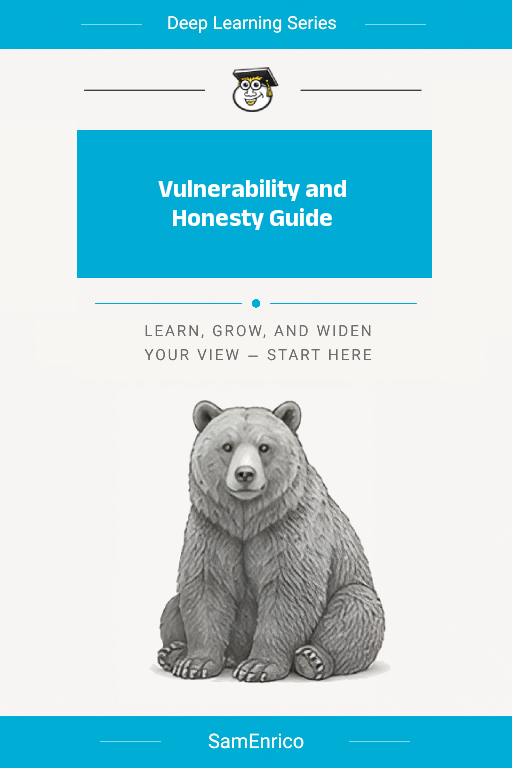
Vulnerability and Honesty Guide eBook
Share personal struggles without oversharing, show
Share personal struggles without oversharing, showing how challenges shaped you while maintaining boundaries that keep readers comfortable.
Formats
Free sample
Chapter 1: The Sharing Trap...--Most people believe that vulnerability is a binary choice: either you hide your struggles completely, or you confess them entirely. This is the single greatest mistake in modern emotional culture—and it is why so many well-intentioned attempts at honesty end in awkward silences, damaged reputations, and a lingering sense of shame.The woman who cries in a job interview, thinking she is being “authentic.” The manager who shares his marital problems during a team meeting, believing he is building trust. The friend who trauma-dumps her entire childhood story at a casual dinner, leaving everyone at the table staring at their plates. Each of these people made the same error: they confused confession with connection. They assumed that more honesty is always better.
And they learned, often painfully, that vulnerability without boundaries is not courage—it is a form of self-harm.This book exists because that confusion is everywhere. Scroll through social media for five minutes and you will see people oversharing their deepest wounds to thousands of strangers, then wondering why they feel more alone afterward. Sit in any open-plan office and you will hear colleagues trapped in conversations where one person has unloaded far more than anyone was prepared to receive. Look at your own life and you will almost certainly remember a moment when you said too much, felt the room shift, and spent the next three days replaying the conversation in your head.That feeling—that hot, sinking sensation of having exposed too much—has a name. Brené Brown, the researcher who has done more than anyone to bring vulnerability into mainstream conversation, calls it the Vulnerability Hangover.
It is the emotional equivalent of waking up after a night of drinking and realizing you said things you cannot take back. Your stomach drops. Your mind races. You wonder what they think of you now. You wish you could rewind time.Here is the truth that most books about vulnerability will not tell you: unfiltered openness is not brave.
It is reckless.The research is clear. In one study cited by Brown in Daring Greatly, job candidates who disclosed personal struggles early in the interview process were rated as less hireable than those who waited—unless their credentials were already exceptional. Why? Because competence is the container for vulnerability. Without demonstrated skill, a personal reveal does not read as courage.
It reads as instability. The interviewer does not think, “What a brave, authentic person.” They think, “If this is how they show up in an interview, what will happen under pressure?”This is the Vulnerability Paradox: every meaningful human emotion—love, grief, joy, fear—requires you to be seen. But not every person in your life has earned the right to see every part of you. The more intimate the story, the more selective you must be about who hears it. Share a Level 4 struggle (a current crisis, a trauma detail, a shame spiral) with a Level 1 relationship (an acquaintance, a new colleague, a stranger on the internet), and you are not being brave.
You are being unsafe with yourself.The purpose of this chapter—and this entire book—is to give you a different way. Not the all-or-nothing trap of “hide everything or confess everything.” Not the exhausting performance of constant authenticity. But a third path: measured vulnerability. The ability to share your struggles in a way that builds trust without trauma-dumping, that shows how challenges shaped you without making the listener uncomfortable, and that protects your own peace while still letting others in.Before we go any further, let me tell you what this book is not. It is not an argument for hiding.
It is not permission to be cold, guarded, or emotionally unavailable. And it is absolutely not a justification for the kind of polished, curated, Instagram-perfect persona that pretends nothing is wrong. That approach—the opposite of oversharing—is equally damaging. People who never share anything struggle to form deep relationships. They are perceived as distant, untrustworthy, or robotic.
And they often suffer in silence, convinced that their struggles are theirs alone to bear.No. The answer is not less honesty. The answer is more structure.This chapter will introduce the foundational concepts that the rest of the book will build upon: the difference between oversharing and measured vulnerability, the four dimensions that separate helpful honesty from harmful dumping, the research on competence and trust, and the single most important question you can ask yourself before you open your mouth. By the end of this chapter, you will have a clear framework for understanding why your past attempts at vulnerability may have backfired—and a roadmap for doing it differently going forward.The All-or-Nothing Trap Let us start with a thought experiment. Imagine a scale from zero to ten.
Zero is complete silence: you share nothing about your inner life, your struggles, your emotions. Ten is complete confession: you share everything, with everyone, at all times.Most people assume that the goal of “being vulnerable” is to move from zero toward ten. The more you share, the more authentic you become. The more you reveal, the deeper your connections. This assumption is so widespread that it has become a kind of folk wisdom.
You have heard it a hundred times: “Just be yourself.” “Open up more.” “Let people see the real you.”But here is the problem: the scale is wrong.Vulnerability is not a line from zero to ten. It is a matrix with two axes. The first axis is depth: how sensitive or intimate the material is. The second axis is breadth: how many people hear it. A healthy vulnerability strategy is not “share more.” It is “share the right depth with the right breadth.” Or, to put it more simply: share Level 3 material with Level 2 people, Level 4 material only with Level 1 people, and never confuse the two.(We will define these levels in detail in Chapter 4.
For now, think of Level 1 as acquaintances, Level 2 as friends, Level 3 as close trusted people, and Level 4 as sacred material that belongs only in therapy.)The all-or-nothing trap is seductive because it feels decisive. You tell yourself: “I am going to stop hiding. I am going to be radically honest. I am going to share my whole story.” And for a moment, it feels like freedom. But then the hangover hits.
You realize you told your new coworker about your divorce. You realize you posted your anxiety spiral on Instagram. You realize you made your dinner party into a therapy session.You overshared. And now you are stuck with the consequences.The alternative—hiding everything—is equally seductive but for different reasons. It feels safe.
It feels controlled. You tell yourself: “No one needs to know my business. I will keep my struggles to myself.” And that works, for a while. But over time, hiding becomes its own prison. You feel alone.
No one really knows you. You are performing a version of yourself that does not include pain, which means you are performing a version of yourself that is not fully human.Both paths lead to the same destination: loneliness. The oversharer is lonely because they have scared people…
This is the end of the free sample. Get the eBook to keep going. Buy now
About this book
Details
- Author
- Donaldson Celena
- Publisher
- SamEnrico
- Language
- English
- Genre
- Non-Fiction, Student's Shortcut
- Released
- 2026-05-27
- Pages (approx.)
- 139
- Available as
- eBook, Audiobook

Read better in the ZLOADR app
Your eBooks on your phone or tablet. Sign in with your SamEnrico account and start reading.
More by Donaldson Celena
 Remote Work Email ManagementDonaldson Celena$11.99
 Non Stick Baking Paper RisksDonaldson Celena$11.99
 Major Depressive Disorder Recovery RoadmapDonaldson Celena$11.99
 The Foster Care ConfessionDonaldson Celena$11.99
 Russian Mafia HandbookDonaldson Celena$11.99
 Homeless Shelter FounderDonaldson Celena$11.99
 Captive Testimonies Middle PassageDonaldson Celena$11.99
 Success Without Burnout for CaregiversDonaldson Celena$11.99
 Suleiman the Magnificent: The Sultan Who Shaped EmpiresDonaldson Celena$11.99
 The Battle of Britain Field: How Football Hooliganism Shook AustraliaDonaldson Celena$11.99
 How to Produce Water SoftenersDonaldson Celena$11.99
 How to Become a Rubber CutterDonaldson Celena$11.99
You may also like
 Hong Kong Handover 1997Dunn Johnnie$11.99
 Zumba For Postnatal Recovery CourseNeal Christian$11.99
 Zumba for BeginnersLadner Nikia$11.99
 YouTube Comment Mining GuideHumes Pandora$12.99
 Worry Box MeditationCarlin Rudy$11.99
 Workplace Stress MeditationNguyen Lynn$11.99
 Workplace Stress and Sleep RepairHawley Ivory$11.99
 Workplace Perfectionism CureDelaney Jeffry$11.99
 Workplace Injustice Anger GuideWallen Isabelle$11.99
 Work Addiction and Burnout LinkGreenwood Ester$11.99
 Women in Yoga and WellnessBeattie Galina$11.99
 Women in Stand Up ComedyChun Evangeline$11.99