
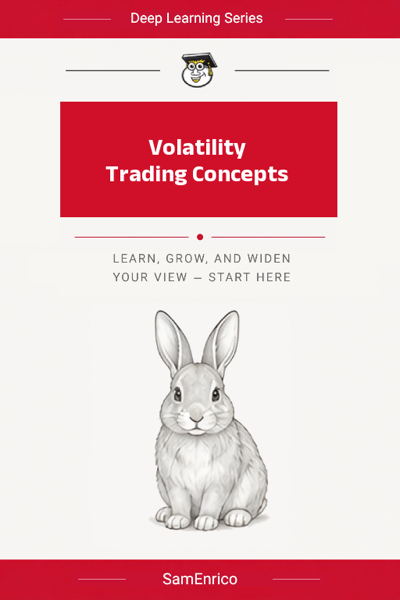
Volatility Trading Concepts eBook
A Coursebook on Volatility Trading Concepts
by Jobe Jeffie
A Coursebook on Volatility Trading Concepts
Formats
Free sample
Chapter 1: The Insurance Lie--Most traders never lose money because they are wrong about direction. They lose money because they pay too much for the right to be right.Pause and let that sink in. Walk into any retail brokerage office or scroll through any trading forum, and you will hear the same obsession: "Is the stock going up or down?" Thousands of hours are spent on chart patterns, earnings predictions, and Fed-watching, all in service of answering that single question. Yet the data tells a brutal truth. Studies of retail option traders consistently show that over 80 percent lose money over time, and the primary culprit is not incorrect direction—it is overpaying for optionality.
The average trader buys options that are statistically overpriced, watches time decay eat their premium, and then blames their directional forecast when the trade fails. They were right about the move and still lost money. That is the Insurance Lie.Here is what an option actually is. An option is a contract that transfers risk from one party to another in exchange for a premium. That is it.
The buyer of an option is purchasing insurance. The seller of an option is becoming an insurance company. When you buy a put option on a stock you own, you are insuring your portfolio against a decline. When you sell a call option against a stock you own, you are selling someone else insurance that the stock will not rise above a certain price. This is the correct mental model for every single option trade you will ever make, from the simplest covered call to the most complex volatility swap.Now consider how insurance works in the real world.
An insurance company does not ask "Will this house burn down?" before setting the premium for a fire insurance policy. They ask "What is the probability that this house burns down over the next year, and how much will we have to pay if it does?" They then set the premium above the expected value of that loss, plus a margin for profit and a reserve for catastrophe. The insurance company does not need to know whether any specific house will burn. They only need to know that across thousands of policies, the premiums collected will exceed the claims paid. That is the insurance business model.
That is also the option selling business model.The option buyer, by contrast, is the homeowner. They pay a premium to transfer risk because they cannot afford the worst-case outcome. They are not trying to profit in expectation—they are trying to cap their downside. The confusion begins when retail traders treat options like lottery tickets. They buy out-of-the-money calls hoping for a moonshot, not realizing that the premium they paid already prices in a reasonable probability of that moonshot.
They are buying insurance on a house they do not own, paying a premium that is actuarially fair or worse, and wondering why they lose money over time.The Architecture of a Bet To understand volatility trading, you must first understand what goes into the price of an option. Every option price is determined by six inputs, and you need to know each one intimately. The underlying price is the current market price of the stock, index, or future on which the option is written. The strike price is the price at which the option holder can buy (call) or sell (put) the underlying. The time to expiration is the remaining life of the option, measured in years or trading days.
The risk-free interest rate is the rate you could earn on a risk-free asset, typically proxied by Treasury bills. The dividend yield is the expected dividends paid by the underlying over the option's life. And volatility is the wildcard—the input that represents the uncertainty of future price movements.Here is what matters about these six inputs. Some you control, and some you do not. You control the strike price you choose.
You control the expiration date you select. You do not control the underlying price—it moves wherever the market takes it. You do not control volatility—it shifts with fear, greed, and macroeconomic news. This distinction is critical because it tells you where your trading edge can realistically come from. You cannot predict the underlying price consistently, or you would already be a billionaire hedge fund manager and not be reading this book.
You cannot predict volatility perfectly, but you can develop a systematic approach to comparing implied volatility (the market's forecast) to realized volatility (what actually happens). That comparison is the foundation of all volatility trading.The Black-Scholes-Merton model, despite its mathematical complexity, is conceptually simple. It takes these six inputs and produces a single number: the fair price of the option assuming that markets are efficient, that trading is continuous, and that price changes follow a lognormal distribution. The model assumes that large price moves are rare and that prices cannot go negative. These assumptions are wrong in important ways, which we will explore throughout this book.
But the model remains useful because it gives us a common language. When traders say "implied volatility," they mean the volatility input that makes the Black-Scholes-Merton model spit out the current market price of the option. It is the market's consensus forecast of future volatility, reverse-engineered from the price.Think of implied volatility as the price of fear. When markets are calm and complacent, implied volatility is low. Options are cheap.
When markets are panicked and uncertain, implied volatility spikes. Options become expensive. This is not a bug of the model—it is a feature of the market. The option price is not just a mathematical calculation; it is a reflection of supply and demand, of fear and greed, of the collective anxiety of every participant in the market.The Buyer's Curse and the Seller's Edge Here is the uncomfortable truth that most option trading books will not tell you. The vast majority of retail traders should be net sellers of options, not net buyers.
This is not because selling is inherently more profitable in every single trade. It is because the market systematically overprices options relative to their expected payoff.Let us walk through the logic. Imagine you are an insurance company. You sell a one-year fire insurance policy on a house worth $500,000. Based on historical data, the probability of a total loss from fire in any given year is 0.2 percent.
The expected loss on the policy is therefore $1,000 (0.002 multiplied by $500,000). If you charge a premium of $1,200, your expected profit is $200 per policy. You will lose money on the rare policy that pays out, but across thousands of policies, you profit consistently. That is the insurance business.Now imagine you are a homeowner. You buy that same policy.
Your expected loss is negative $200 per year. You are paying more than the actuarially fair premium. But you do it anyway because you cannot afford a $500,000 loss. You are not trying to make money in expectation—you are trying to survive a catastrophe.Options work the same way. The seller of an option collects a premium that is, on average across many trades, higher than the expected payout.
The buyer pays that premium and has a negative expected return on the trade. The buyer is not irrational—they are…
This is the end of the free sample. Get the eBook to keep going. Buy now
About this book
Details
- Author
- Jobe Jeffie
- Publisher
- SamEnrico
- Language
- English
- Genre
- trading, Informative, Educational
- Released
- 2026-06-02
- Pages (approx.)
- 142
- Available as
- eBook, Audiobook

Read better in the ZLOADR app
Your eBooks on your phone or tablet. Sign in with your SamEnrico account and start reading.
More by Jobe Jeffie
 NVC For Law Enforcement GuideJobe Jeffie$11.99
 Cash Flow for Nonprofits GuideJobe Jeffie$11.99
 Hydrogen Economy Capital GuideJobe Jeffie$11.99
 Twelve Step for Control AddictsJobe Jeffie$11.99
 Restless Leg Syndrome Exercise ProtocolJobe Jeffie$11.99
 Hillary Gurkha FriendshipJobe Jeffie$11.99
 Avalanche Buried AliveJobe Jeffie$11.99
 Mount Carmel Siege DiaryJobe Jeffie$11.99
 Maharal of Prague GolemJobe Jeffie$11.99
 Tides of Destiny: The Portuguese Charting of the UnknownJobe Jeffie$11.99
 The Marble Corsair: Cellini’s Golden HeistJobe Jeffie$11.99
 The Last Letter: The Unseen Love Story of WWII’s ‘Greatest Generation’Jobe Jeffie$11.99
You may also like
 Shift Work Shift Trading GuideDuff Cathrine$11.99
 Insider Trading SentimentWurtz Shawnda$11.99
 Gambler's Fallacy TradingGaydos Shu$11.99
 Cryptocurrency Trading AddictionGeorge Kathleen$11.99
 Brokerage Account Margin TradingSegura Hermila$11.99
 Gambling Addiction and Day TradingClanton Hyacinth$11.99
 Beginner Mindfulness for Stock TradersFultz Mary$11.99
 Dividend Capture Strategy GuideWallace Antoinette$11.99
 Unauthorized Trading CasesQuintanilla Ima$11.99
 Insider Trading Heist TheoryTripp Luvenia$11.99
 Trader Distraction Control GuideSummers Gina$11.99
 Loss Aversion Trading GuideBoucher Ellamae$11.99