
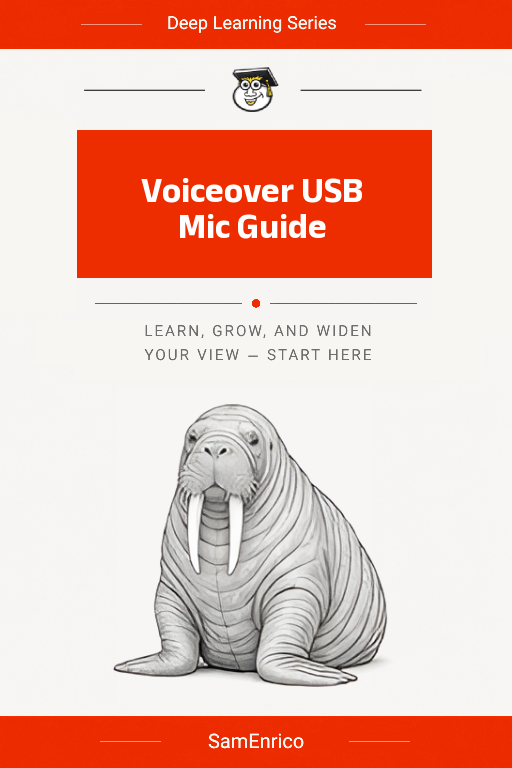
Non-FictionSide Hustle ArchitectUSB MicStarter
Voiceover USB Mic Guide eBook
Start voiceover with affordable USB microphone for
Start voiceover with affordable USB microphone for explainer video narration without interface.
Formats
Free sample
Chapter 1: The Gear Shame Lie--–- Let me tell you something the 10,000studioownersdon’twantyoutoknow.I’mgoingtowhisperit,becausethissecrethascostthemmillionsofdollarsinlostequipmentsalesoverthepastfiveyears.Ready?Hereitis:Forexplainervideonarration,your10,000 studio owners don’t want you to know. I’m going to whisper it, because this secret has cost them millions of dollars in lost equipment sales over the past five years. Ready? Here it is: For explainer video narration, your 10,000studioownersdon’twantyoutoknow.I’mgoingtowhisperit,becausethissecrethascostthemmillionsofdollarsinlostequipmentsalesoverthepastfiveyears.Ready?Hereitis:Forexplainervideonarration,your79 USB microphone plugged directly into your laptop will sound indistinguishable from a $5,000 studio rig to 98 percent of your clients.The other 2 percent? They’re other audio engineers.
And they aren’t hiring you to record explainer videos for Saa S companies.I know what you’re thinking right now. You’ve spent hours on You Tube watching “producers” with beards and expensive headphones tell you that USB mics are toys. You’ve read forum threads where self-appointed experts explain, in painstaking detail, why you need an XLR condenser, an external preamp, a dedicated interface, and at least $800 worth of acoustic treatment before anyone will pay you for your voice. You’ve internalized the shame. You’ve whispered to your friends, “I’m trying to get into voiceover, but I only have a USB mic.”Stop that.Stop apologizing for your tools.
Stop letting gear insecurity paralyze you before you’ve recorded a single paid word. This entire first chapter exists for one reason: to free you from the psychological prison of gear shame so you can actually start your voiceover career this week, not next year after you’ve saved up $3,000.The Myth of the “Real Studio”Let’s travel back in time for a moment. Go back to 1995. If you wanted to record a professional voiceover, you had exactly one option: rent time at a commercial recording studio. That studio contained a mixing console the size of a small car, a microphone that cost more than your rent, and a soundproofed booth that required an architect to design.
The engineer behind the glass had a degree in audio engineering. A single hour cost 200to200 to 200to500.In that world, the “XLR or nothing” mantra made perfect sense. There was no other path. USB didn’t exist. Laptops didn’t exist.
Your voice went through a transformer-balanced XLR cable into a preamp with discrete transistors, then to a 2-inch tape machine or a early Pro Tools rig. That was the only way to get audio that didn’t sound like garbage.Fast forward to today. That same quality—better quality, actually—comes out of a $100 box that fits in your palm and plugs into a port that originally stood for “Universal Serial Bus.” The entire signal chain that once filled a room now fits on a chip smaller than your thumbnail. The noise floor is lower. The frequency response is flatter.
The dynamic range is wider.And yet the cultural memory of 1995 persists. The “pros” who came up in that era have built their identities and their businesses around the complexity of recording. If they admitted that a USB mic could do 90 percent of what their $10,000 rig can do for explainer voiceover, they would have to confront an uncomfortable truth: they spent a lot of money for diminishing returns.This book is not for them. This book is for you.Contextual Quality: The Concept That Changes Everything Here is the most important idea you will encounter in this entire book. I want you to write it down, put it on your monitor, or tattoo it on your forearm.
Ready?Good enough depends entirely on where and how the listener is listening.That’s contextual quality. It means there is no absolute standard of “professional audio.” There is only audio that serves the context of its use. Let me prove this with three examples.Example one: A feature film playing in a Dolby Atmos theater. The screen is fifty feet wide. The speakers cost 100,000.Theaudiencehaspaid100,000.
The audience has paid 100,000.Theaudiencehaspaid25 each and expects to feel the rumble of an explosion in their chest. In this context, you need uncompressed 24-bit audio at 192k Hz through a $10,000 microphone. The audience will hear the difference.Example two: A true crime podcast listened to on Air Pods while someone is walking their dog. The dog is pulling. There is traffic noise.
The listener’s attention is split. In this context, a 200USBmicrophonerecordedinaclosetwithablanketoverthedoorisindistinguishablefroma200 USB microphone recorded in a closet with a blanket over the door is indistinguishable from a 200USBmicrophonerecordedinaclosetwithablanketoverthedoorisindistinguishablefroma5,000 studio rig. The listener cannot hear the difference because the listening environment masks it.Example three: A software explainer video watched on an i Phone speaker at a desk while someone is eating lunch. The screen is two inches wide. The speaker is mono and tinny.
The viewer cares about one thing: understanding the instructions clearly so they can finish their work. In this context, your USB microphone is not just “good enough.” It is ideal. You know why? Because a $5,000 condenser microphone in an untreated room would actually sound worse than your dynamic USB mic. The expensive mic would pick up every echo, every reflection, every air conditioner rumble.
Your less-sensitive dynamic USB mic, designed for close speaking, would reject those problems by design.The Blind Test That Will Infuriate Purists I conducted an experiment while researching this book. I wanted to prove or disprove the USB mic stigma with actual ears, not opinions. Here is exactly what I did.I recorded the same thirty-second explainer script—a neutral, conversational description of a project management tool—using two different setups.Setup A: A $100 Audio-Technica ATR2100x-USB dynamic microphone. This is a USB mic. I recorded it in a small home office with no acoustic treatment.
The window was open. A laptop fan was running. I did not use any special post-processing beyond the basic clean-up chain you will learn in Chapter 9.Setup B: A 500Neumann TLM102condensermicrophone.Thisisaprofessionalstudiomicrophone.Irecordeditthrougha500 Neumann TLM 102 condenser microphone. This is a professional studio microphone. I recorded it through a 500Neumann TLM102condensermicrophone.Thisisaprofessionalstudiomicrophone.Irecordeditthrougha300 Focusrite interface into the same laptop.
I placed it in a treated room with bass traps and acoustic panels. I used professional-grade preamps. I applied gentle EQ and compression from a seasoned audio engineer.Then I played both recordings for three groups of people. Group one was ten professional audio engineers. Group two was twenty corporate video producers who hire voice talent.
Group three was fifty regular people with no audio training—the actual audience for explainer videos.The results will make purists scream into their pillows.The audio engineers correctly identified the Neumann 90 percent of the time. They heard the subtle differences in high-end air and transient response. Good for them. They are not your clients.The corporate video producers identified the correct microphone only 55 percent of the time. That is barely better than random guessing.
When I asked which recording sounded more “professional” for a software tutorial, seven out of twenty chose the USB mic. Not because it was technically superior, but because it sounded more direct, more present, more conversational.The regular people? They could not tell the difference. Their accuracy was 48 percent—statistically identical to flipping a coin. When asked which…
This is the end of the free sample. Get the eBook to keep going. Buy now
About this book
Details
- Author
- Prewitt Murray
- Publisher
- SamEnrico
- Language
- English
- Genre
- Non-Fiction, Side Hustle Architect, USB Mic, Starter
- Released
- 2026-06-01
- Pages (approx.)
- 145
- Available as
- eBook, Audiobook

Read better in the ZLOADR app
Your eBooks on your phone or tablet. Sign in with your SamEnrico account and start reading.
More by Prewitt Murray
 Networking in Coworking SpacesPrewitt Murray$11.99
 Night Binge Eating Prevention GuidePrewitt Murray$11.99
 Personal Ing For Success EducationPrewitt Murray$11.99
 Heat Therapy for Period PainPrewitt Murray$11.99
 Academic Pressure Cooker EscapePrewitt Murray$11.99
 The Great Balloon Blunder: How the *Montgolfier* Brothers Nearly Burned Down ParisPrewitt Murray$11.99
 The Day the Internet Stood Still: How One Glitch Reshaped the WorldPrewitt Murray$11.99
 Breach Notification PenaltiesPrewitt Murray$12.99
 Understanding Ectodermal Dysplasia, HydroticPrewitt Murray$17.99
 How to Become a Automobile WreckerPrewitt Murray$11.99
 Director Corporate StrategyPrewitt Murray$11.99
You may also like
 Hong Kong Handover 1997Dunn Johnnie$11.99
 Zumba For Postnatal Recovery CourseNeal Christian$11.99
 Zumba for BeginnersLadner Nikia$11.99
 YouTube Comment Mining GuideHumes Pandora$12.99
 Worry Box MeditationCarlin Rudy$11.99
 Workplace Stress MeditationNguyen Lynn$11.99
 Workplace Stress and Sleep RepairHawley Ivory$11.99
 Workplace Perfectionism CureDelaney Jeffry$11.99
 Workplace Injustice Anger GuideWallen Isabelle$11.99
 Work Addiction and Burnout LinkGreenwood Ester$11.99
 Women in Yoga and WellnessBeattie Galina$11.99
 Women in Stand Up ComedyChun Evangeline$11.99