
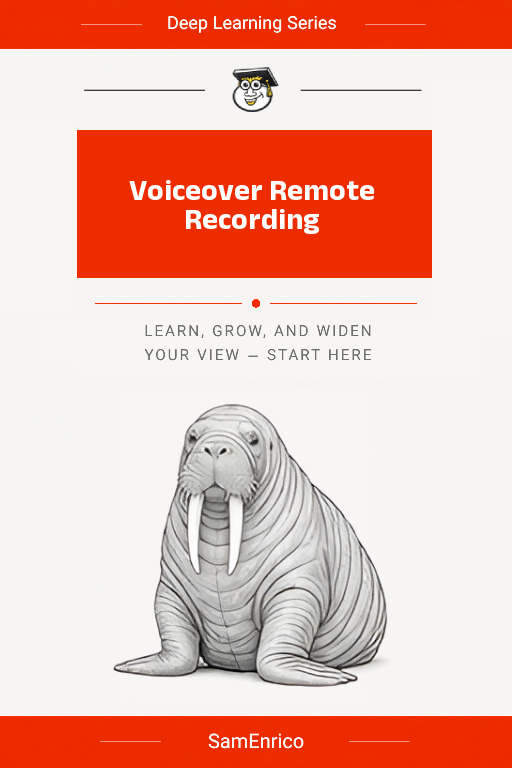
Non-FictionSide Hustle ArchitectRemoteDelivery
Voiceover Remote Recording eBook
Deliver remote voiceover recordings to clients wor
Deliver remote voiceover recordings to clients worldwide using source connect or standard file delivery.
Formats
Free sample
Chapter 1: Two Roads Diverged--–- In 2014, I lost a $12,000 voiceover gig because I didn't own an ISDN line. The client, a national automotive brand, needed a live-directed session with their creative director in Detroit. I had a broadcast-quality home studio, a Neumann microphone, and ten years of experience. None of that mattered. I couldn't receive their real-time direction, so they booked a talent three states away who could.Nine years later, that same client booked me for a $15,000 campaign.
This time, they didn't ask about ISDN. They asked if I used Source-Connect. When I said yes, the creative director replied with four words that changed how I think about this business: "Great. Send your session ID."The technology had changed. But more importantly, the entire industry had shifted.
What happened between those two moments—the death of ISDN, the rise of remote recording, and the birth of the anywhere-with-an-internet-connection voice actor—is the subject of this chapter. Because before you can master the technical workflows that follow in this book, you need to understand the landscape you're operating in. You need to see the two roads that every modern voice actor must walk, often on the same day, sometimes in the same hour.The Myth of the One True Workflow Walk into any voiceover Facebook group or Reddit forum, and you'll find a heated debate raging. "Source-Connect is the only professional option." "No, file delivery is more efficient." "Real talent doesn't need live direction." "If you're not recording with the client in your ear, you're not a real voice actor."Ignore all of it.This tribalism—this insistence that there is one correct way to deliver remote recordings—has cost voice actors millions of dollars in lost bookings. I've watched talented performers turn down lucrative work because they refused to learn Source-Connect.
I've seen narrators lose audiobook contracts because they insisted on live sessions for projects that clearly demanded asynchronous delivery. I've coached actors who spent months building elaborate home studios only to discover they'd chosen the wrong workflow for their target market.The truth is simple and uncomfortable: you need both.The modern voiceover industry operates on two parallel tracks. One track is live directed, using software like Source-Connect to bring the client into your session in real time. The other track is asynchronous, where you record alone and deliver finished files via email or cloud storage. Neither track is better.
Neither track is going away. And the most successful voice actors I know—the ones earning six figures and above—move between both tracks seamlessly, often multiple times per week.Here's what that looks like in practice. On Monday morning, you might deliver a live directed commercial for a New York ad agency using Source-Connect. The creative director hears your takes in real time, approves them on the spot, and you hang up with the session complete. That afternoon, you switch gears to an asynchronous audiobook for an ACX author.
You record for three hours alone, edit for two hours the next day, and deliver the files via Dropbox. The author downloads them, approves them without revisions, and you invoice for your per-finished-hour rate.Two workflows. One career. That's the model this book teaches.Why the Industry Split Happened To understand why two workflows exist, you need to go back to 2019. Before that year, the vast majority of professional voiceover work fell into a single category: live directed, usually via ISDN (Integrated Services Digital Network), a digital telephone line technology that had been the industry standard since the 1990s.
Voice actors paid hundreds of dollars monthly for ISDN lines. Studios built entire business models around renting ISDN-equipped booths. Clients expected to direct sessions in real time because that was the only way to get broadcast-quality audio remotely.Then the pandemic hit.Overnight, every studio closed. Every client went remote. And every voice actor with a home studio suddenly had an opportunity they'd never had before.
The problem was that most home studios lacked ISDN capability. Even if you had the hardware, ISDN required specialized installation that wasn't possible during lockdowns. The industry needed an alternative, fast.Source-Connect, which had existed since 2007 but was considered a niche alternative to ISDN, suddenly became essential. Voice actors who already owned it found themselves booked solid. Those who didn't scrambled to learn it.
Meanwhile, a separate revolution was happening. Audiobook platforms like ACX (Audiobook Creation Exchange) had already normalized asynchronous delivery. E-learning companies had been receiving raw voice files via email for years. These workflows didn't require live direction at all. Clients simply wanted finished audio, delivered on time, at spec.When the pandemic ended, the industry didn't snap back to the old model.
Instead, it bifurcated. Clients who loved the efficiency of asynchronous delivery stuck with it. Clients who missed the creative collaboration of live direction demanded Source-Connect sessions. And a new category emerged: hybrid workflows, where a producer might join a live session for the first few takes, then let the talent finish asynchronously.Today, the split is roughly sixty percent asynchronous to forty percent live directed, according to industry surveys. But the ratio varies wildly by genre.
Animation and video game work skews heavily toward live direction. Audiobooks and e-learning are almost entirely asynchronous. Commercials and corporate narration fall somewhere in the middle, with high-budget projects favoring live direction and lower-budget projects using file delivery.Workflow One: Live Directed Sessions Live directed remote recording is the direct descendant of the old ISDN session. You and the client are connected in real time. They hear your microphone feed as you record.
They can stop you, offer direction, request retakes, or ask for alternative reads. You respond immediately, just as you would if they were sitting next to you in a commercial studio.The technology has evolved significantly. Modern live directed sessions use specialized software designed for low-latency, high-quality audio transmission. The industry standard is Source-Connect, which we will explore in exhaustive detail throughout Part II of this book. Alternatives include Session Link Pro (popular in Europe), ip DTL (common for international sessions), and even Zoom with its high-fidelity audio mode enabled—though Zoom introduces more latency and lower audio quality than dedicated solutions.Which projects demand live direction?Live directed sessions are non-negotiable for several categories of work:Commercials with tight timing requirements.
A thirty-second radio spot needs to hit exactly 29.5 seconds to accommodate a musical sting and legal disclaimer. The client needs to hear pacing in real time. A read that is half a second too long can break the entire edit. A read that is half a second too short leaves dead air that the producer must fill. Live direction allows the client to say "faster" or "slow down that last phrase" in real time.Animation and video game dialogue.
Character voices require specific emotional beats that align with visual cues that you cannot see. The client needs to hear whether your surprised grunt lands exactly on the frame where the cartoon anvil falls. Live direction allows for micro-adjustments that are nearly impossible to communicate asynchronously.Corporate narration with picky stakeholders. When the CEO or creative director wants to hear every sentence as it will sound in the final…
This is the end of the free sample. Get the eBook to keep going. Buy now
About this book
Details
- Author
- Burrows Riley
- Publisher
- SamEnrico
- Language
- English
- Genre
- Non-Fiction, Side Hustle Architect, Remote, Delivery
- Released
- 2026-05-27
- Pages (approx.)
- 122
- Available as
- eBook, Audiobook

Read better in the ZLOADR app
Your eBooks on your phone or tablet. Sign in with your SamEnrico account and start reading.
More by Burrows Riley
 Networking Anxiety ReductionBurrows Riley$11.99
 Binge Eating in College CourseBurrows Riley$11.99
 Caregiver Joy RetrievalBurrows Riley$11.99
 Adrenal Support Vitamin ProtocolBurrows Riley$11.99Adrenal Support Vitamin ProtocolBurrows Riley$11.99
 High School Student Stress PlanBurrows Riley$11.99
 The Phantom Ticker: Wall Street's Ghostly WhispersBurrows Riley$11.99
 Frozen in Time: The Lost Dinosaurs of the Gobi DesertBurrows Riley$11.99
 How to Become a Quilting-machine OperatorBurrows Riley$11.99
 Financial Data Breach GuideBurrows Riley$12.99
 Understanding Ectrodactyly Diaphragmatic Hernia Corpus CallosumBurrows Riley$17.99
 ECE AssistantBurrows Riley$11.99
You may also like
 Hong Kong Handover 1997Dunn Johnnie$11.99
 Zumba For Postnatal Recovery CourseNeal Christian$11.99
 Zumba for BeginnersLadner Nikia$11.99
 YouTube Comment Mining GuideHumes Pandora$12.99
 Worry Box MeditationCarlin Rudy$11.99
 Workplace Stress MeditationNguyen Lynn$11.99
 Workplace Stress and Sleep RepairHawley Ivory$11.99
 Workplace Perfectionism CureDelaney Jeffry$11.99
 Workplace Injustice Anger GuideWallen Isabelle$11.99
 Work Addiction and Burnout LinkGreenwood Ester$11.99
 Women in Yoga and WellnessBeattie Galina$11.99
 Women in Stand Up ComedyChun Evangeline$11.99