
Non-FictionSide Hustle ArchitectPricingRate
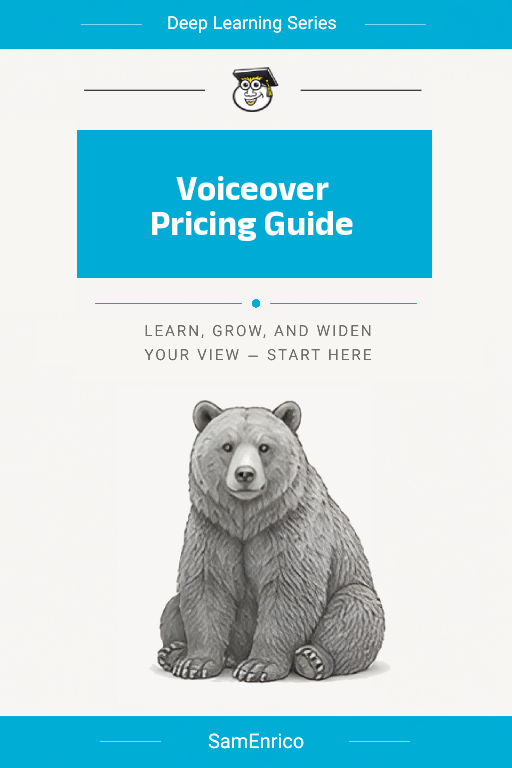
Voiceover Pricing Guide eBook
Price explainer voiceover services by project leng
Price explainer voiceover services by project length or per word including commercial and non commercial rates.
Formats
Free sample
Chapter 1: The Invisible Leak--–- You have already lost money today. Not because you aren't talented. Not because your microphone isn't expensive enough. Not because the market is flooded with cheaper talent. You lost money because you are using the wrong pricing model for the wrong project, and you don't even know it.Let me prove this to you in under sixty seconds.Think about your last five voiceover invoices.
Not the projects you auditioned for and lost. The ones you booked. The ones where the client said yes, you recorded the files, you delivered them, and you got paid. Now answer three questions:First, did you charge the same rate per word for a commercial tagline as you did for an e-learning module? Second, did you have a line item on your invoice that said something like "Usage Fee," "License Fee," or "Broadcast Rights"?
Third, do you know, without looking it up, what the GVAA rate guide recommends for a local radio spot versus a national television campaign?If you answered "yes" to the first question, "no" to the second, or "I'm not sure" to the third, you have experienced the Invisible Leak. It is called that because you cannot see the money evaporating. It does not show up as a refund or a chargeback. It shows up as the gap between what you charged and what you could have charged if you had known the single most important distinction in professional voiceover pricing.This chapter exists to close that gap forever.The 5Commercial That Should Have Been5 Commercial That Should Have Been 5Commercial That Should Have Been4,800I want to tell you about a voice actor named Sarah. (Her real name is different, but her story is true.) Sarah had been working professionally for four years.
She had a treated home studio, a Neumann microphone, and a client list that included regional banks, local car dealerships, and a handful of national brands through pay-to-play platforms. She was busy. She was booking work consistently. And she was exhausted because she was always chasing the next fifty-dollar invoice.One afternoon, Sarah received a direct message through her website. A marketing manager at a regional automotive group needed a voice for a new campaign.
The script was five words. Five. The client wanted the tagline for a series of television and radio spots running across three states for six months.Sarah, who had always charged by the word because that was what she learned on Upwork, calculated her rate. Five words at fifteen cents per word. Seventy-five cents.
She almost laughed. Instead, she panicked and sent a quote for fifty dollars because she felt embarrassed asking for more on such a short script.The client replied within an hour. "Fifty dollars is fine. When can you record?"Sarah recorded the tagline in fifteen minutes, edited it in another fifteen, and delivered the file. She felt good about the quick turnaround.
She did not feel good about the fifty dollars, but she told herself it was easy money.Six months later, Sarah was at a voiceover conference. She attended a workshop on commercial pricing. The instructor put up a slide that showed the GVAA recommended rate for a regional television commercial with a six-month run. The number started with a four and ended with three zeros. $4,800.
For a session fee plus usage. For a five-word tagline.Sarah's stomach turned. She pulled out her phone and calculated: She had charged 50.Theindustrystandardwas50. The industry standard was 50.Theindustrystandardwas4,800. She had left 4,750onthetable.Forfifteenminutesofwork.Foraclientwhowouldhavepaidthe4,750 on the table.
For fifteen minutes of work. For a client who would have paid the 4,750onthetable.Forfifteenminutesofwork.Foraclientwhowouldhavepaidthe4,800 if she had asked for it, because the marketing manager had a budget and Sarah's $50 quote had simply been accepted as a pleasant surprise.That was the moment Sarah learned the difference between a session fee and a usage fee. That was the moment she realized she had been running a business on a model designed for hobbyists. And that was the moment she stopped charging by the word for commercial work.This book exists because of Sarah. And because of David, who lost $47,000 in a single year on mispriced video game sessions.
And because of Maria, who charged per finished hour for audiobooks but never accounted for her editing time. And because of every voice actor who has ever said, "I don't know how to price this," and then guessed low out of fear.You are not Sarah yet. But if you are reading this chapter, you have probably left money on the table in the past thirty days. The question is not whether the leak exists. The question is whether you are ready to plug it.The Single Most Expensive Mistake in Voiceover Let me state this as clearly as I can: Applying a per-word pricing model to commercial or broadcast work is the single most expensive mistake a voice actor can make.I am not saying per-word pricing is bad.
Per-word pricing is excellent for certain types of work. E-learning modules. Corporate narrations that live on internal servers. Audiobooks (though per-finished-hour is better). Any project where the recording will never be broadcast to the public and will never generate revenue through advertising or ticket sales.But when you apply per-word pricing to a commercial spot—a five-second radio tag, a thirty-second television ad, a You Tube pre-roll campaign—you are making a category error.
You are pricing the labor of saying the words. You are not pricing the value of those words reaching an audience.Here is the difference in the simplest possible terms:Per-word pricing answers the question: How much effort does it take me to say these words?Commercial pricing answers the question: How much value do these words create for the client when people hear them?A five-word tagline takes very little effort to say. Fifteen minutes, maybe less. But if that tagline runs on national television during the Super Bowl, it creates millions of dollars in brand awareness and sales for the client. The client is not paying you for your fifteen minutes.
They are paying you for the license to use your voice to reach millions of people.This is not charity. This is not greed. This is how every professional creative industry works. Photographers do not charge by the click. Songwriters do not charge by the note.
Graphic designers do not charge by the pixel. They charge a creative fee for their time and a licensing fee for the use of their work. Voiceover is no different.When you charge a commercial client a per-word rate, you are effectively giving away your licensing rights for free. You are saying, "You can use my voice to reach as many people as you want, for as long as you want, and I will only charge you for the time it took me to speak into a microphone."That is not sustainable. That is not professional.
And it is absolutely not necessary, because the clients who need commercial voiceover have budgets. They are spending thousands of dollars on media buys. They are paying agencies and producers. They are not looking for the cheapest voice. They are…
This is the end of the free sample. Get the eBook to keep going. Buy now
About this book
Details
- Author
- Willoughby Eun
- Publisher
- SamEnrico
- Language
- English
- Genre
- Non-Fiction, Side Hustle Architect, Pricing, Rate
- Released
- 2026-05-30
- Pages (approx.)
- 140
- Available as
- eBook, Audiobook

Read better in the ZLOADR app
Your eBooks on your phone or tablet. Sign in with your SamEnrico account and start reading.
More by Willoughby Eun
 Virtual Networking Success GuideWilloughby Eun$11.99
 Self Hypnosis For Exam PreparationWilloughby Eun$11.99
 Hope for the Tired CarerWilloughby Eun$11.99
 Menstrual Health for Shift WorkersWilloughby Eun$11.99
 College Stress Survival HandbookWilloughby Eun$11.99
 Silicon Samurai: The Untold Story of Japan's First Tech BillionaireWilloughby Eun$11.99
 The Frozen Odyssey: The Lost Expedition of the MahanadyaWilloughby Eun$11.99
 Danegeld TaxWilloughby Eun$11.99
 Australian Privacy Breach GuideWilloughby Eun$12.99
 Understanding Ebola Virus DiseaseWilloughby Eun$17.99
 How to Become a Cargo AgentWilloughby Eun$11.99
You may also like
 Hong Kong Handover 1997Dunn Johnnie$11.99
 Zumba For Postnatal Recovery CourseNeal Christian$11.99
 Zumba for BeginnersLadner Nikia$11.99
 YouTube Comment Mining GuideHumes Pandora$12.99
 Worry Box MeditationCarlin Rudy$11.99
 Workplace Stress MeditationNguyen Lynn$11.99
 Workplace Stress and Sleep RepairHawley Ivory$11.99
 Workplace Perfectionism CureDelaney Jeffry$11.99
 Workplace Injustice Anger GuideWallen Isabelle$11.99
 Work Addiction and Burnout LinkGreenwood Ester$11.99
 Women in Yoga and WellnessBeattie Galina$11.99
 Women in Stand Up ComedyChun Evangeline$11.99