
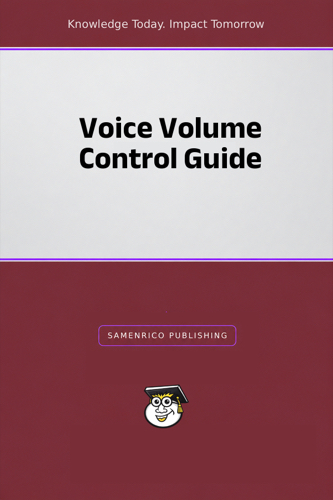
Voice Volume Control Guide Audiobook
Teaches reading loudness for confidence, softness
by Hawes Launa
Teaches reading loudness for confidence, softness for submission.
Formats
Free sample
Chapter 1: The Reptilian Hijack--–- The first time your voice betrayed you, you felt it in your throat. Not as pain, but as absence. The word you intended to speak arrived instead as a crack, a squeak, or a hollow whisper. You were standing in a room full of people—perhaps a meeting, perhaps a family dinner, perhaps a confrontation with someone who held power over you—and your voice simply left. Or it exploded.
You spoke too loudly, too harshly, and watched faces flinch. In that moment, you were not you. You were your brainstem.This chapter reveals a truth that most communication books avoid: you do not consciously control your volume. Your conscious mind selects the words, but a much older part of your brain—the periaqueductal gray (PAG), a tiny region deep in the midbrain—decides how loud those words will be. And the PAG does not care about your career, your relationships, or your dignity.
It cares about one thing: survival.The PAG is your reptilian volume dial. It evolved hundreds of millions of years ago, long before humans had language, long before the neocortex (the seat of rational thought) wrapped itself around your brain like a crown. In reptiles and early mammals, the PAG controlled vocalization as a life-or-death tool: a loud hiss to scare a predator, a quiet whimper to avoid detection, a sharp cry to summon the tribe. Those same circuits are still live in your skull. When you walk into a room and perceive a power gap—a boss who can fire you, a rival who intimidates you, a lover who might leave you—your PAG scans the environment, calculates threat level, and sets your volume before you have time to think.This is the reptilian hijack.
And until you understand it, you will never truly control your voice.The Neuroscience of the Unconscious Volume Dial Let us begin with anatomy. The periaqueductal gray is a column of gray matter surrounding the cerebral aqueduct in the midbrain. For decades, neuroscientists studying vocalization focused on the cortex—the "thinking" part of the brain—because language is uniquely human. But in the 1990s, researchers like Uwe Jürgens and John D. Newman demonstrated that decorticated animals (those whose cortex had been removed) could still produce vocalizations.
Cats without a cortex could still hiss. Monkeys without a cortex could still scream. What remained? The PAG.The PAG receives…
This is the end of the free sample. Get the Audiobook to keep going. Buy now
About this book
Details
- Author
- Hawes Launa
- Publisher
- SamEnrico
- Language
- English
- Genre
- Non-Fiction, Self-Help, Volume
- Released
- 2026-06-08
- Pages (approx.)
- 152
- Available as
- eBook, Audiobook

Listen in the VoxFlicks app
Audiobooks and audio dramas wherever you go. Sign in with your SamEnrico account and press play.
More by Hawes Launa
 Rewire Loneliness TalkHawes Launa$11.99
 American Nobel Science Dominance GuideHawes Launa$11.99
 Spending Black Friday SurvivalHawes Launa$11.99
 Death Valley Missing CasesHawes Launa$11.99
 The Chemistry Nobel RibozymesHawes Launa$11.99
 Mindfulness Of Daily ChoresHawes Launa$11.99
 Breaking the Work Binge CycleHawes Launa$11.99
 The Last King of the Andamans: The Forgotten Exile of Ross IslandHawes Launa$11.99
 Gandharva's Last Serenade: The Cursed Celestial MinstrelsHawes Launa$11.99
 The Mineral Guide to AcanthiteHawes Launa$11.99
 Growing Copiapoa Syn.pilocopiapoaHawes Launa$11.99
 Physical Chemistry Numerical WorkbookHawes Launa$12.99
You may also like
 Hong Kong Handover 1997Dunn Johnnie$11.99
 Zumba For Postnatal Recovery CourseNeal Christian$11.99
 Zumba for BeginnersLadner Nikia$11.99
 YouTube Comment Mining GuideHumes Pandora$12.99
 Worry Box MeditationCarlin Rudy$11.99
 Workplace Stress MeditationNguyen Lynn$11.99
 Workplace Stress and Sleep RepairHawley Ivory$11.99
 Workplace Perfectionism CureDelaney Jeffry$11.99
 Workplace Injustice Anger GuideWallen Isabelle$11.99
 Work Addiction and Burnout LinkGreenwood Ester$11.99
 Women in Yoga and WellnessBeattie Galina$11.99
 Women in Stand Up ComedyChun Evangeline$11.99