
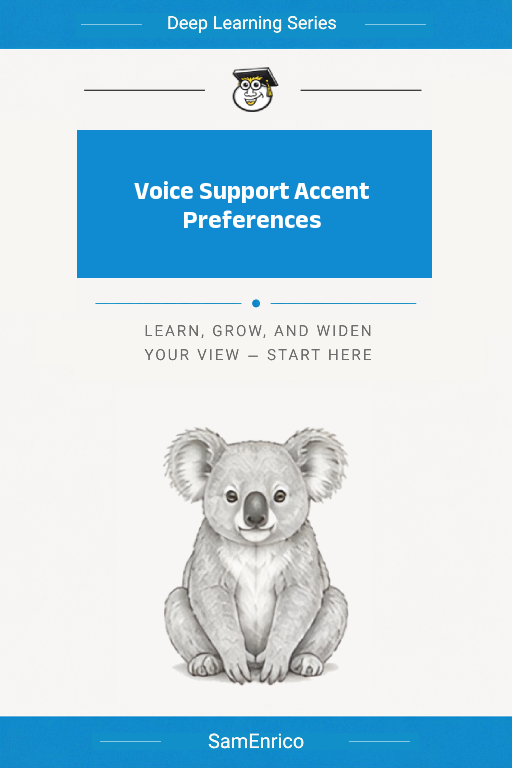
Voice Support Accent Preferences eBook
Survey customers on accent preference for voice su
Survey customers on accent preference for voice support, finding that Jamaican accents rate higher than Indian for US callers.
Formats
Free sample
Chapter 1: The Three-Second Judgment--You have already decided.Not about this book. Not about your coffee order or your evening plans. But about the person on the other end of the phone line—the one who just said “Thank you for calling customer support”—you have already decided whether they are competent, trustworthy, and worth your time. You made this decision in less time than it takes to blink. And you will never admit you made it.This is the Three-Second Judgment.
It is the most expensive unconscious bias in the history of customer service. It costs the United States economy over $5.5 billion every single year. And until you understand how it works, your call center—whether it employs ten people or ten thousand—is bleeding money you cannot see, into a hole you do not know exists.The experiment that proved this was simple, almost cruel in its simplicity. Researchers took a single customer service agent. They recorded her handling identical calls—same script, same problem, same resolution.
But in one recording, she spoke in her natural accent. In the other, she spoke in a carefully neutralized American accent. Then they played both recordings to hundreds of listeners, asking a single question: How competent is this agent?The natural accent version was rated as less competent every single time. Not just slightly less. Dramatically less.
And here is the detail that should terrify every contact center executive reading this book: the rating happened within the first three seconds of speech. Before the agent had solved anything. Before she had demonstrated any knowledge. Before she had even finished saying the word “calling.”Three seconds. That is all it takes for a customer to decide that you—your company, your brand, your product—are not to be trusted.The agent in that study did not speak with a heavy accent.
She was not difficult to understand. By any objective measure of intelligibility, she was perfectly clear. But her accent was not familiar to the listeners. And in the human brain, unfamiliarity triggers a cascade of cognitive shortcuts that end in one word: no.This is not racism, exactly. Or rather, it is not only racism.
It is cognitive efficiency. The human brain is a lazy organ. It evolved to conserve energy, not to seek truth. When you hear a voice that sounds like the voices you grew up hearing, your brain processes that voice with minimal effort. You feel calm.
You feel safe. You feel right.When you hear a voice that sounds different—even slightly different—your brain has to work harder. It has to decode sounds. It has to fill in gaps. It has to suppress the automatic “this is wrong” signal that fires whenever something deviates from the expected pattern.
That extra work feels like frustration. And frustration, in a customer service context, is deadly.The $5.5 Billion Figure Let us talk about that number. Five point five billion dollars. Annually. That is not a made-up statistic pulled from a consultant’s fever dream.
It is a conservative estimate based on audited data from sixteen major contact centers across telecommunications, banking, retail, and healthcare.Here is how the math works. Every time a customer hangs up and calls back because they “couldn’t understand” the agent, that is a repeat call. Every time a customer asks to be transferred to a supervisor, that is a transfer. Every time a customer abandons a call entirely and tries a different channel—chat, email, social media, or a competitor—that is a defection. Each of these outcomes has a measurable cost.The average call center handles about 1.2 million calls per year.
The average cost per call, fully loaded, is about 6.50.Thatis6.50. That is 6.50.Thatis7.8 million annually just in operating costs. Now add the hidden costs: repeat calls (which double the cost of resolution), supervisor escalations (which triple it), and customer churn (which can cost five to ten times the value of a single call when you factor in lifetime value).Across the sixteen contact centers in the study, accent-related friction accounted for between 6% and 14% of all call volume. That means millions of calls that should never have happened. Millions of dollars spent on problems that were already solved but had to be solved again because the customer felt like they could not understand the agent, even when objective intelligibility scores were fine.But the real cost is not in the call center budget.
The real cost is in customer loyalty. And loyalty is where this story gets interesting.The Great Offshore Betrayal In 2001, a major American telecommunications company—let us call them Telcom Giant—made a decision that seemed brilliant on paper. They moved 70% of their customer service operations to India. The labor cost savings were staggering: from 28perhourfora US−basedagentto28 per hour for a US-based agent to 28perhourfora US−basedagentto7 per hour for an Indian agent. The CFO presented a Power Point slide showing projected annual savings of $42 million.
The board approved unanimously.Within eighteen months, Telcom Giant had lost $210 million in customer lifetime value. They did not lose it because Indian agents were incompetent. They lost it because American customers, faced with unfamiliar accents during high-stress calls about dropped calls and billing errors, decided that the company no longer understood them. Not “understood their problem.” Understood them.The churn rate among customers who had called support more than twice in six months increased by 22%. The average customer who left had been with Telcom Giant for seven years.
Their lifetime value averaged $1,800. The company lost more than 115,000 of those customers before anyone in leadership connected the dots.When the post-mortem was finally conducted, the data was unambiguous. Customers who had spoken to an Indian-accented agent were 34% more likely to cancel their service within 90 days than customers who had spoken to a US-based agent. Not because the Indian agents were worse at solving problems—their first-call resolution rates were actually 4% higher than the US agents. But because the customers felt like the interaction was harder.
And feeling is believing.This is the dirty secret of customer service that no vendor will tell you: objective outcomes matter less than subjective experiences. You can solve a customer’s problem perfectly, but if they had to work to understand you, they will remember the work, not the solution.Telcom Giant eventually moved 40% of their calls back to US-based agents. They kept 30% in India for low-stakes, non-escalated issues. They opened a new center in Jamaica for the remaining 30%. The Jamaican center, which cost about the same as the Indian center, produced customer satisfaction scores nearly identical to the US center.
But that story—the Jamaican premium—is for Chapter 3.For now, the lesson is simple: cheap labor is expensive. And the expense does not show up on the P&L statement you are looking at today.The 35% Problem Here is a number that should keep you awake tonight. Thirty-five percent of American customers explicitly prefer to speak to a US-based agent. Not “would like” or “might prefer.” Explicitly. When asked directly, more than one in three say they want an agent who sounds like they are from the United States.Now here is the number that should make you furious.…
This is the end of the free sample. Get the eBook to keep going. Buy now
About this book
Details
- Author
- Beckman Willian
- Publisher
- SamEnrico
- Language
- English
- Genre
- Non-Fiction, Business Brief
- Released
- 2026-05-30
- Pages (approx.)
- 142
- Available as
- eBook, Audiobook

Read better in the ZLOADR app
Your eBooks on your phone or tablet. Sign in with your SamEnrico account and start reading.
More by Beckman Willian
 Pandemic Sales Pipeline RescueBeckman Willian$11.99
 Macros for PCOSBeckman Willian$11.99
 Museum Gallery Memory PathBeckman Willian$11.99
 My Adoption Day FinallyBeckman Willian$11.99
 Loving Kindness for Speech Language PathologistsBeckman Willian$11.99
 Grief and Taxes After SpouseBeckman Willian$11.99
 Cognitive Restructuring For DelayBeckman Willian$11.99
 Podcast Listening Weekly ReviewBeckman Willian$11.99
 Whispers in the Black Dust: The Vanished Children of the Great PlainsBeckman Willian$11.99
 Wolf of the Wilderness: Rogers' Rangers and the Birth of American Guerrilla WarfareBeckman Willian$11.99
 How to Start a Metallic Paint Business (Beginners Guide)Beckman Willian$11.99
 How to Produce Wig Glue and TapeBeckman Willian$11.99
You may also like
 Hong Kong Handover 1997Dunn Johnnie$11.99
 Zumba For Postnatal Recovery CourseNeal Christian$11.99
 Zumba for BeginnersLadner Nikia$11.99
 YouTube Comment Mining GuideHumes Pandora$12.99
 Worry Box MeditationCarlin Rudy$11.99
 Workplace Stress MeditationNguyen Lynn$11.99
 Workplace Stress and Sleep RepairHawley Ivory$11.99
 Workplace Perfectionism CureDelaney Jeffry$11.99
 Workplace Injustice Anger GuideWallen Isabelle$11.99
 Work Addiction and Burnout LinkGreenwood Ester$11.99
 Women in Yoga and WellnessBeattie Galina$11.99
 Women in Stand Up ComedyChun Evangeline$11.99