
Non-FictionBiographyLabor RightsActivism
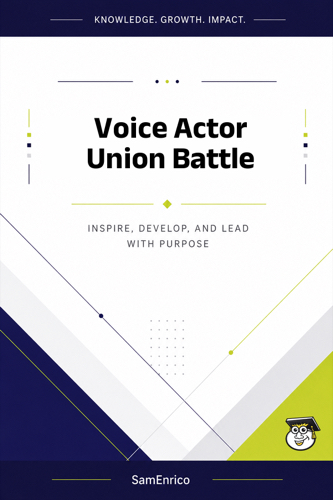
Voice Actor Union Battle eBook
Reveal the fight for fair pay and residuals in the
by Meza Sam
Reveal the fight for fair pay and residuals in the animation industry.
Formats
Free sample
Chapter 1: The Invisible Man...--–- In the spring of 1989, a 81-year-old man named Mel Blanc checked into Cedars-Sinai Medical Center in Los Angeles. He was not famous in the way that movie stars were famous. No paparazzi camped outside his room. No entertainment shows speculated about his condition. But if you had asked any American child under the age of twelve who made them laugh the hardest, the answer would have been, indirectly, this man.
Mel Blanc was the voice of Bugs Bunny, Daffy Duck, Porky Pig, Tweety Bird, Sylvester the Cat, Yosemite Sam, Foghorn Leghorn, Marvin the Martian, Pepe Le Pew, Speedy Gonzales, and approximately four hundred other characters. He was, by every conceivable measure, the most prolific voice actor in the history of the medium. And he was dying in a hospital room, worried about his mortgage.The irony was not lost on those who knew him. Blanc had spent fifty-three years making generations of children laugh. His characters had generated billions of dollars for Warner Bros.
His voice was so recognizable that people would stop him on the street not to ask for an autograph for Mel Blanc, but to ask him to "do the Bunny." He obliged, always, because he understood something that the studios never did: the voice was not a product. The voice was a relationship. When Bugs Bunny said "What's up, Doc?" in that nasal Brooklyn-accented drawl, audiences didn't hear a sound effect. They heard a personality. They heard mischief, confidence, and a sly工人阶级 wisdom that said the little guy could outsmart the powerful man every time.
That was Mel Blanc's gift. And for that gift, Warner Bros. had paid him as a day player.The Day Player's Bargain To understand why voice actors are fighting for residuals and fair pay in 2026, you must first understand the original sin of the industry. The original sin is this: from the very beginning, animation studios treated voice work as a technical craft rather than a performative art. A voice actor was not considered an "actor" in the same way that Humphrey Bogart or Katharine Hepburn was an actor.
A voice actor was considered a specialized technician, like a sound engineer or a Foley artist, who happened to use his larynx instead of a boom microphone. This distinction was not accidental. It was a legal and financial strategy designed to minimize compensation.In the 1930s and 1940s, when Blanc was building his menagerie at Warner Bros., the Screen Actors Guild (SAG) had already established minimum pay scales for on-screen talent. A featured actor in a live-action film earned a guaranteed daily rate, plus residuals for reruns, plus health and pension contributions. But SAG's jurisdiction was fuzzy when it came to animation.
Were voice actors "actors" if their faces never appeared on screen? The studios argued they were not. They argued that voice work was closer to radio broadcasting, which had its own separate union (AFTRA, the American Federation of Television and Radio Artists). This jurisdictional gray zone became a financial black hole.Blanc's contract with Warner Bros. was typical for the era.
He was paid by the session, usually a flat fee of $185 to $250 per recording session, regardless of how many characters he voiced in that session. He could voice Bugs, Daffy, and Porky in the same three-hour block and receive the same payment as a day player who voiced a single line as an anonymous background character. There were no residuals. No royalties. No health benefits.
No pension contributions. When Blanc's characters appeared in theatrical re-releases, television syndication, or merchandise, he received nothing additional. His voice was, in the legal language of his contract, a "work for hire." That meant Warner Bros. owned it completely, forever, including the right to use it without further payment.Blanc accepted these terms because there were no alternative terms to accept. He was not being exploited in the narrow sense of the word—he was paid fairly by the standards of the time, and he lived comfortably.
But the precedent set by his contract was catastrophic for everyone who came after him. The precedent was this: a voice actor's performance is a fungible commodity, not a unique artistic contribution. Fungible means interchangeable. A dollar bill is fungible because any dollar bill can replace any other dollar bill. A voice actor, under the Warner Bros.
contract, was treated as fungible because the studio believed any competent performer could replicate Bugs Bunny's laugh or Daffy Duck's lisp. They were wrong, of course. Blanc's genius was singular. But the legal framework they built assumed otherwise, and that framework would survive Blanc by decades.The Isolation Booth There was another factor that kept voice actors powerless during the golden age of animation: they worked alone. Unlike live-action actors, who gathered on soundstages with directors, cinematographers, other actors, and crew members, voice actors recorded in isolation.
They stood alone in a soundproof booth, sometimes with a window looking out at the recording engineer, often with nothing but a microphone and a script. They could not see the other actors they were supposedly interacting with. They could not feed off the energy of a live audience or a fellow performer. They could not build the kind of professional relationships that led to union organizing.This isolation was not accidental. Studios discovered early on that recording voice actors separately gave them more control over the final product.
If an actor made a mistake, the engineer could simply punch in a correction without stopping the entire session. If an actor was difficult, the studio could replace them without any other performer knowing. But the unintended consequence of this isolation was that voice actors never developed collective consciousness. A live-action actor walking through the Warner Bros. lot would see dozens of other actors, directors, writers, and crew members.
They would share stories about working conditions, compare pay rates, and discuss union grievances over lunch. Voice actors, by contrast, arrived at the studio, entered a booth, spoke into a microphone for three hours, and left. They rarely saw another actor. They had no one to compare notes with. They did not know what their colleagues were being paid.
And so they did not know they were being underpaid.Blanc himself was acutely aware of this problem. In interviews late in his life, he recalled asking a Warner Bros. executive why he couldn't record with the other voice actors, as they sometimes did for the radio shows. The executive told him it was "technically impractical." Blanc knew this was a lie. The real reason was that when voice actors recorded together, they started talking to each other.
And when they started talking, they started comparing contracts. And when they started comparing contracts, they started asking uncomfortable questions like "Why am I being paid half of what he's being paid for the same show?" The isolation booth was not just a technical necessity. It was a union-busting tool.The Screen Actors Guild's Blind Spot The Screen Actors Guild, now SAG-AFTRA after a merger with AFTRA in 2012, has always had a complicated relationship with voice actors. In the 1930s and 1940s, SAG was focused on winning basic protections for live-action actors…
This is the end of the free sample. Get the eBook to keep going. Buy now
About this book
Details
- Author
- Meza Sam
- Publisher
- SamEnrico
- Language
- English
- Genre
- Non-Fiction, Biography, Labor Rights, Activism
- Released
- 2026-06-10
- Pages (approx.)
- 144
- Available as
- eBook, Audiobook

Read better in the ZLOADR app
Your eBooks on your phone or tablet. Sign in with your SamEnrico account and start reading.
More by Meza Sam
 Exercising Through PerimenopauseMeza Sam$11.99
 Difficult Conversations In MinistryMeza Sam$11.99
 Teen Job Confidence BuildingMeza Sam$11.99
 The Gratitude Letter Practice GuideMeza Sam$11.99
 Tamerlane's Shadow: The Conqueror Who Built an Empire on BonesMeza Sam$11.99
 UK Ltd for Foreign FoundersMeza Sam$12.99
 Freelance Bookkeeping Portfolio BuildingMeza Sam$12.99
 Understanding Yellow FeverMeza Sam$17.99
 How to Become a Locomotive-crane OperatorMeza Sam$11.99
 The Metaverse MarriageMeza Sam$11.99
You may also like
 Hong Kong Handover 1997Dunn Johnnie$11.99
 Zumba For Postnatal Recovery CourseNeal Christian$11.99
 Zumba for BeginnersLadner Nikia$11.99
 YouTube Comment Mining GuideHumes Pandora$12.99
 Worry Box MeditationCarlin Rudy$11.99
 Workplace Stress MeditationNguyen Lynn$11.99
 Workplace Stress and Sleep RepairHawley Ivory$11.99
 Workplace Perfectionism CureDelaney Jeffry$11.99
 Workplace Injustice Anger GuideWallen Isabelle$11.99
 Work Addiction and Burnout LinkGreenwood Ester$11.99
 Women in Yoga and WellnessBeattie Galina$11.99
 Women in Stand Up ComedyChun Evangeline$11.99