
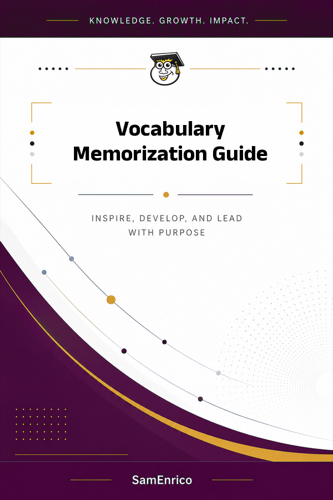
Vocabulary Memorization Guide eBook
Learn foreign language words using association and
by Goss Phoebe
Learn foreign language words using association and repetition.
Formats
Free sample
Chapter 1: The Forgetting Trap--–- It happens to every language learner. You spend twenty minutes carefully studying a list of ten new words. You repeat them out loud. You write them down. You feel confident.
Then, forty-eight hours later, you stare at a flashcard for the word you “definitely knew” and draw a complete blank. The shape of the word is there somewhere, buried under layers of vague recognition, but the meaning refuses to surface. You flip the card. Oh, right. That one.
And then you do something strange: you tell yourself that you have a bad memory.This is the lie that has wasted more hours of language study than any other. The belief that some people are born with “good memories” and others with “bad memories” is not just inaccurate—it is actively harmful. It turns a solvable problem into an identity. You stop asking “What should I change about my method?” and start accepting “I’m just not good at this.” The first and most important truth of this book is simple: there are no bad memories. There are only untrained memories and poorly chosen techniques.Consider this.
In study after study, researchers have shown that average people can perform extraordinary memory feats after just a few weeks of training. In one famous experiment, a student with an unremarkable memory improved so dramatically that he could recall the order of 80 random numbers after hearing them once. He was not a genius. He was not born with a photographic memory. He simply learned to use a technique you will learn in Chapter 5 of this book.
The same principle applies to vocabulary. The difference between someone who remembers 95 percent of what they learn and someone who remembers 20 percent is almost never innate ability. It is method.So if you have ever said any of the following, this chapter is for you: “I can study a word ten times and still forget it.” “I’m fine with recognition, but recall is impossible.” “I learn a word, and three days later it’s gone.” These are not symptoms of a defective memory. They are symptoms of a defective system. And the defect has a name: the forgetting curve.THE DISCOVERY THAT CHANGED MEMORY SCIENCEIn the 1880s, a German psychologist named Hermann Ebbinghaus did something no one had thought to do before.
He decided to study forgetting scientifically. Before Ebbinghaus, memory was treated as something mysterious, almost spiritual—a gift rather than a process. Ebbinghaus believed that forgetting followed predictable rules, and he set out to find them using himself as the only subject.He created hundreds of nonsense syllables—meaningless three-letter combinations like RUK, POF, and ZID—so that his prior knowledge could not help him remember them. Then he memorized lists of these syllables and tested himself at different intervals: twenty minutes later, one hour later, nine hours later, one day later, two days later, and so on. He did this thousands of times, meticulously recording how much he forgot and when.The result was the Forgetting Curve, one of the most replicated findings in the history of psychology.
Ebbinghaus discovered that forgetting is not linear. It does not happen slowly and steadily over time. Instead, forgetting is brutally fast at first, then dramatically slows down. His data showed that within twenty minutes of learning a list of nonsense syllables, he had forgotten nearly half of them. Within one hour, he had forgotten more than half.
Within twenty-four hours, he had forgotten roughly two-thirds. After that, the forgetting slowed considerably, but the damage was already done.Here is what that means for you. When you study ten new vocabulary words today, you will likely forget five of them within the first hour. By tomorrow morning, you will remember only three or four. By the end of the week, if you do nothing, you will be lucky to remember two.
This is not because you are lazy or distracted or unintelligent. This is because the human brain was not designed to remember arbitrary information like foreign vocabulary. It was designed to remember where food was located, which paths were safe, and who in your tribe could be trusted. Vocabulary is an unnatural task for your brain, and your brain responds by deleting it aggressively unless you intervene.The mistake most learners make is assuming that simply repeating a word enough times in a single sitting will override the forgetting curve. They sit down with a list of words and repeat each one twenty times.
They feel a sense of accomplishment. They close the book. And twenty-four hours later, they have lost most of what they “learned.” Why? Because the forgetting curve does not care how many times you repeated a word in one session. It cares about the timing of those repetitions.WHY CRAMMING IS MATHEMATICALLY INEFFICIENTLet us be precise about why cramming fails.
When you study a word for the first time, you create a fragile neural pathway. That pathway begins to decay immediately. The decay is exponential: the strongest decay happens in the first few hours, then the decay rate slows. To prevent the pathway from disappearing, you need to reactivate it just before it would have decayed beyond recall.Cramming does the opposite. Cramming repeats the same information many times while the pathway is still strong—wasting those repetitions—and then stops completely while the pathway is decaying.
Imagine trying to keep a fire burning by pouring all your wood on it in the first five minutes, then walking away for a week. That is cramming. You use your limited repetition budget inefficiently because you cluster your repetitions too closely together and then leave a long gap of no repetitions at all.The numbers make this painfully clear. Suppose you have one hour to spend on vocabulary this week. You could use that hour to cram on Sunday afternoon: sixty minutes of intense repetition, after which you feel temporarily fluent.
By the following Sunday, based on Ebbinghaus’s curve, you will remember roughly 20 percent of what you crammed. You spent sixty minutes to retain 20 percent.Or you could distribute that same hour across the week: ten minutes on Monday, ten on Tuesday, ten on Wednesday, ten on Thursday, ten on Friday, ten on Saturday. On Monday, you learn the words. On Tuesday, you review them just as they were about to be forgotten. Each review strengthens the pathway and resets the decay clock.
By Sunday, with the same total study time of one hour, you will remember roughly 80 to 90 percent of what you learned. Identical effort. Wildly different results.This is not a small difference. This is the difference between feeling like you “can’t learn languages” and feeling like you have a superpower. The only variable that changed was the timing of the repetitions.
Not your intelligence. Not your age. Not your “natural talent” for languages. Just timing.RECOGNITION VERSUS RECALL: THE HIDDEN TRAPBefore we go further, we need to distinguish between two kinds of memory that feel similar but are neurologically distinct. The first is recognition.
Recognition is what happens when you see a word and think, “Oh yes, I know that one.” Multiple-choice tests measure…
This is the end of the free sample. Get the eBook to keep going. Buy now
About this book
Details
- Author
- Goss Phoebe
- Publisher
- SamEnrico
- Language
- English
- Genre
- Non-Fiction, Self-Help, Language
- Released
- 2026-06-09
- Pages (approx.)
- 142
- Available as
- eBook, Audiobook

Read better in the ZLOADR app
Your eBooks on your phone or tablet. Sign in with your SamEnrico account and start reading.
More by Goss Phoebe
 The Family Incest TruthGoss Phoebe$11.99
 Neonatal ICU Nurse StressGoss Phoebe$11.99
 Blackout Curtains for Day SleepersGoss Phoebe$11.99
 Gymnast Self Hypnosis GuideGoss Phoebe$11.99
 CPR for Fitness CentersGoss Phoebe$11.99
 Active Listening Under PressureGoss Phoebe$11.99
 Action Planning for FirefightersGoss Phoebe$11.99
 The Billionaire's Floating City: The Rise and Fall of the World's Most Expensive YachtGoss Phoebe$11.99
 The Scholastic Crown of Europe: The Rise of the Medieval UniversityGoss Phoebe$11.99
 Oleiformis Pers Fodder Radish: Oil Radish Harvesting For Green ManureGoss Phoebe$11.99
 Three Platform Listing Optimization PrimerGoss Phoebe$12.99
 How to Produce ElasticGoss Phoebe$11.99
You may also like
 Hong Kong Handover 1997Dunn Johnnie$11.99
 Zumba For Postnatal Recovery CourseNeal Christian$11.99
 Zumba for BeginnersLadner Nikia$11.99
 YouTube Comment Mining GuideHumes Pandora$12.99
 Worry Box MeditationCarlin Rudy$11.99
 Workplace Stress MeditationNguyen Lynn$11.99
 Workplace Stress and Sleep RepairHawley Ivory$11.99
 Workplace Perfectionism CureDelaney Jeffry$11.99
 Workplace Injustice Anger GuideWallen Isabelle$11.99
 Work Addiction and Burnout LinkGreenwood Ester$11.99
 Women in Yoga and WellnessBeattie Galina$11.99
 Women in Stand Up ComedyChun Evangeline$11.99