
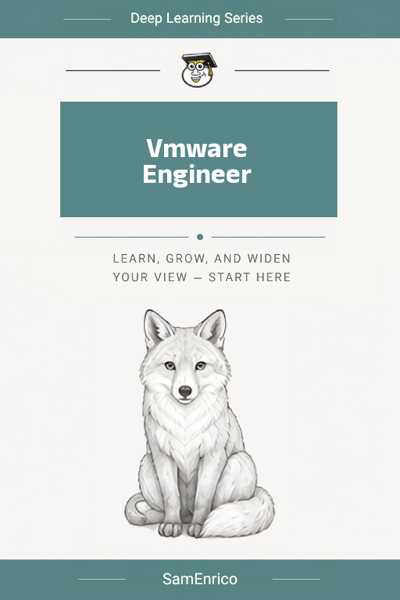
Non-FictionInformativeEducational
Vmware Engineer eBook
A Coursebook on Vmware Engineer
A Coursebook on Vmware Engineer
Formats
Free sample
Chapter 1: The Five Pillars–- The phone rang at 2:17 AM on a Tuesday. Not the desk phone—that would have been too formal. It was the on-call mobile, buzzing against the nightstand like an angry hornet. The caller ID showed “NOC - Emergency Line.” You answer, still half-asleep, and a voice on the other end says the words no virtualization engineer ever wants to hear: “The entire finance cluster is down. All fifty VMs.
No one can process payments. The CFO is already on the warpath.”This is not a certification exam question. There is no multiple choice. There is no “next” button to click. There is only you, a flashing red v Sphere client, and a building full of people who have forgotten that virtualization is supposed to make things more reliable, not less.
You log in. You see that three out of four ESXi hosts are disconnected. The fourth is running, but its CPU ready time is spiking to 30%. You have no idea why. The last engineer who touched this environment left six months ago, and the documentation is a single text file that says “Everything works fine.”This moment—this 2:17 AM panic—is the difference between an administrator and an engineer.
An administrator knows how to click through the v Center interface to create a VM. An engineer knows why that VM falls over at 2 AM, how to design a cluster that survives the loss of three hosts, and when to say “no” to a request for a 32-v CPU VM because the math doesn’t work. This book is not about teaching you to pass the VCP exam, though it will help. This book is about teaching you to be the person whose phone doesn’t ring at 2:17 AM—because you engineered the infrastructure to handle failure before it happened.Welcome to the mindset of a VMware engineer. Let’s start with the framework that will guide every decision you make from this chapter forward: the Five Pillars of Engineering.The 2:17 AM Test – Why Most VMware Training Fails Before we define the pillars, let’s diagnose the problem with how most people learn VMware.
The typical path looks like this: you buy a certification guide, memorize the steps for creating a distributed switch, practice deploying a VM from a template, and then take a multiple-choice exam. You pass. You get the VCP credential. You feel invincible.Then reality hits.Your first production environment has 200 VMs, not the 10 you practiced with. The storage array is from a vendor you’ve never heard of.
The network team configured the switches with MTU 1500 instead of 9000, and no one told you. The previous administrator set CPU reservations on every single VM because “it seemed like a good idea.” And now, at 2 AM, all of that complexity collapses into a single question: Why is this broken?Most training fails because it teaches you what to click, but not how to think. It teaches you features, not trade-offs. It gives you recipes, not a cooking philosophy. This chapter—and this book—flips that model.
Instead of starting with “how to install ESXi,” we start with “how to design infrastructure that doesn’t need rescue.” The Five Pillars are your mental checklist. Every decision you make as an engineer should trace back to one or more of these pillars. If a decision weakens a pillar without strengthening another, it is probably the wrong decision.Let me tell you about a real engineer I once worked with, let’s call her Priya. Priya inherited a v Sphere environment that crashed every single month during the end-of-quarter financial close. The previous administrator had blamed “storage latency” for two years.
Priya didn’t guess. She systematically evaluated each pillar. She found that availability was fine (HA worked), security was fine (firewalls locked down), scalability was fine (plenty of capacity), but performance and manageability were broken. The storage policy was misconfigured—striping set to 12 instead of 1—causing every write to fan out across a dozen disks. And there was no monitoring, so no one knew until the batch jobs failed.
Priya fixed the storage policy in one hour and deployed v Realize Operations in one week. The crashes stopped. She became the senior engineer. That is what the Five Pillars can do for you.Pillar One: Availability – The Art of Not Falling Over Availability is the simplest pillar to understand and the hardest to implement correctly. It answers one question: When something fails, does the workload keep running?
Note the phrase “when something fails,” not “if something fails.” In engineering, we assume failure. Disks fail. Power supplies fail. Network cables get chewed by rodents (I have seen this). Racks get mis-wired during maintenance.
A contractor trips over a power cord. These are not edge cases; they are daily reality in any data center of meaningful size.Availability in VMware engineering is not just about turning on High Availability in a cluster. That is the minimum, not the goal. Real availability engineering considers multiple layers of failure:At the host level, availability means designing so that no single ESXi host is a single point of failure. If you have one host running a critical VM, you have already lost.
The solution is clustering, but clustering alone is not enough. You must also consider affinity and anti-affinity rules—do you want two VMs on the same host for performance (affinity) or on different hosts so that a single host failure doesn’t take down both (anti-affinity)? There is no right answer for all cases. A web server pair might need anti-affinity so that load balancing works during a host failure. A database cluster might need affinity to reduce network latency between nodes.
Trade-offs.At the network level, availability means redundant NICs, redundant upstream switches, and LACP teaming policies that actually survive a switch failure. I have seen environments where the network team configured active/standby NICs but plugged both into the same physical switch. When that switch died, the host lost all connectivity despite having “redundant” NICs. That is not availability; that is theater. True availability requires diverse paths: different switches, different power circuits, sometimes different network rooms.At the storage level, availability means multipathing.
Whether you use Fibre Channel, i SCSI, or v SAN, you need at least two paths from each host to each LUN or datastore. But multipathing alone is not enough; you must also configure the path selection policy (PSP) correctly. The default, Most Recently Used (MRU), is safe but not optimal for performance. Round Robin (RR) balances load but requires monitoring to ensure you aren’t overwhelming your storage array. Fixed pathing gives you control but requires manual failover.
Each choice is a trade-off.At the control plane level, availability means v Center High Availability (VCHA) or at least a robust backup and restore strategy for the v Postgres database. Many engineers spend all their time protecting workloads and none protecting the manager. Then v Center corrupts its database, and suddenly you cannot manage any of your highly available workloads because the management interface is gone. That is like building a fireproof safe but losing the key.The gold standard for availability is Fault Tolerance (FT)…
This is the end of the free sample. Get the eBook to keep going. Buy now
About this book
Details
- Author
- Eldridge Cherri
- Publisher
- SamEnrico
- Language
- English
- Genre
- Non-Fiction, Informative, Educational
- Released
- 2026-05-07
- Pages (approx.)
- 153
- Available as
- eBook, Audiobook

Read better in the ZLOADR app
Your eBooks on your phone or tablet. Sign in with your SamEnrico account and start reading.
More by Eldridge Cherri
 LGBTQ Charity Fraud Investigation HandbookEldridge Cherri$11.99
 Blue Zone Seaweed And Fish GuideEldridge Cherri$11.99
 Food Addiction for Family MembersEldridge Cherri$11.99
 Gym Small Talk GuideEldridge Cherri$11.99
 The Vegetable Prep GuideEldridge Cherri$11.99
 Fafnir's Last Roar: The Dragon Who Became GoldEldridge Cherri$11.99
 How to Start a Photo Engraving Business (Beginners Guide)Eldridge Cherri$11.99
 Understanding Wilkie–Taylor–scambler SyndromeEldridge Cherri$17.99
 Ghana VC Firms GuideEldridge Cherri$12.99
 Founder Disclosure to CofoundersEldridge Cherri$12.99
You may also like
 Hong Kong Handover 1997Dunn Johnnie$11.99
 Zumba For Postnatal Recovery CourseNeal Christian$11.99
 Zumba for BeginnersLadner Nikia$11.99
 YouTube Comment Mining GuideHumes Pandora$12.99
 Worry Box MeditationCarlin Rudy$11.99
 Workplace Stress MeditationNguyen Lynn$11.99
 Workplace Stress and Sleep RepairHawley Ivory$11.99
 Workplace Perfectionism CureDelaney Jeffry$11.99
 Workplace Injustice Anger GuideWallen Isabelle$11.99
 Work Addiction and Burnout LinkGreenwood Ester$11.99
 Women in Yoga and WellnessBeattie Galina$11.99
 Women in Stand Up ComedyChun Evangeline$11.99