
Non-FictionHealth & WellnessAntioxidant
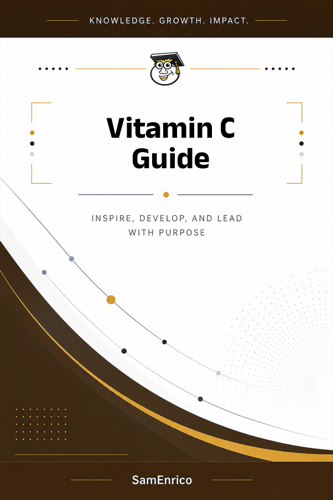
Vitamin C Guide eBook
Explains antioxidant role, collagen synthesis, and
Explains antioxidant role, collagen synthesis, and scurvy.
Formats
Free sample
Chapter 1: The Sailors' Curse...--–- In 1740, Commodore George Anson set sail from England with six ships and nearly 2,000 men. His mission: to harass Spanish shipping and seize treasure in the Pacific. Four years later, he returned with one ship and 145 men. Not a single sailor had died in battle. The enemy that had decimated Anson's fleet was not Spanish cannon fire but an invisible, silent killer that had haunted maritime exploration for centuries.
The men had not been shot, stabbed, or drowned. They had rotted alive.Their gums swelled into spongy, purple masses that bled at the slightest touch. Old wounds tore open. Bones that had healed decades earlier suddenly cracked and splintered for no reason. Teeth loosened and fell out.
Skin erupted in bruises without any remembered impact. The sailors became so weak that lifting a cup of water required two hands. Many simply lay down and never rose again. Those who survived wrote of a profound hopelessness, a darkness that settled into the soul long before the body gave out.The disease had many names—the scourge of the sea, the maritime plague, the sailor's grief—but the medical world called it scurvy. And for more than two centuries, no one understood what caused it or why it responded, seemingly miraculously, to fresh fruits and vegetables.
This chapter traces that mystery from the Age of Sail to the Nobel Prize, introducing the molecule that would eventually reveal itself as one of the most essential compounds in human biology.The Age of Scurvy To understand why vitamin C matters, you must first understand what happens without it. Scurvy was not a rare or exotic disease. It was the single greatest cause of maritime death between 1500 and 1800. Historians estimate that scurvy claimed more than two million sailors during the Age of Exploration—more than all naval battles, shipwrecks, and storms combined. On long voyages, the attrition rate was staggering.
Vasco da Gama's first voyage to India in 1497 lost 55 percent of his crew to scurvy. Magellan's circumnavigation lost 80 percent. Even as late as the early nineteenth century, the British Royal Navy was losing more men to scurvy each year than to the French Navy.The tragedy was compounded by confusion. Ships carried lemons, limes, sauerkraut, and other antiscorbutics (the term means "against scurvy") without any systematic understanding of why they worked. Captains experimented with everything from cider and malt to sulfuric acid and vinegar.
Some treatments seemed to work; others did not. The randomness of these observations reflected a deeper ignorance: no one yet knew that scurvy was a deficiency disease. The concept of vitamins did not exist. The idea that a missing dietary component could kill you slowly and spectacularly was outside the framework of eighteenth-century medicine.The Breakthrough That Was Ignored In 1747, a Scottish naval surgeon named James Lind conducted one of the first controlled clinical trials in medical history. Aboard HMS Salisbury, he selected twelve sailors suffering from scurvy with similar symptoms.
He divided them into six pairs and gave each pair a different treatment: cider, elixir of vitriol (diluted sulfuric acid), vinegar, seawater, a paste of garlic and horseradish, or two oranges and one lemon daily. The pair receiving citrus fruits improved dramatically within six days. One of them returned to duty shortly thereafter. Lind had found the cure.Yet his 1753 treatise, A Treatise of the Scurvy, was largely ignored. The problem was not the evidence but the paradigm.
Lind himself did not fully grasp his own discovery. He believed citrus worked because of its "power to resist putrefaction," not because it contained an essential nutrient. Moreover, citrus fruits were expensive and spoiled quickly. The British Navy experimented with concentrated "robur" (a boiled-down juice) that had no antiscorbutic effect because heat destroyed the active compound. For decades, confusion reigned.It was not until 1795 that the Royal Navy finally adopted a daily ration of lemon juice for all sailors, based on the persistent advocacy of Admiral Lord St.
Vincent and the physician Sir Gilbert Blane. The results were immediate and dramatic. Between 1795 and 1815, the Royal Navy issued 1.6 million gallons of lemon juice and virtually eliminated scurvy. Britain's naval supremacy in the Napoleonic Wars was built not on cannons alone but on citrus. British sailors earned the nickname "limeys" not from limes (which were later substituted and were less potent) but from this practice.
The scurvy plague had been conquered without anyone understanding the underlying biochemistry.The Last Piece of the Puzzle The nineteenth century brought the rise of germ theory and bacteriology. Nutrition research took a backseat to infectious disease. Scurvy was increasingly seen as a problem of the past, a quaint footnote to the Age of Sail. But scurvy had not disappeared. It persisted in isolated populations, in Arctic expeditions, in prisons and asylums, and among the urban poor who lived on bread and tea.
In 1897, a Dutch physician named Christiaan Eijkman observed that chickens fed polished rice developed beriberi, while chickens fed unpolished rice remained healthy. He had discovered a deficiency disease caused by removing the outer layer of the grain—but he mistakenly believed the outer layer contained an "antidote" to a toxin in the polished rice.The true breakthrough came from multiple directions. In 1907, two Norwegian physicians, Axel Holst and Theodor Frølich, induced scurvy in guinea pigs by feeding them a grain-only diet. This was crucial because guinea pigs, like humans, cannot synthesize their own vitamin C. (Most other laboratory animals, including rats and mice, produce their own and never develop scurvy no matter what they eat.) Holst and Frølich had created a reliable animal model for the disease.Over the next two decades, researchers gradually isolated the active principle.
In 1928, the Hungarian biochemist Albert Szent-Györgyi isolated a compound from adrenal glands, citrus fruits, and cabbage that he initially called "hexuronic acid." He had no idea it was the antiscorbutic factor. He was studying cellular respiration. By chance, he sent a sample to J. L. Svirbely, a former student of Szent-Györgyi's who was now working with the American researcher Charles Glen King at the University of Pittsburgh.
King's lab had been systematically testing fractions of lemon juice for antiscorbutic activity in guinea pigs. Svirbely tested Szent-Györgyi's hexuronic acid and found that it cured scurvy.In a remarkable coincidence, both groups published their findings in the same month of 1932. The antiscorbutic factor had a new name: ascorbic acid, from the Latin *a-* (without) and scorbutus (scurvy). Szent-Györgyi received the Nobel Prize in Physiology or Medicine in 1937 for his work on biological combustion, with special mention of vitamin C. The sailor's curse had finally been identified.The GULO Gene: Why We Are Broken Now we arrive at the central evolutionary mystery of vitamin C.
Most animals do not need to consume it. Rats, mice, dogs, cats, horses, cows, and nearly all mammals produce their own vitamin C from glucose in a four-step enzymatic pathway. The pathway converts glucose to glucuronic acid, then to L-gulonolactone, and finally—via the enzyme L-gulonolactone oxidase (GULO)—to ascorbic acid. A rat produces about 200 milligrams of vitamin C per kilogram of body weight per day, scaled up to human weight, that would be roughly 10,000…
This is the end of the free sample. Get the eBook to keep going. Buy now
About this book
Details
- Author
- Butterfield Kimbery
- Publisher
- SamEnrico
- Language
- English
- Genre
- Non-Fiction, Health & Wellness, Antioxidant
- Released
- 2026-06-05
- Pages (approx.)
- 150
- Available as
- eBook, Audiobook

Read better in the ZLOADR app
Your eBooks on your phone or tablet. Sign in with your SamEnrico account and start reading.
More by Butterfield Kimbery
 Walking Meditation in the HospitalButterfield Kimbery$11.99
 Pet Loss KeepsakesButterfield Kimbery$11.99
 Dream Body Sensations LogButterfield Kimbery$11.99
 10 Year Goal Backwards PlanButterfield Kimbery$11.99
 The Major System for NumbersButterfield Kimbery$11.99
 Names and Faces Memory SystemButterfield Kimbery$11.99
 Cultural Differences TalksButterfield Kimbery$11.99
 The Celestial Weavers: Africa's Astronomers of the StarsButterfield Kimbery$11.99
 The River of Fire: Dien Bien Phu's Shadow WarButterfield Kimbery$11.99
 A Collector's Handbook to the Lanchester SpriteButterfield Kimbery$11.99
 Payment Timing OptimizationButterfield Kimbery$12.99
 Cooperative Warehouse Receipt GuideButterfield Kimbery$12.99
You may also like
 Hong Kong Handover 1997Dunn Johnnie$11.99
 Zumba For Postnatal Recovery CourseNeal Christian$11.99
 Zumba for BeginnersLadner Nikia$11.99
 YouTube Comment Mining GuideHumes Pandora$12.99
 Worry Box MeditationCarlin Rudy$11.99
 Workplace Stress MeditationNguyen Lynn$11.99
 Workplace Stress and Sleep RepairHawley Ivory$11.99
 Workplace Perfectionism CureDelaney Jeffry$11.99
 Workplace Injustice Anger GuideWallen Isabelle$11.99
 Work Addiction and Burnout LinkGreenwood Ester$11.99
 Women in Yoga and WellnessBeattie Galina$11.99
 Women in Stand Up ComedyChun Evangeline$11.99