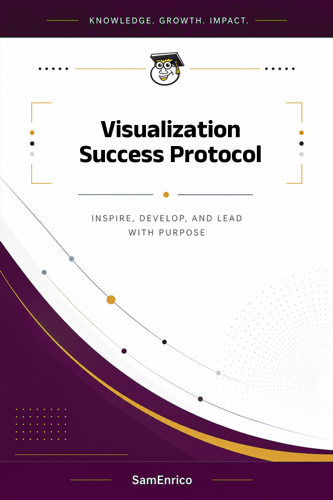
Visualization Protocol For Talks eBook
Rehearse success mentally to prime your brain for
Rehearse success mentally to prime your brain for confident delivery.
Formats
Free sample
Chapter 1: The Rehearsal Lie–- Every speaker has heard it a thousand times: “Practice makes perfect.” But no one tells you that most practice is useless. Worse, some practice actually makes you worse.You stand in your living room, alone, reciting your opening line for the twentieth time. Your cat watches from the sofa. The words flow smoothly. Your voice sounds reasonable.
You feel, for a moment, almost ready.Then you walk into the actual room. Forty-seven faces turn toward you. The lights feel hotter than you imagined. Someone coughs. Your carefully rehearsed opening vanishes like smoke.
What comes out of your mouth is a strained, rushed version of what you practiced—if anything comes out at all.This is not a failure of effort. It is a failure of understanding.For years, speakers have been sold a lie: that the best way to prepare for a talk is to stand alone in a quiet room and say the words out loud, over and over, until they feel automatic. This lie is seductive because it feels productive. You can check a box: “Rehearsed for two hours.” You can feel the soreness in your throat and call it progress.But the evidence tells a different story. Physical rehearsal alone—repeating your words in a neutral environment—does almost nothing to prepare your brain for the chaos of a live audience.
In fact, it can actively harm your performance by creating a false sense of security that shatters the moment reality differs from your practice conditions.This chapter reveals the rehearsal lie in full. You will learn why your brain treats your living room and a conference stage as completely different planets. You will discover the neuroscience of why worry works like rehearsal—just the wrong kind. And you will begin to understand the single most important shift you can make in your preparation: moving from physical repetition to mental simulation.The truth is uncomfortable but liberating. You have not been failing at practice.
You have been practicing the wrong thing.The Living Room Problem Consider two speakers. Both have a forty-five-minute presentation to deliver to two hundred people. Both have prepared their slides and know their content.Speaker A does what most people do. She stands in her home office, clicks through her slides, and says her words out loud. She repeats the talk seven times over three days.
By the final run-through, she can deliver the entire presentation without looking at her notes. She feels confident. She has practiced.Speaker B does something else entirely. He spends the same three days not speaking out loud, but sitting quietly with his eyes closed. He imagines the actual room: the size, the lighting, the temperature.
He imagines specific faces in the front row. He imagines the sound of his voice through a microphone, the feeling of the clicker in his hand, the smell of coffee from the audience’s travel mugs. He imagines a phone ringing and himself pausing calmly. He imagines applause at the end.Who is better prepared?Most people would say Speaker A. She has “done the work.” She has physical proof of her effort—recordings, notes, a hoarse voice.
Speaker B, by contrast, appears to have done nothing at all. He sat in a chair with his eyes closed.But research on performance under pressure tells a shocking story. When tested in high-stakes conditions, Speaker A often performs worse than someone who did no rehearsal at all. Why? Because her brain learned the talk in a low-stakes, quiet, familiar environment.
When the environment changed—lights, noise, faces, pressure—her brain could not generalize. The neural pathways she built were tied to her living room. They did not transfer.Speaker B, however, built neural pathways tied to the experience he would actually have. His brain had already walked onto that stage, heard that cough, felt that clicker. When reality matched his mental simulation, his brain responded as if it had done it all before.This is the living room problem.
Physical rehearsal in a safe, quiet, familiar environment teaches your brain to perform in that environment only. And you will never give your talk in that environment.The Neuroscience of Mental Simulation To understand why mental rehearsal works and physical rehearsal alone fails, you need to understand a remarkable property of your brain: it cannot reliably distinguish between a vividly imagined experience and a real one.This is not a metaphor or a motivational slogan. It is a neurological fact.Mirror neurons, discovered by Italian neuroscientists in the 1990s, fire identically whether you perform an action or watch someone else perform it. The same neurons activate when you swing a tennis racket and when you watch Serena Williams swing a tennis racket. Your brain simulates the action internally without your muscles moving.But the discovery goes further.
Subsequent research showed that mirror neurons also fire when you imagine performing an action in first-person perspective. Close your eyes and vividly imagine picking up a cup of coffee. Your motor cortex activates. Your sensory cortex activates. Your brain generates a weak version of the real signal.This is not imagination as fantasy.
This is imagination as neural rehearsal.The motor cortex plans and executes movement. When you visualize yourself gesturing during a talk, your motor cortex activates as if you were actually gesturing. The auditory cortex processes sound. When you visualize your voice filling a room, your auditory cortex activates. The somatosensory cortex processes touch and body position.
When you visualize your hand on a podium, this region activates. The amygdala and insula process emotion. When you visualize the anxiety of walking on stage, these regions activate—which is why worrying feels so real.The key insight is this: your brain does not have a special “imagination mode” that is separate from “reality mode.” It has one set of neural circuits. Those circuits fire based on sensory input from the outside world or sensory input from internal memory and imagination. The brain processes both.
The only difference is intensity.This is why elite performers in every field—Olympic athletes, concert musicians, trauma surgeons, fighter pilots—spend as much or more time on mental rehearsal as on physical practice. They are not being mystical. They are being efficient. They have learned that one hour of vivid, multi-sensory mental rehearsal can be as effective as three hours of physical practice, because the mental version trains the same neural pathways without the fatigue, risk, or environmental mismatch of physical practice.The Olympic Athlete Study The most famous study on mental rehearsal comes from Russian Olympic athletes in the 1980s. Sports psychologists divided athletes into four groups:Group 1 practiced physically for 100% of their training time.Group 2 practiced physically for 75% of their time and mentally for 25%.Group 3 practiced physically for 50% of their time and mentally for 50%.Group 4 practiced physically for 25% of their time and mentally for 75%.The results shocked the sports world.
Group 4—the athletes who spent most of their time imagining their performance—improved the most. They showed greater gains in speed, accuracy, and consistency than athletes who spent all their time on the field or in the gym.How is this possible? Because physical practice has…
This is the end of the free sample. Get the eBook to keep going. Buy now
About this book
Details
- Author
- Armstrong Lindsay
- Publisher
- SamEnrico
- Language
- English
- Genre
- Non-Fiction, Mental Wealth, Visualization
- Released
- 2026-06-06
- Pages (approx.)
- 141
- Available as
- eBook, Audiobook

Read better in the ZLOADR app
Your eBooks on your phone or tablet. Sign in with your SamEnrico account and start reading.
More by Armstrong Lindsay
 Feynman Woman in PhysicsArmstrong Lindsay$11.99
 DoorDash Peak Pay DecoderArmstrong Lindsay$11.99
 The Model Overdose ConfessionArmstrong Lindsay$11.99
 The Recovery Capital CourseArmstrong Lindsay$11.99
 Remote Fundraising CommunicationArmstrong Lindsay$11.99
 Growth Hormone Myths DebunkedArmstrong Lindsay$11.99
 Blood Moon Standstill: The 2019 Hong Kong SiegeArmstrong Lindsay$11.99
 The Complicated Parent GriefArmstrong Lindsay$11.99
 Cannabis and MemoryArmstrong Lindsay$11.99
 The Last Oracle of Delphi: Prophecy, Power, and the Fall of a Divine InstitutionArmstrong Lindsay$11.99
 The Linguistic Architects of Timbuktu: Decoding the World's WisdomArmstrong Lindsay$11.99
 Understanding Bacterial GastroenteritisArmstrong Lindsay$17.99