
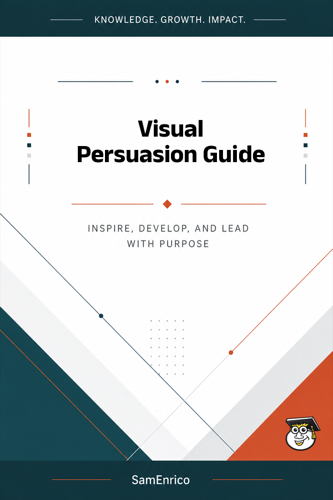
Non-FictionSelf-HelpVisual Design
Visual Persuasion Guide eBook
Use images and colors to influence.
by Vick Leigha
Use images and colors to influence.
Formats
Free sample
Chapter 1: The Blink Test--–- You are about to lose your audience in less time than it takes to snap your fingers. Not in five seconds. Not in three. In 200 milliseconds—the duration of a single blink—the human brain has already decided whether your visual message matters. That decision is final.
That decision is unconscious. And that decision happens before a single word has been read.Welcome to the attention economy, where the currency is not money but milliseconds. Every image, every slide, every ad, and every video you create enters a battlefield of competing stimuli. Your viewer’s brain is not lazy; it is efficient. It has evolved over millions of years to prioritize visual input as a survival mechanism.
Long before humans developed written language, the visual cortex was processing threats, opportunities, and social cues in the blink of an eye. That ancient wiring has not changed. What has changed is the volume of visual noise competing for those ancient circuits.This chapter will permanently alter how you think about every visual you create. By the time you finish reading, you will understand why most presentations fail before the first slide appears, why Instagram defeated every text-first social platform, and why your carefully crafted email header is likely being ignored. More importantly, you will learn the single most important principle of visual persuasion: design with the blink in mind.The 200-Millisecond Reality Neuroscience has established a fact that most communicators ignore: the human visual cortex processes images 60,000 times faster than text.
This is not marketing hyperbole. It is a measurable neurological reality. When an image hits your retina, the signal travels to the visual cortex along a dedicated superhighway. Text, by contrast, requires sequential decoding—letter by letter, word by word, meaning by meaning. By the time the brain has registered a single word of text, it has already understood the essence of an image.Consider what happens in 200 milliseconds.
A snake appears in the grass. Before you consciously think “snake,” your body has already released adrenaline. Your pupils have dilated. Your muscles have tensed. This is the “low road” of visual processing—a shortcut that bypasses conscious thought entirely.
The same pathway is activated by every visual you encounter, whether threatening or benign. A bright yellow button against a dark background triggers the same rapid processing as a predator. A human face looking directly at you triggers the same social wiring as a tribe member signaling danger or friendship.The practical implication is staggering. Your audience has judged your slide, your ad, your website hero image, or your thumbnail before they have even decided to pay attention. The blink test is unforgiving.
Fail it, and no amount of brilliant copy, clever humor, or compelling data will save you. The viewer has already scrolled, clicked away, or mentally checked out.The Rise of Skimming Culture If the neurological reality were not sobering enough, consider the behavioral reality. The average knowledge worker receives 120 emails per day. The average social media user sees 300 to 500 pieces of content per hour of scrolling. The average Power Point slide is given less than 15 seconds of attention before the audience member looks at their phone.This is skimming culture, and it is not going away.
Research from the Nielsen Norman Group, based on decades of eye-tracking studies, has established a consistent pattern: users read only 20 percent of the words on a typical web page. But they scan nearly every image. The same pattern holds for presentations, advertisements, and even printed materials. The brain has adapted to information overload by becoming a ruthless filter. Visuals pass through the filter.
Text usually does not.Consider the implications for your work. If you are designing a slide deck, your audience will look at the images, charts, and layout before reading a single bullet point. If you are designing an email newsletter, your reader will see the header image and the layout before registering the subject line they already clicked. If you are designing a landing page, the hero image determines within 200 milliseconds whether the visitor stays or bounces.This is not a tragedy. It is an opportunity.
The communicators who understand the primacy of visuals will dominate the attention economy. Those who cling to text-first, information-dense communication will become invisible.Why Power Point Presentations Fail The most common crime against visual persuasion is committed daily in conference rooms, lecture halls, and virtual meetings. It is called “Death by Power Point,” and its primary weapon is the bullet point.The standard Power Point slide contains a title, three to five bullet points, perhaps a logo, and sometimes a clip art image added as an afterthought. From a visual persuasion perspective, this is catastrophic. The slide has no single focal point.
The text requires sequential decoding. The logo competes with the content. And the clip art, added to “make it look nice,” actually increases cognitive load without adding persuasive value.Let us analyze what happens when such a slide is projected. The audience, in the first 200 milliseconds, sees a field of gray boxes (text) with no clear hierarchy. Their brains, desperate for a focal point, latch onto the largest object—often the logo or a decorative header.
By the time they have located the first bullet point, the presenter has already started speaking. The audience is now in a state of cognitive dissonance: read or listen? They cannot do both effectively. Most will attempt to read, missing the presenter’s spoken words, then feel anxious and disengage.The solution is not to abandon slides. The solution is to understand that every slide is a visual communication first and a textual document second.
The slide must pass the blink test. The audience must understand the core message in 200 milliseconds, before the presenter says a single word.Case Study: Instagram’s Visual Revolution To understand the power of visual-first design, look no further than Instagram. When the platform launched in 2010, it was a simple photo-sharing app with filters. Facebook, Twitter, and Linked In were text-first platforms where images were attachments, not the main event. Instagram’s radical insight was that the image should be the entire screen.
No headlines competing for attention. No sidebars. No text at all until the user deliberately chose to read a caption.The result was a seismic shift in social media expectations. By 2012, Facebook had acquired Instagram for $1 billion. By 2015, Twitter had redesigned its timeline to prioritize images.
By 2018, Linked In had become a visual platform where text-only posts perform significantly worse than image posts. The text-first platforms adapted or died because users had been trained by Instagram to expect visual primacy.The lesson is not that text is obsolete. The lesson is that text is secondary. On Instagram, the image earns the attention; the caption keeps it. On a slide deck, the visual earns the attention; the spoken words deepen it.
On a landing page, the hero image earns the attention; the headline and copy close the sale. Visuals are the gateway. Everything else is the conversation that happens after the gateway is opened.The Cost of Ignoring the Blink Test What happens when you ignore the blink test? The cost is measured in lost…
This is the end of the free sample. Get the eBook to keep going. Buy now
About this book
Details
- Author
- Vick Leigha
- Publisher
- SamEnrico
- Language
- English
- Genre
- Non-Fiction, Self-Help, Visual Design
- Released
- 2026-06-07
- Pages (approx.)
- 149
- Available as
- eBook, Audiobook

Read better in the ZLOADR app
Your eBooks on your phone or tablet. Sign in with your SamEnrico account and start reading.
More by Vick Leigha
 Marketplace Business Plan GuideVick Leigha$11.99
 Financial Stress Relief HandbookVick Leigha$11.99
 Money Blocking for Problem GamblersVick Leigha$11.99
 The Phantom Merchants of the Swahili Coast: Ghosts of the Indian Ocean TradeVick Leigha$11.99
 Merrill Financial Services RepresentativeVick Leigha$11.99
 US Job Notice Period GuideVick Leigha$12.99
 Learn to Play the LokangaVick Leigha$11.99
 How to Start a Bowls Made of Glass Business (Beginners Guide)Vick Leigha$11.99
You may also like
 Hong Kong Handover 1997Dunn Johnnie$11.99
 Zumba For Postnatal Recovery CourseNeal Christian$11.99
 Zumba for BeginnersLadner Nikia$11.99
 YouTube Comment Mining GuideHumes Pandora$12.99
 Worry Box MeditationCarlin Rudy$11.99
 Workplace Stress MeditationNguyen Lynn$11.99
 Workplace Stress and Sleep RepairHawley Ivory$11.99
 Workplace Perfectionism CureDelaney Jeffry$11.99
 Workplace Injustice Anger GuideWallen Isabelle$11.99
 Work Addiction and Burnout LinkGreenwood Ester$11.99
 Women in Yoga and WellnessBeattie Galina$11.99
 Women in Stand Up ComedyChun Evangeline$11.99