
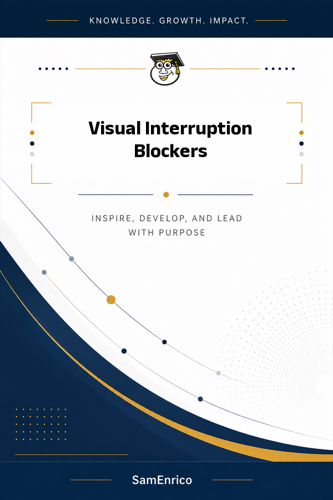
Visual Interruption Blockers eBook
Use sight barriers, strategic positioning, and per
by Wendt Leena
Use sight barriers, strategic positioning, and peripheral vision control to reduce visual noise.
Formats
Free sample
Chapter 1: The Penny Thief--–- By 3:00 PM, Sarah had done nothing wrong and everything right. She had slept eight hours. She had eaten a protein-rich breakfast. She had not checked email until 9:30 AM, following the advice of every productivity guru she followed. She had even meditated for twelve minutes, which felt like an eternity.
And yet, at 3:17 PM on a Tuesday, she found herself staring at her second monitor—not reading it, just staring—with the vague, nauseating sensation that her brain had been replaced with wet cotton. Her to-do list still had eleven items. Her eyes felt gritty. A notification had popped up seven minutes ago, and she had watched it fade without clicking it, which she counted as a victory. But the victory felt hollow because she had also lost those seven minutes entirely.
She couldn't remember what she had been thinking about. She wasn't sure she had been thinking about anything.Sarah's experience is not a failure of discipline. It is not a lack of willpower, a moral failing, or evidence that she needs a better productivity system. It is, quite simply, the predictable outcome of living in a world that has declared war on her visual attention—and she doesn't even know the war is happening. Every day, you wake up and walk onto a battlefield where the weapons are invisible, the enemy is everywhere, and the casualties are measured in hours of your life that you will never get back.
This book is about identifying that battlefield, understanding its terrain, and finally building fortifications that work. But before we can build anything, you need to understand what you are fighting against. You need to meet the penny thief.The Theory of Attentional Pennies Imagine that your attention is a jar of pennies. At the start of every day, you have exactly one thousand pennies. Every time you shift your gaze from one thing to another—every time a notification flashes, every time someone walks past your desk, every time you glance at a blinking light or a swaying plant or a cluttered shelf—you spend one penny.
Not because the glance itself is expensive, but because the re-orientation is. When your brain interrupts whatever it was doing to process a new visual stimulus, it takes time to disengage from the previous task, shift attention, evaluate the new stimulus, decide it's irrelevant, and then re-engage with the original task. That sequence, repeated hundreds of times per day, is the single largest drain on your cognitive resources that you have never measured.The research on this is startlingly consistent. A study at the University of California, Irvine found that after a typical interruption—a glance at a passing person, a flicker of motion in peripheral vision—it takes an average of twenty-three minutes to return to the original task with the same depth of focus. Twenty-three minutes.
That means a single, seemingly insignificant visual interruption at 10:00 AM doesn't cost you ten seconds. It costs you twenty-three minutes. By 3:00 PM, if you have experienced just ten such interruptions—and most people experience dozens—you have lost nearly four hours. Not to checking your phone. Not to scrolling social media.
To looking at things you didn't need to look at, triggered by visual noise you didn't even notice was there.This is what I call the theory of attentional pennies. Every object in your sightline, every motion in your periphery, every flicker of contrast at the edge of your vision is a tiny thief, reaching into your jar and stealing one penny at a time. You never feel the individual thefts because they are too small. But at 3:00 PM, when your jar is empty and you cannot understand why you are exhausted despite having done almost nothing, you are feeling the cumulative weight of a hundred small thefts. The thief is not your phone.
The thief is not your coworkers or your children or your own weak will. The thief is the visual environment you have unknowingly constructed, piece by piece, object by object, year by year.Visual Noise: A Definition Before we go any further, we need a working definition of the enemy. Visual noise is any unintended visual stimulus that competes for your attentional resources without providing value commensurate with the attention it demands. Notice the word unintended. This is crucial.
A notification from your spouse saying "I love you" is intended. It has value. A notification from a marketing email is also intended—by the marketer—but not by you. The definition centers on your intention, not the stimulus's purpose. A beautiful painting on your wall might be intended by you to bring joy, but if it sits in your peripheral vision while you are trying to write a report, it is visual noise.
A blank wall is not noise. A clock on the wall that you check once per hour is not noise. A clock that ticks audibly and has a swinging pendulum that catches your peripheral vision every three seconds is absolutely noise.Visual noise comes in three primary forms. The first is static noise: objects that do not move but occupy space in your visual field. A cluttered bookshelf, a stack of papers, a second monitor showing a screensaver, a coffee mug with a bright logo, a window onto a busy street.
Static noise is the easiest to identify because it does not change; it simply sits there, taxing your working memory by forcing your brain to constantly inhibit the impulse to look at it. Every time your gaze passes over a static object, your brain spends a fraction of a second evaluating whether it is relevant. If it is never relevant, those fractions add up.The second form is dynamic noise: moving objects, changing lights, or shifting contrasts. A ceiling fan, a person walking past a doorway, a car driving by a window, a notification badge that increments from 1 to 2, a blinking cursor on an inactive window, a video playing in the corner of your screen. Dynamic noise is more expensive than static noise because motion triggers an involuntary orienting response—your brain literally cannot help but glance toward motion, at least briefly, before consciously suppressing the impulse.
That suppression itself costs energy.The third form is temporal noise: visual changes that occur on a predictable but intermittent schedule. A clock that ticks once per second, a screensaver that changes every thirty seconds, a calendar reminder that pops up hourly, a weather widget that updates every five minutes. Temporal noise is insidious because your brain learns to anticipate it, which means it spends energy monitoring for the change, not just responding to it after the fact.The Difference Between Active and Passive States Not all visual noise is equally expensive. The cost depends heavily on what you are doing when the noise arrives. This is where most productivity advice gets it exactly backwards.Conventional wisdom says that you should protect your deep work states—your periods of intense, focused concentration—because they are when you are most vulnerable to interruption.
This is only half true. Deep work states are expensive to achieve and expensive to lose, but they are also defended by…
This is the end of the free sample. Get the eBook to keep going. Buy now
About this book
Details
- Author
- Wendt Leena
- Publisher
- SamEnrico
- Language
- English
- Genre
- Non-Fiction, Self-Help, Environmental Design, Ergonomics
- Released
- 2026-06-08
- Pages (approx.)
- 124
- Available as
- eBook, Audiobook

Read better in the ZLOADR app
Your eBooks on your phone or tablet. Sign in with your SamEnrico account and start reading.
More by Wendt Leena
 Letting Go of Resentment JournalWendt Leena$11.99
 Chunking for High SchoolWendt Leena$11.99
 Geo Arbitrage Vietnam HandbookWendt Leena$11.99
 Windmill Turning CalmWendt Leena$11.99
 Resume Kuwait Specific GuideWendt Leena$11.99
 Commercial Real Estate DemographicsWendt Leena$11.99
 Self Esteem After Weight GainWendt Leena$11.99
 Navigating Parental Narcissism GuideWendt Leena$11.99
 The Relativity Detective: How a Young Scientist Proved Einstein Right in the JungleWendt Leena$11.99
 The Fires of Axum: How an African Kingdom Tamed the EarthWendt Leena$11.99
 Fury from the Deep: The Night the Sea Stole ChristmasWendt Leena$11.99
 How to Become a Purchase-price AnalystWendt Leena$11.99