
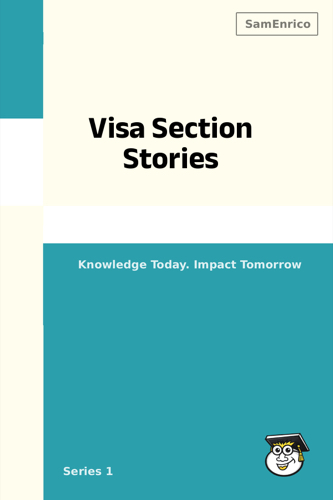
Non-FictionBiographyConsular Affairs
Visa Section Stories eBook
Shares heartbreaking and hopeful decisions made at
Shares heartbreaking and hopeful decisions made at the visa window, from reunions to rejections.
Formats
Free sample
Chapter 1: The Glass Lottery...–- The waiting room smells of bleach and desperation. That is the first thing you notice—the sharp, chemical clean that tries too hard to cover something older. The second thing is the chairs. Plastic, bolted to metal frames, arranged in rows like a school auditorium after a funeral. They are designed to be uncomfortable.
Not accidentally uncomfortable. Intentionally. The kind of uncomfortable that reminds you that you are not a guest here. You are a supplicant.The consulate opens at 7:30 AM, but the line starts forming at 4. By 6, there are already two hundred people on the sidewalk, clutching manila folders and passport photos and the desperate hope that today will be different.
Some have been here before. Three times. Five times. A woman in a green headscarf tells me she has applied for a tourist visa seven times. Seven denials.
She is back for an eighth because her daughter is having a baby in Chicago and she has never held a grandchild. She shows me the ultrasound photo tucked inside her passport. “This is why I am going,” she says. “Not to stay. To hold.” The guard calls the first group inside.
She zips her folder to her chest and walks toward the metal detector like a soldier toward a war she did not start.This is the world behind the glass. Not the world of policy papers and congressional hearings and State Department memos. The world of the plastic chair. The world of the 90-second interview. The world where a tired officer on a tea break can change a life with a single question, and where a tired officer after a bad lunch can end one with a single stamp.I did not know any of this when I first walked into a consulate.
I was twenty-three, fresh out of college, standing in the US embassy in Ankara with a passport that had no stamps and a stomach full of acid. I was applying for a student visa to study chemical engineering at a university I could barely afford. My father had sold his taxi to pay the application fee. My mother had prayed over every document, touching each page to her lips before placing it in the folder. I was the first person in my family to apply for any visa to anywhere.
I did not know that the officer behind the glass would not care about any of this.His name does not matter. I do not remember it. What I remember is the window. Number 16. The glass was thick enough that my reflection looked back at me—a thin Turkish kid in a borrowed blazer, sweat beading on his upper lip, holding a folder full of dreams that weighed nothing at all.
The officer was middle-aged, bald, wearing a tie that was slightly too tight. He had the look of a man who had asked the same questions ten thousand times and stopped listening to the answers around question seven thousand.“Purpose of travel?”“Student. Chemical engineering. University of—"“Who pays?”“My father. And a scholarship.
Partial scholarship.”“Have you ever been arrested?”“No.”“Have you ever overstayed a visa?”“No.”“Have you ever worked illegally in the United States?”“No.”He looked at my passport. Blank. He looked at my bank statement. Thin. He looked at my scholarship letter.
Partial, not full. I could see him calculating. I could see the stamp in his hand hovering over the page. Denied. That was what the math said.
Denied. Young, single, male, insufficient funds, insufficient ties to home country. The algorithm was clear. He had probably made the decision before I opened my mouth.But then something happened. He did not stamp.
He looked at his watch. He looked at the line behind me—fifteen more people, each with their own folder, their own desperation, their own 90 seconds. He sighed. And then he did something I have never seen another officer do, before or since.He stood up.“Wait here,” he said. And he walked away from the window.I stood there for three minutes.
Maybe four. Long enough for my sweat to cool and my heart to slow from a sprint to a jog. When he came back, he was holding a cup of tea. Not American coffee. Tea.
A small glass tulip cup on a saucer, the way my grandmother makes it. He took a sip. He set the cup down. And then he asked me a question that was not on any form.“What are you running toward?”Not from. Toward.
No one had ever asked me that. The application forms asked about crimes and addresses and previous visas and terrorist affiliations. They asked about money and parents and purpose of travel. They never asked about toward.I told him the truth. Not the rehearsed answer I had practiced in the mirror.
The truth. I told him that my father drove a taxi for fourteen hours a day and came home with yellow fingers from the steering wheel and a back that curved like a question mark. I told him that my mother had never left the neighborhood where she was born and that she read National Geographic magazines from the 1980s because they were the only window she had to the world. I told him that I wanted to become an engineer not because I loved chemistry—I did, but that was not the point—but because I wanted to build a water filtration system for my village. The well had been contaminated for years.
Children got sick. Old people died. And no one in the government cared because the village was poor and the village was Kurdish and the village did not vote for the right people.I told him that I was running toward a future where my mother could drink from the tap without fear. I told him that I was running toward a workshop with tools and a lathe and a computer that could run simulation software. I told him that I was running toward a life that did not end in the back seat of a taxi, staring at the same streets until your eyes went gray.He listened.
He did not interrupt. He did not take notes. He just listened, sipping his tea, watching me the way you might watch a bird that has landed on your windowsill—curious, a little surprised, not entirely sure what comes next.When I finished, he was quiet for a long time. Then he picked up the stamp. I closed my eyes.
I heard the thump of rubber on paper. When I opened them, he was sliding my passport back through the slot.“Approved,” he said. “Four years. Don’t waste it.”I did not waste it. I graduated.
I built the water filtration system. It is still running, ten years later, serving three hundred families. My father retired from the taxi. My mother flew on an airplane for the first time to attend my graduation. She cried the whole way across the Atlantic, not from sadness but from the sheer wonder of being above the clouds.That is the story I tell when people ask me…
This is the end of the free sample. Get the eBook to keep going. Buy now
About this book
Details
- Author
- Kemper Grisel
- Publisher
- SamEnrico
- Language
- English
- Genre
- Non-Fiction, Biography, Consular Affairs
- Released
- 2026-06-06
- Pages (approx.)
- 157
- Available as
- eBook, Audiobook

Read better in the ZLOADR app
Your eBooks on your phone or tablet. Sign in with your SamEnrico account and start reading.
More by Kemper Grisel
 NVC Jackal Language ConversionKemper Grisel$11.99
 Harvard Extension School Academic IntegrityKemper Grisel$11.99
 TM Compared to MindfulnessKemper Grisel$11.99
 The Tokyo Trial: Japan's Fight for Women's Football Equality (2015)Kemper Grisel$11.99
 How to Produce Bicycle PedalsKemper Grisel$11.99
 Science TeacherKemper Grisel$11.99
 Multidisciplinary Proposal GuideKemper Grisel$12.99
 How to Start a Botanical Products for Pharmaceutical Use Business (Beginners Guide)Kemper Grisel$11.99
You may also like
 Hong Kong Handover 1997Dunn Johnnie$11.99
 Zumba For Postnatal Recovery CourseNeal Christian$11.99
 Zumba for BeginnersLadner Nikia$11.99
 YouTube Comment Mining GuideHumes Pandora$12.99
 Worry Box MeditationCarlin Rudy$11.99
 Workplace Stress MeditationNguyen Lynn$11.99
 Workplace Stress and Sleep RepairHawley Ivory$11.99
 Workplace Perfectionism CureDelaney Jeffry$11.99
 Workplace Injustice Anger GuideWallen Isabelle$11.99
 Work Addiction and Burnout LinkGreenwood Ester$11.99
 Women in Yoga and WellnessBeattie Galina$11.99
 Women in Stand Up ComedyChun Evangeline$11.99