
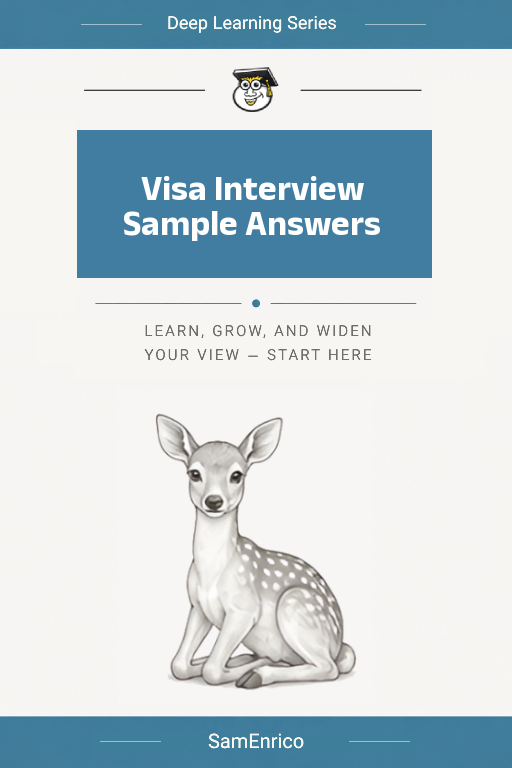
Visa Interview Sample Answers eBook
Use templates for 'Why this university?', 'Who fun
by Holly Lizzie
Use templates for 'Why this university?', 'Who funds you?', and 'What are your plans after graduation?'
Formats
Free sample
Chapter 1: The 30-Second Graveyard--The young man from Hyderabad had done everything right. A GRE score in the 92nd percentile. An acceptance letter from a top-20 engineering program. A full tuition waiver plus a research assistantship. His father was a retired government officer with a pristine service record.
The family had liquid savings of nearly $90,000. By every objective measure, he was the ideal F-1 visa applicant.He walked up to the window at the U.S. consulate in Chennai. The visa officer, a woman in her early forties with tired eyes, looked at his I-20 for exactly three seconds. Then she asked her first and only question: "Why do you want to go to the United States?"The young man smiled nervously and said: "Because America has the best education system in the world.
I have always dreamed of studying there. It will help me grow as a person and build a better future."Twenty-seven seconds after he approached the window, the officer handed him a white slip. Denied. Section 214(b). The young man walked out in disbelief.
He had spent three months preparing his documents, two weeks memorizing answers, and nearly $2,000 on visa fees and travel. None of it mattered.What did he do wrong? He told the officer exactly what she hears fifty times a day. "America is great. I want a better future." Those words, spoken sincerely by a truly qualified applicant, triggered the presumption of immigrant intent.
The officer did not deny him because he was unqualified. She denied him because he failed to prove he would come home.This chapter will ensure you never make the same mistake. You will learn why the deck is stacked against you before you open your mouth, how the 214(b) presumption works like an invisible wall, and why emotional answers are the fastest path to a denial stamp. More importantly, you will learn the Three Pillars of a non-immigrant answer that flips the officer's default suspicion into confident approval.The Gravity of the Presumption Let us start with a hard truth that most visa guides soften or avoid entirely. The U.S.
immigration officer on the other side of that glass is not your friend, your teacher, or your advocate. She is a law enforcement officer whose job is to enforce Section 214(b) of the Immigration and Nationality Act. That section creates a legal presumption that every person applying for a non-immigrant visa is actually an intending immigrant.Read that again. The law presumes you intend to immigrate. The burden of proof is on you to overcome that presumption.
Not to match it. Not to balance it. To overcome it completely.This is radically different from most legal situations. In a criminal trial, you are presumed innocent until proven guilty. In a visa interview, you are presumed guilty of intending to immigrate until you prove otherwise.
The officer does not need a reason to deny you. She needs a reason to approve you. If she has any doubt, if your story has any gap, if your answers sound vague or memorized or unconvincing, the law instructs her to deny.Most denied applicants never understand this. They walk out thinking the officer was racist, or having a bad day, or on a power trip. Some of those things may occasionally be true.
But the vast majority of denials happen because the applicant failed to overcome the presumption. They gave the officer a reason to say no, not a reason to say yes.Consider the young man from Hyderabad again. When he said "America has the best education system," he was telling the truth. But that truth did nothing to overcome the presumption. In fact, it reinforced it.
Why would someone who believes America is the best at everything ever want to leave? The officer heard: "This person loves America, has no ties to his home country that he mentioned, and is probably looking for a way to stay permanently."Now consider a different answer. What if he had said: "In my home country of India, the semiconductor fabrication industry is projected to grow 40 percent over the next three years. However, there are no Ph D programs in gallium nitride semiconductor design. I need this specific degree to qualify for senior engineer roles at companies like Tata Electronics.
Without it, I cannot advance. With it, I will return immediately to fill a role that currently does not exist in my country because the qualified people do not exist."That answer would have taken about fifteen seconds. It mentions a specific home-country industry, a specific growth projection, a specific educational gap, a specific company, and a specific career barrier. Every sentence chips away at the presumption of immigrant intent. By the end, the officer would have to actively ignore the evidence to deny him.The difference between these two answers is not English fluency.
It is not intelligence. It is strategic storytelling. The first answer was about America. The second answer was about home. The first answer was emotional.
The second answer was economic. The first answer could be given by any student from any country. The second answer could only be given by someone who had done their homework on their own country's labor market.This is the single most important lesson of this entire book. The visa officer does not care how much you love America. She cares how much you need to go home.Strong Ties versus Weak Ties The concept of "ties" to your home country is the operational heart of 214(b) adjudication.
Officers are trained to evaluate whether an applicant has strong enough ties to their home country to compel their return after a temporary stay in the United States. But not all ties are created equal. In fact, some ties that applicants think are strong are actually quite weak.Weak ties are emotional, personal, and unverifiable. They include statements like: "I love my family," "My parents live here," "I miss my hometown food," "My girlfriend is waiting for me," "I have a dog," "This is where I grew up." Officers hear these statements constantly. They have no way to verify them.
More importantly, emotional ties can be broken easily. People leave families for better opportunities every day. A parent's love does not stop someone from immigrating. In fact, many immigrants eventually bring their families to join them. Emotional ties, therefore, do little to overcome the presumption of immigrant intent.Strong ties are economic, professional, and educational.
They are concrete, verifiable, and difficult to abandon. Consider these examples:An economic tie: "I own a 2,000 square foot commercial property in downtown Mumbai that generates rental income of $2,500 per month. Here is the deed and the last six months of bank deposits."A professional tie: "I am four years into a six-year partnership track at a law firm in Delhi. If I leave permanently, I forfeit my partnership share of approximately $400,000. Here is my partnership agreement."An educational tie: "There are only three universities in my country that offer a master's degree in my field, and none of them have the laboratory equipment required for the research I need to complete for my employer.
My employer has agreed to promote me to senior researcher only upon my return with this U.S. degree. Here is…
This is the end of the free sample. Get the eBook to keep going. Buy now
About this book
Details
- Author
- Holly Lizzie
- Publisher
- SamEnrico
- Language
- English
- Genre
- Non-Fiction, Student's Shortcut, Sample Q&A
- Released
- 2026-06-01
- Pages (approx.)
- 152
- Available as
- eBook, Audiobook

Read better in the ZLOADR app
Your eBooks on your phone or tablet. Sign in with your SamEnrico account and start reading.
More by Holly Lizzie
 Sober Living GuideHolly Lizzie$11.99
 Fitness Activity ReviewHolly Lizzie$11.99
 UK Company Director CreditHolly Lizzie$11.99
 Self Talk For Change ResistanceHolly Lizzie$11.99
 The Emotional Regulation for SeniorsHolly Lizzie$11.99
 Habit Formation for ProductivityHolly Lizzie$11.99
 Carpool Calm StrategyHolly Lizzie$11.99
 The Ratcliffe Highway Murders: London's First Serial KillerHolly Lizzie$11.99
 Sherman Alexie Spokane VoiceHolly Lizzie$11.99
 The Siege of Rhodes: Knights vs. Sultans in a Medieval ShowdownHolly Lizzie$11.99
 A Collector's Handbook to the It. ItHolly Lizzie$11.99
 How to Produce Travertine FlooringHolly Lizzie$11.99