
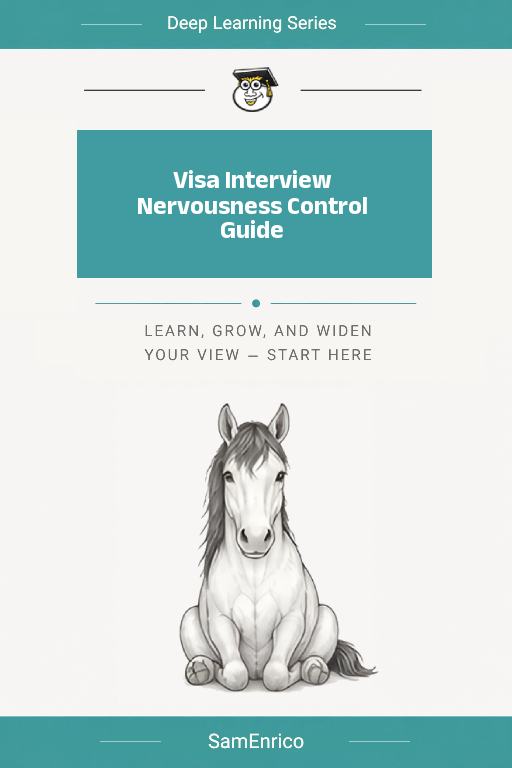
Visa Interview Nervousness Control Guide eBook
Practice deep breathing and power posing before en
Practice deep breathing and power posing before entering embassy to project calm confidence.
Formats
Free sample
Chapter 1: The Bangalore Blank-Out--–- The taxi pulled away from the curb at 8:47 AM, and Vikram’s heart had already abandoned him.Not metaphorically. Literally. It was pounding somewhere in his throat, a frantic drum that drowned out every other sound—the honking of Bangalore traffic, the drone of the auto-rickshaw beside him, even the voice of his own mother on the phone, wishing him luck. He couldn’t hear her. He couldn’t hear anything except the thud-thud-thud of his own body betraying him.Vikram was twenty-four years old.
He had a master’s degree in computer science from one of India’s top universities. He had a legitimate job offer from a mid-sized tech firm in Austin, Texas, complete with a sponsorship letter, a salary well above the prevailing wage, and a visa petition that had already been approved by the U.S. Citizenship and Immigration Services. His paperwork was immaculate. His credentials were flawless.
His intentions were entirely above board.And none of that mattered at 8:47 AM, because Vikram’s body had decided that the U.S. Consulate in Bangalore was not a place of business but a predator’s den, and that the visa officer waiting inside was not a diplomat but a threat to his survival.By the time he reached the security checkpoint, his palms were slick with sweat. He wiped them on his trousers, then immediately regretted it because now there were dark, visible patches on his new gray slacks. The security guard asked him to empty his pockets. Vikram fumbled with his phone.
He dropped it. He bent down to pick it up, hit his head on the metal detector’s frame, and heard someone behind him sigh in exasperation.This is it, he thought. I’ve already failed, and I haven’t even seen the officer yet.By the time Vikram took his seat in the waiting area, he had run through his answers in his head seventeen times. He knew the script perfectly. He knew that when the officer asked, “What will you do in the United States?”, he would say, “I will work as a software engineer for Tech Solutions Inc., a company specializing in cloud infrastructure.” He knew that when the officer asked, “How long do you plan to stay?”, he would say, “Initially for the duration of my three-year work contract, with the understanding that I will return to India upon completion.” He knew that when the officer asked, “Do you have family in the United States?”, he would say, “No, all my immediate family resides in Chennai.”He knew the answers.
He had rehearsed them in the mirror. He had rehearsed them with his cousin. He had rehearsed them while brushing his teeth, while waiting for his coffee, while lying in bed the night before.And then his number was called.Vikram stood up. He walked the fifteen feet to the window. He looked up at the visa officer—a woman in her forties with kind eyes but a businesslike expression—and opened his mouth.Nothing came out.Not silence, exactly.
He made a sound. A small, strangled, half-breath of a sound that was not a word and not a greeting and not anything resembling a coherent sentence. His mind, which had been so full of prepared answers just moments ago, was now completely, terrifyingly empty. It was as if someone had reached into his skull and deleted every file.The officer waited. Vikram’s mouth opened and closed like a fish on a dock.
He could feel the eyes of everyone in the waiting room on the back of his neck. He could feel sweat beading on his upper lip. He could feel his hands shaking at his sides.Finally, he managed to croak out a single word: “Hi.”The officer raised an eyebrow. “Hello,” she said. “Do you have your passport?”Vikram looked down at his empty hands.
His passport was still in his bag. His bag was still on his chair. He had forgotten to bring his passport to the window.He wanted to disappear. He wanted the floor to open up and swallow him whole. Instead, he turned around, walked back to his seat, retrieved his passport, walked back to the window, and handed it over with hands that trembled so visibly he could see the officer’s gaze flick down to them, then back up to his face.The interview lasted another three minutes.
Vikram managed to answer the questions—barely—but his voice cracked on every sentence. He stumbled over words he had known since childhood. He said “um” seventeen times. He looked down at the counter instead of at the officer’s eyes. When it was over, the officer stamped something, slid a piece of paper back through the slot, and said, “I’m sorry, but I cannot approve your visa at this time.”Vikram walked out of the consulate in a daze.
He didn’t cry until he was back in the taxi, alone, with his rejection slip crumpled in his fist. He had done everything right. His documents were perfect. His answers were correct. His future was secure—or it should have been.But his body had failed him.
And that failure had cost him everything.The Invisible Enemy Vikram’s story is not unusual. In fact, it is so common among visa applicants that consular officers have a name for it. They call it the “prepared-but-blank” phenomenon—the experience of watching a perfectly qualified applicant walk up to the window, open their mouth, and collapse into a puddle of incoherent anxiety.Every year, thousands of visa applicants are denied not because their documents are insufficient, not because their intentions are fraudulent, and not because they lack the qualifications for the visa they seek. They are denied because their nervousness is misinterpreted. A visa officer sees shaking hands and thinks, “This person is hiding something.” They see averted eyes and think, “This person is untrustworthy.” They hear a quivering voice and think, “This person is not sure about their answers.”The cruel irony is that the most honest, well-prepared, well-intentioned applicants are often the most nervous—because they have the most to lose.
The person who truly intends to return home after their studies has everything riding on a successful interview. The person who has saved for years for a tourist visa has invested their entire dream in that single conversation. The person who has secured a legitimate job offer knows that this interview is the last gate between them and a life-changing opportunity.And yet, it is precisely that investment—that deep, genuine caring about the outcome—that triggers the biological response that can ruin everything.The Biology of Betrayal To understand what happened to Vikram—and what happens to countless applicants just like him—we have to go back about two hundred thousand years. Back to the African savanna, where your ancestors faced a very different kind of threat than a visa officer behind a glass window.Imagine you are an early human, walking through tall grass. Suddenly, you hear a growl.
You turn and see a predator—a lion, perhaps, or a pack of hyenas—and your body reacts instantly. Your heart rate…
This is the end of the free sample. Get the eBook to keep going. Buy now
About this book
Details
- Author
- Portillo Valeri
- Publisher
- SamEnrico
- Language
- English
- Genre
- Non-Fiction, Student's Shortcut
- Released
- 2026-05-29
- Pages (approx.)
- 149
- Available as
- eBook, Audiobook

Read better in the ZLOADR app
Your eBooks on your phone or tablet. Sign in with your SamEnrico account and start reading.
More by Portillo Valeri
 IBS Differential Diagnosis GuidePortillo Valeri$11.99
 Ferry Waiting Rage ManagementPortillo Valeri$11.99
 The Freelance Productivity SystemPortillo Valeri$11.99
 Namibia Remote Work GuidePortillo Valeri$11.99
 The Interruption Recovery Log WorkbookPortillo Valeri$11.99
 Body Language PersuasionPortillo Valeri$11.99
 Whiplash Associated Disorder ExercisesPortillo Valeri$11.99
 Media Circus Case StudyPortillo Valeri$11.99
 Teen Self Esteem and RejectionPortillo Valeri$11.99
 Echoes of the Forgotten: The Unsung Heroes of the 1960 Valdivia EarthquakePortillo Valeri$11.99
 The Two Faces of the Silk Road: How a 19th-Century Explorer and a 21st-Century Hacker Redefined TradePortillo Valeri$11.99
 The Silent Hunters of the Pacific: Japan's I-Boats in World War IIPortillo Valeri$11.99
You may also like
 Hong Kong Handover 1997Dunn Johnnie$11.99
 Zumba For Postnatal Recovery CourseNeal Christian$11.99
 Zumba for BeginnersLadner Nikia$11.99
 YouTube Comment Mining GuideHumes Pandora$12.99
 Worry Box MeditationCarlin Rudy$11.99
 Workplace Stress MeditationNguyen Lynn$11.99
 Workplace Stress and Sleep RepairHawley Ivory$11.99
 Workplace Perfectionism CureDelaney Jeffry$11.99
 Workplace Injustice Anger GuideWallen Isabelle$11.99
 Work Addiction and Burnout LinkGreenwood Ester$11.99
 Women in Yoga and WellnessBeattie Galina$11.99
 Women in Stand Up ComedyChun Evangeline$11.99