
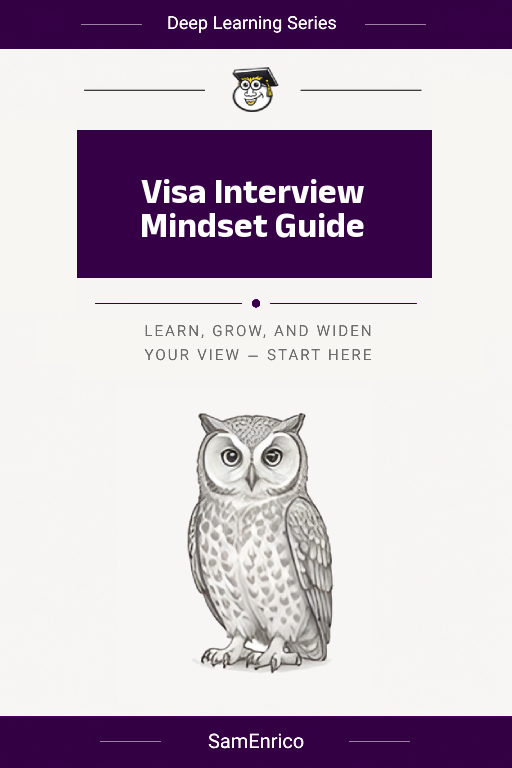
Visa Interview Mindset Guide eBook
Manage pre-interview anxiety, build confidence, an
by Lima Genevie
Manage pre-interview anxiety, build confidence, and project calm professionalism during the interview.
Formats
Free sample
Chapter 1: Your Brain Lies--If you are reading this book, there is a very good chance that right now—at this very moment—your body is doing something uncomfortable. Your chest may feel tight. Your palms might be damp. Perhaps you have that familiar hollow sensation in your stomach, the one that shows up before a difficult conversation, a medical test, or the moment a door opens and someone with a clipboard calls your name.Here is what you need to know immediately, before anything else in this book: That feeling is not a sign that something is wrong with you.It is a sign that something is working exactly as it evolved to work. The problem is that your brain has not yet received the memo that a visa interview is not a predator.This chapter will deconstruct the single greatest obstacle between you and a calm, professional visa interview: your own brain's ancient, powerful, and wildly outdated threat-detection system.
You will learn why a simple conversation behind a glass window can trigger the same physiological response as being chased by a wild animal. More importantly, you will learn how to stop fighting your biology and start using it.By the end of this chapter, you will never again ask yourself, "Why am I so nervous?" Instead, you will say, "Ah—there is my amygdala doing its job. Now let me redirect it."The Three-Second Transformation Imagine two versions of yourself.The first version walks into the embassy. Her heart is pounding. She notices her hands are cold and slightly shaking.
She thinks, Something is wrong with me. I'm going to blow this. They can see how scared I am. By the time she reaches the window, her prefrontal cortex—the part of her brain responsible for clear thinking, memory recall, and verbal fluency—has partially shut down. She hears the officer ask, "What is the purpose of your trip?" and her mind goes blank.
She stumbles through an answer, apologizes unnecessarily, and walks out convinced she failed.The second version experiences the exact same physical sensations. Her heart pounds. Her hands shake. But she thinks something different. She thinks, My body is getting ready.
This is important, and I am activated. That is exactly what should happen. She takes a slow breath. By the time she reaches the window, her prefrontal cortex is fully online. She hears the question, pauses for two seconds, and answers clearly.
She walks out knowing she did her best, regardless of the outcome.The only difference between these two versions of the same person is interpretation.The physical response is identical. The outcome is completely different.This chapter will teach you how to become the second version.The Amygdala's Ancient Mistake To understand why a visa interview feels like a threat, you need to meet a small, almond-shaped cluster of neurons deep inside your brain called the amygdala (pronounced ah-mig-dah-la).The amygdala is your brain's rapid-response threat-detection system. It evolved hundreds of thousands of years ago, long before there were embassies, visa officers, or even language. Its job was simple and vital: detect danger and activate the body's survival response before you had time to think.And it is extraordinarily fast. The amygdala can process a potential threat in approximately 20 milliseconds—faster than conscious thought.
By the time you are aware of feeling afraid, your amygdala has already sent signals to your adrenal glands, released cortisol and adrenaline into your bloodstream, and prepared your body for fight, flight, or freeze.Here is the problem: the amygdala is not very smart. It does not distinguish between different kinds of threats. A rustling bush that might contain a predator and a visa officer asking about your employment history look remarkably similar to your amygdala. Both trigger the same cascade of hormones. Both prepare you to run, fight, or play dead.Dr.
Joseph Le Doux, a neuroscientist who has spent decades studying the amygdala, calls this the "low road" of threat processing. It is fast, automatic, and imprecise. The "high road" (conscious processing through the prefrontal cortex) is slower, more accurate, and takes several hundred milliseconds to engage. The problem is that the low road is already in full gear by the time the high road gets online.So when you stand before a visa officer who holds the power to say yes or no, your brain does not distinguish between that officer and a predator. The officer asks a question.
Your amygdala interprets being evaluated by an authority figure as a survival threat. Your body floods with cortisol. Your heart races. Your palms sweat. Your mouth goes dry.
And crucially, your prefrontal cortex—the very part of your brain you need for clear answers—begins to down-regulate.This is not a character flaw. This is not weakness. This is evolution.Why Your Prefrontal Cortex Abandons You The prefrontal cortex (PFC) is the most recently evolved part of the human brain. It is located directly behind your forehead and is responsible for what psychologists call "executive functions": planning, reasoning, impulse control, working memory, and verbal fluency. It is what allows you to remember a three-part answer, choose the right word, and resist the urge to say something defensive.Here is what most people do not know: the PFC is metabolically expensive.
It requires significant amounts of glucose and oxygen to function. When your amygdala activates the fight-flight-freeze response, your body priorities resources toward survival functions (large muscle groups, heart, lungs) and away from non-essential functions (digestion, reproduction, and yes, complex thinking).In practical terms, this means that under high stress, your PFC literally has fewer resources to work with. It becomes harder to recall facts you know perfectly well. It becomes harder to construct coherent sentences. It becomes harder to inhibit impulsive responses (like saying "I promise I'll come back!" which sounds desperate rather than credible).This is why you can practice an answer fifty times in the mirror and still freeze when asked the exact same question.
It is not that you did not know the answer. It is that your PFC was temporarily under-resourced because your amygdala was screaming about a predator that does not exist.Neuroscientist Amy Arnsten has spent decades studying the effects of stress on prefrontal cortical function. Her research shows that even mild, acute stress can rapidly impair PFC function by reducing dopamine and norepinephrine signaling in the PFC. In other words: the moment you feel "stressed," your brain's CEO starts making errors.But here is the good news. The same research shows that you can train your brain to respond differently.
The PFC is plastic. It can learn. And the first step is renaming what you are feeling.The Threat Response vs. The Challenge Response Psychologists have identified two distinct ways the body can respond to a stressful situation: the threat response and the challenge response.Both produce physiological arousal. Both increase heart rate, release adrenaline, and sharpen sensory awareness.
The difference is not in the body but in the interpretation of that arousal.In a threat response, you interpret the situation as exceeding your resources. You think: "I can't handle this. Something bad is going to happen. They are judging…
This is the end of the free sample. Get the eBook to keep going. Buy now
About this book
Details
- Author
- Lima Genevie
- Publisher
- SamEnrico
- Language
- English
- Genre
- Non-Fiction, Student's Shortcut, Mindset
- Released
- 2026-05-29
- Pages (approx.)
- 148
- Available as
- eBook, Audiobook

Read better in the ZLOADR app
Your eBooks on your phone or tablet. Sign in with your SamEnrico account and start reading.
More by Lima Genevie
 Self Esteem for Weight StigmaLima Genevie$11.99
 One Teacher Changed EverythingLima Genevie$11.99
 Spiritual Community GuideLima Genevie$11.99
 Business Credit for Construction SupplyLima Genevie$11.99
 Letting Go of RejectionLima Genevie$11.99
 Award Acceptance SpeechLima Genevie$11.99
 Nike Sneakers and Exit BagsLima Genevie$11.99
 Growth Mindset for FreelancersLima Genevie$11.99
 The Last Oracle of Delphi: When Prophecy Met PoliticsLima Genevie$11.99
 The Crystal Palace Trial: How a Glass Revolution Defied the CriticsLima Genevie$11.99
 How to Produce Truck Bed Storage Boxes and OrganizersLima Genevie$11.99
 How to Start a Copper Goods (retail) Business (Beginners Guide)Lima Genevie$11.99