
Non-FictionStudent's ShortcutSponsored
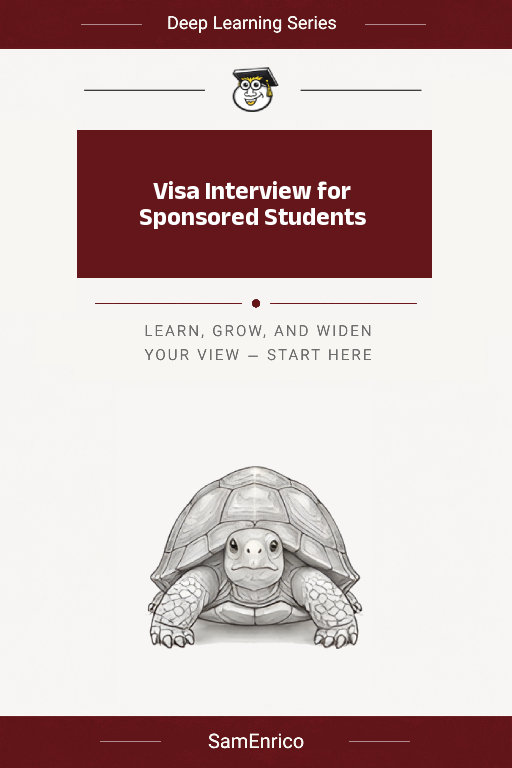
Visa Interview for Sponsored Students eBook
Present sponsor letters, employer agreements, or g
by Love Camille
Present sponsor letters, employer agreements, or government sponsorship documents professionally.
Formats
Free sample
Chapter 1: The Sponsor Mirage--The letter arrived on a Tuesday. Crisp white paper, embossed gold seal, a signature that curled with authority. It promised everything: full tuition, living stipend, health insurance, even a travel allowance. The student – let's call him Ahmed – held it like a winning lottery ticket. He had done everything right.
Perfect grades. A prestigious government scholarship from SACM. An acceptance letter from a top-tier American university. His family celebrated. His advisor congratulated him.
His future was assured.Three weeks later, Ahmed sat in a fluorescent-lit hallway outside the US embassy in Riyadh. He wore his best suit. His folder was organized. He had practiced his answers. When the consular officer called his number, Ahmed walked to the window with confidence.
He slid his passport and I-20 through the slot. The officer – a woman in her forties with tired eyes – flipped through the pages without expression."Your sponsor letter," she said.Ahmed handed over the beautiful document with the gold seal.The officer read it for eleven seconds. Then she looked up."This letter says 'full support' but does not specify an amount in USD," she said. "I cannot verify that the funds exist. I am placing your case under 221(g) administrative processing.
You will receive instructions by email."Ahmed's visa was not denied. It was worse. It was suspended in a bureaucratic limbo that would last eight months, cost him his university admission, and force him to reapply from scratch. The gold seal meant nothing. The government scholarship meant nothing.
The only thing that mattered was a single missing number on a single page.Ahmed had fallen for the Sponsor Mirage.The Illusion That Destroys Visas The Sponsor Mirage is the belief that a sponsorship letter – any sponsorship letter – is inherently powerful. That a government logo, a university seal, or a corporate letterhead will automatically convince a consular officer to approve your visa. This is the single most dangerous misconception in the sponsored student visa process, and it has destroyed more applications than lack of money, poor English, or questionable academic records combined.Here is the truth that no university advisor will tell you and that most sponsorship letters will never admit: A sponsorship letter is not proof of funds. It is a promise of funds. And consular officers do not trust promises.Every year, tens of thousands of sponsored students walk into embassies around the world holding letters that say "full support," "comprehensive sponsorship," or "all expenses covered." And every year, thousands of those students walk out with 221(g) notices, denials, or requests for further review.
Not because their sponsors are fraudulent. Not because they lack money. But because their documentation fails to meet the specific, unforgiving requirements of immigration law.This chapter is your first and most important line of defense against the Sponsor Mirage. By the time you finish reading, you will understand exactly what consular officers are looking for, why your well-meaning sponsor may have given you documents that will fail, and how to fix every common deficiency before you ever sit down for your interview.Why Sponsorship Is Different from Self-Funding Before we dissect the components of a winning sponsorship dossier, you need to understand a fundamental shift in how consular officers evaluate sponsored students versus self-funded students.When you pay for your own education, the officer's job is relatively straightforward. They look at your bank statements.
They verify that the funds exist. They check that the money is yours (not borrowed or temporarily parked). They confirm that the total meets or exceeds the I-20 or CAS requirements. If all three conditions are satisfied, the financial portion of your visa is approved. The officer's primary concern is quantity – do you have enough?When a third party sponsors you, everything changes.
The officer's primary concern shifts from quantity to authenticity. Is this sponsor real? Does the sponsor actually have the money? Is the sponsor legally obligated to pay? Is there a hidden relationship (employment, family, debt) that could influence your intent to return home?
The officer is no longer just counting dollars. They are investigating a relationship.This shift is codified in what I call the 33% Rule – but with a critical clarification that most guides get wrong. The 33% rule states that if an individual supporter (a family member or friend) pays for more than one-third of your total costs, the burden of proof shifts from proving your assets to proving the supporter's authenticity. However – and this is where confusion has ruined countless applications – this rule applies only to individual supporters, not to governments, universities, or employers.If your uncle pays 40% of your costs, the officer will scrutinize your uncle. They will ask for his bank statements, his tax returns, and proof of his relationship to you.
If the Saudi government pays 100% of your costs, the 33% rule does not apply. The officer will scrutinize the government's letter – but they will not ask for the government's bank statements. Different sponsor types trigger different verification standards, and confusing them is a fast path to rejection.Throughout this book, we will treat three distinct sponsor types separately:Government sponsors (SACM, Fulbright, Chevening, etc.) – the gold standard, but with their own pitfalls Employer sponsors (companies paying for employee education) – the highest risk category University sponsors (TA/RA positions, scholarships, fellowships) – the most common, but also the most misunderstood Each type has different documentation requirements, different officer expectations, and different failure modes. A letter that works for a government sponsor will fail for an employer sponsor. A letter that works for a university fellowship will fail for a family supporter.
You must know your sponsor type before you read another page.The Three Pillars of Sponsored Visa Approval Every successful sponsored visa application rests on three pillars. If any pillar is weak, the entire application collapses. Most students focus exclusively on the first pillar – financial ability – and ignore the other two. This is a catastrophic mistake.Pillar One: Financial Ability (The "Do You Have It?" Question)Financial ability is exactly what it sounds like: can your sponsor actually pay for your education? This is the easiest pillar to prove, yet it is the one most commonly botched.
To prove financial ability, you need two things:First, a sponsor letter that explicitly states the amount of funding in USD or GBP, the duration of funding, and the specific costs covered (tuition, fees, living expenses, health insurance, travel). Vague language like "full support" or "all necessary expenses" is legally meaningless and will trigger a 221(g) request for clarification. We will dissect the exact language required in Chapter 2.Second, proof that the money exists. For government sponsors, this usually means a Financial Guarantee Letter (FGL) that the government has issued to the university. For employer sponsors, this means bank statements or audited financial statements.
For university sponsors, this means a signed offer letter from the financial aid office. The type of proof varies by sponsor type, but the underlying requirement is identical: the officer must see evidence that the money is real, liquid, and accessible.Here is where most students fail: they confuse the promise with the proof. A sponsor letter is a promise. A bank statement is proof. You need both.
If you walk into your interview with only a letter, you have given the officer a reason to doubt you.…
This is the end of the free sample. Get the eBook to keep going. Buy now
About this book
Details
- Author
- Love Camille
- Publisher
- SamEnrico
- Language
- English
- Genre
- Non-Fiction, Student's Shortcut, Sponsored
- Released
- 2026-06-01
- Pages (approx.)
- 144
- Available as
- eBook, Audiobook

Read better in the ZLOADR app
Your eBooks on your phone or tablet. Sign in with your SamEnrico account and start reading.
More by Love Camille
 Senior Loneliness SolutionsLove Camille$11.99
 Business Credit for Medical PracticesLove Camille$11.99
 Letting Go of Past LovesLove Camille$11.99
 Medication for Driving AngerLove Camille$11.99
 Embracing Failure as LearningLove Camille$11.99
 Self Esteem for Introverts at WorkLove Camille$11.99
 Workshop Facilitation SkillsLove Camille$11.99
 The Cult of Do and Ti ExplainedLove Camille$11.99
 Fadia Naim: The Supermodel Who Redefined Arab BeautyLove Camille$11.99
 Silk Road Shadows: The Untold War Behind the Digital Drug EmpireLove Camille$11.99
 Service Providers Guide to Artwork & MuralsLove Camille$11.99
 How to Start a Hobby in AutoracingLove Camille$11.99
You may also like
 Hong Kong Handover 1997Dunn Johnnie$11.99
 Zumba For Postnatal Recovery CourseNeal Christian$11.99
 Zumba for BeginnersLadner Nikia$11.99
 YouTube Comment Mining GuideHumes Pandora$12.99
 Worry Box MeditationCarlin Rudy$11.99
 Workplace Stress MeditationNguyen Lynn$11.99
 Workplace Stress and Sleep RepairHawley Ivory$11.99
 Workplace Perfectionism CureDelaney Jeffry$11.99
 Workplace Injustice Anger GuideWallen Isabelle$11.99
 Work Addiction and Burnout LinkGreenwood Ester$11.99
 Women in Yoga and WellnessBeattie Galina$11.99
 Women in Stand Up ComedyChun Evangeline$11.99