
Non-FictionStudent's ShortcutProfessional
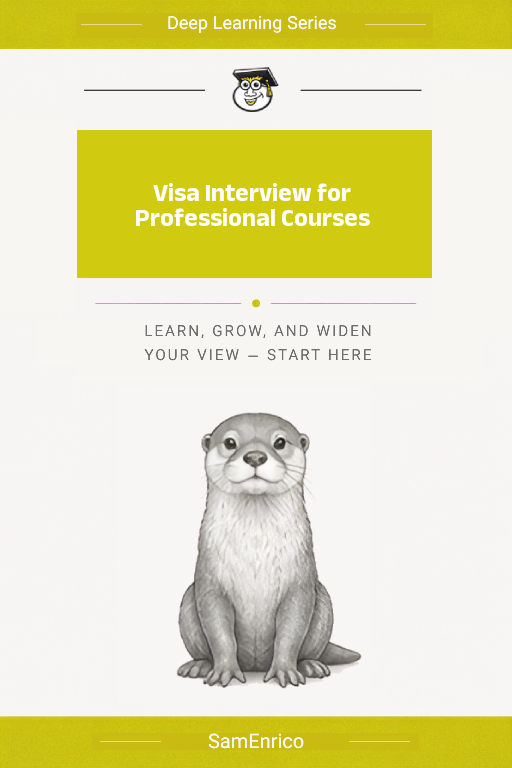
Visa Interview for Professional Courses eBook
Prepare for law, medicine, or architecture program
Prepare for law, medicine, or architecture programs with additional professional licensing questions.
Formats
Free sample
Chapter 1: The Hidden Trap–- The polished wooden counter of the consular section feels colder than you expected. You have spent months—perhaps years—preparing for this moment. You have the acceptance letter from a prestigious American university. You have the scholarship documentation, the test scores, the recommendation letters, and the career plan that your professors called "impressive." You have rehearsed your answers in front of mirrors, friends, and professional coaches. You believe you are ready.Then the consular officer looks up from your passport and asks a question that seems almost offhand: "So, you want to study medicine in the United States.
What happens after you graduate?"You smile. You have prepared for this. "I plan to return to my home country and practice medicine," you say confidently.The officer types for a moment, then asks: "Why wouldn't you stay in the US? Doctors here earn significantly more than in your country."You hesitate. The question feels unfair.
Of course, you would earn more in the US. That is precisely why you want to study here—to gain skills that will make you valuable everywhere. But you cannot say that. You fumble through an answer about family ties and cultural roots. The officer's expression does not change.
Thirty seconds later, you hear the words that will haunt you: "I am sorry, but I cannot approve your visa today under Section 214(b)."What just happened? You told the truth. You had strong credentials. You had every intention of returning home—or at least, you thought you did. But somewhere between your preparation and the interview window, you fell into a trap that ensnares thousands of professional course applicants every year.This chapter reveals that trap.
It is not about your qualifications, your finances, or even your honesty. It is about something far more fundamental: the legal presumption that every applicant for a non-immigrant visa intends to become an immigrant—and why that presumption is infinitely more dangerous for applicants in law, medicine, and architecture than for any other group of students.The 214(b) Presumption: The Legal Hammer Every F-1 visa application is governed by a single paragraph of United States immigration law that most applicants have never read. Section 214(b) of the Immigration and Nationality Act states that every person applying for a non-immigrant visa is presumed to be an intending immigrant unless they prove otherwise. The burden of proof is not on the government to show you want to stay. The burden is entirely on you to prove you will leave.For a tourist visa applicant, this presumption is serious but not insurmountable.
For a student applying for a bachelor's degree in liberal arts, it is challenging but manageable. For a professional course applicant in law, medicine, or architecture, it is a legal hammer designed to deny everyone except those who come extraordinarily prepared.Why the difference? Because consular officers are not naive. They know that a medical degree from Johns Hopkins is not the same as a bachelor's degree in English literature from a regional university. They know that an LL.M.
from Harvard opens doors to international law firms that pay salaries ten times higher than what a lawyer earns in Mumbai or Nairobi. They know that an M.Arch from MIT is a credential that architectural firms in New York, London, and Dubai actively recruit.The officer's mental calculation is simple and brutal: "This applicant has just acquired a golden ticket to a high-paying career in the United States. Why on earth would they ever leave?"The trap, therefore, is not that professional applicants are less worthy. The trap is that their very qualifications—the achievements that got them accepted into competitive programs—become evidence against them in the officer's mind. Every advantage you have worked so hard to achieve is now a red flag.The Three Professions Under the Microscope Not all professional courses trigger equal scrutiny.
Consular officers are trained to identify programs that create the strongest incentives to remain in the United States. Law, medicine, and architecture sit at the top of that list.Law: The Bar Exam Pathway For law students, the officer's primary concern is the bar exam. In several U.S. states—most notably New York and California—foreign-trained lawyers who complete an LL.M. degree at an accredited American law school are eligible to sit for the bar exam.
Passing the bar opens the door to employment with U.S. law firms, corporate legal departments, government agencies, and non-profit organizations.The officer's reasoning is straightforward: "If this applicant can become a licensed attorney in New York after their LL.M., why would they return to a country where legal salaries are a fraction of what they could earn here?" The fact that the applicant has not yet taken the bar exam is irrelevant. The officer assumes that the ability to stay creates the intent to stay.Moreover, law students face unique scrutiny around the nature of legal practice. Unlike medicine or architecture, where licensure is strictly regulated and requires years of supervised practice, the legal profession has relatively permeable borders. A lawyer trained in common law can theoretically advise clients anywhere in the world.
The officer knows this.Medicine: The Residency Question For medical students, the officer's concern centers on the residency match. Every international medical graduate knows that completing a U.S. residency is the standard—and for many, the only—pathway to practicing medicine in America. And while residency positions are competitive, they are not impossible for visa holders. In fact, thousands of international medical graduates match into U.S.
residency programs every year.The officer's assumption is brutal but logical: a medical student who has already invested four years and hundreds of thousands of dollars into a U.S. medical degree will do everything possible to secure a residency match and stay. Why would they abandon that investment? Why would they return to a country where medical salaries are a fraction of U.S. earnings?This is where the dual intent problem becomes acute.
Unlike almost every other F-1 applicant, medical students may legitimately pursue H-1B or Optional Practical Training (OPT) pathways that allow for immigrant intent. The law does not prohibit a medical student from eventually becoming a permanent resident. In fact, the system is explicitly designed to allow it.However—and this is critical—for the initial F-1 interview, you must demonstrate strict non-immigrant intent. You cannot walk into the interview and say, "I might stay if I match into a residency." That answer guarantees denial. The paradox is brutal: you are applying for a visa that requires you to promise to leave, even though everyone involved knows that many medical students eventually stay.Strategic silence is the only solution.
You do not volunteer information about OPT, H-1B, or residency matches. You do not bring up dual intent at all. Your interview answers consistently and unambiguously affirm your intent to return home.Architecture: The Portability Problem Architecture students face a less obvious but equally dangerous form of scrutiny. Unlike law and medicine, where the licensing pathways are widely understood, architecture's regulatory landscape is murky. The officer may not know exactly how architectural licensure works…
This is the end of the free sample. Get the eBook to keep going. Buy now
About this book
Details
- Author
- Ambrose Jaimie
- Publisher
- SamEnrico
- Language
- English
- Genre
- Non-Fiction, Student's Shortcut, Professional
- Released
- 2026-06-01
- Pages (approx.)
- 137
- Available as
- eBook, Audiobook

Read better in the ZLOADR app
Your eBooks on your phone or tablet. Sign in with your SamEnrico account and start reading.
More by Ambrose Jaimie
 Business Credit for LandscapingAmbrose Jaimie$11.99
 Forgiveness for Weight GainAmbrose Jaimie$11.99
 Self Esteem for Administrative StaffAmbrose Jaimie$11.99
 Listening Friendship GuideAmbrose Jaimie$11.99
 Road Rage and AlcoholAmbrose Jaimie$11.99
 Growth Mindset for SalesAmbrose Jaimie$11.99
 Bonnie Nettles the Original TiAmbrose Jaimie$11.99
 Academic Conference PresentationAmbrose Jaimie$11.99
 The Plague Towers of Venice: Engineering Miracles in the Time of CrisisAmbrose Jaimie$11.99
 The Fields of Carrhae: Rome's Bloody Lesson in the EastAmbrose Jaimie$11.99
 Service Providers Guide to Billiard Table SalesAmbrose Jaimie$11.99
 How to Produce Trolley BagsAmbrose Jaimie$11.99
You may also like
 Hong Kong Handover 1997Dunn Johnnie$11.99
 Zumba For Postnatal Recovery CourseNeal Christian$11.99
 Zumba for BeginnersLadner Nikia$11.99
 YouTube Comment Mining GuideHumes Pandora$12.99
 Worry Box MeditationCarlin Rudy$11.99
 Workplace Stress MeditationNguyen Lynn$11.99
 Workplace Stress and Sleep RepairHawley Ivory$11.99
 Workplace Perfectionism CureDelaney Jeffry$11.99
 Workplace Injustice Anger GuideWallen Isabelle$11.99
 Work Addiction and Burnout LinkGreenwood Ester$11.99
 Women in Yoga and WellnessBeattie Galina$11.99
 Women in Stand Up ComedyChun Evangeline$11.99