
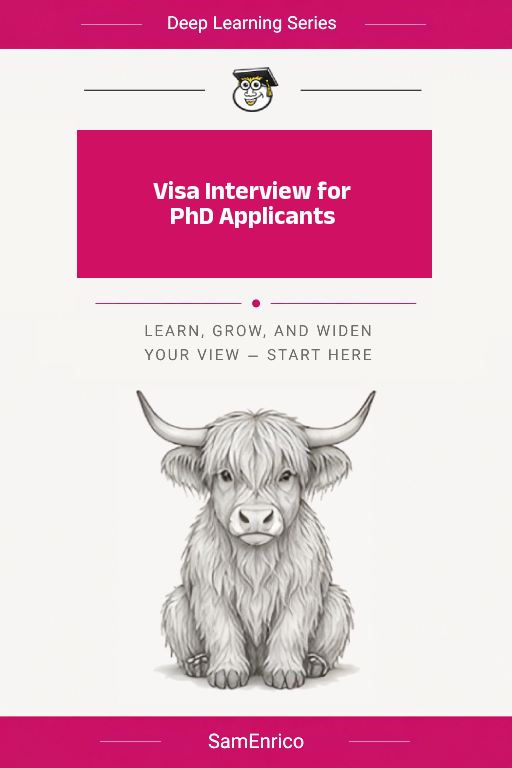
Non-FictionStudent's ShortcutPhD
Visa Interview for PhD Applicants eBook
Prepare for doctoral-level questions about researc
Prepare for doctoral-level questions about research, supervisors, and publication plans.
Formats
Free sample
Chapter 1: The Real Test--–- The night before his visa interview, Dr. Chen—then a Ph D applicant—sat in a budget hotel room three blocks from the US consulate. He had prepared for weeks. His financial documents were organized in a clean folder, each tab labeled. His university’s location and program start date were memorized.
He had rehearsed the standard answers about why he wanted to study in America, about his ties to his home country, about his plans after graduation. He felt ready.But as midnight approached, a different kind of anxiety crept in. What if they asked about his research? He was a materials science applicant with three published papers, but he had never practiced explaining his perovskite solar cell research to a non-specialist. What if they wanted to know his publication plans?
He had vague ideas about publishing during his Ph D, but he had never articulated a timeline. What if they asked about his supervisor’s recent work? He knew his advisor’s name and reputation, but he had not read a single paper in depth.The next morning, the visa officer asked exactly those questions. “Tell me about your research on perovskite solar cells,” the officer said. “And what do you plan to publish during your Ph D?” Dr.
Chen froze. He had prepared for everything except the questions that actually mattered. His answers were halting, vague, and unconvincing. The officer denied his visa.This chapter is for every Ph D applicant who has ever faced that moment of realization—or who wants to avoid it entirely. The student visa interview for doctoral study is fundamentally different from undergraduate or even master’s degree interviews.
You are not just proving that you will return home after your studies. You are proving that you are a credible researcher with a viable academic trajectory. The stakes are higher. The scrutiny is deeper. And the preparation must be rigorous.Why Most Ph D Applicants Fail the Real Test Let us begin with a hard truth.
Most Ph D applicants prepare for the wrong questions. They spend hours organizing financial documents, memorizing university details, and rehearsing answers about family ties. These are not unimportant. Financial documentation matters. Ties to your home country matter.
But they are not what distinguishes successful Ph D applicants from unsuccessful ones.The distinguishing factor is research credibility.Visa officers understand that Ph D candidates are not just students. They are emerging researchers. They will spend five to seven years conducting original research, writing papers, presenting at conferences, and contributing to their fields. The officer’s job is to determine whether you are a credible candidate for that trajectory. They probe your research question, your methodology, your publication plans, your knowledge of your supervisor’s work, and your understanding of your program.A poorly prepared answer about your research can lead to visa denial even when your financial documents are perfect.
I have seen applicants with full scholarships and impeccable family ties denied because they could not explain their research in clear, accessible language. I have seen applicants with partial funding approved because they demonstrated deep knowledge of their advisor’s recent publications and a realistic publication roadmap.The Ph D visa interview is not a financial audit. It is a research credibility interview.The Story of Dr. Chen: What Went Wrong Let us return to Dr. Chen.
After his denial, he was devastated. He had a full scholarship from a top university. His family had strong ties to their home country. His financial documents were flawless. He could not understand why the officer had denied him.He requested the denial explanation.
Under Section 214(b) of the Immigration and Nationality Act, the officer had written: “The applicant did not demonstrate a credible research plan or sufficient knowledge of his proposed program.” The officer had not doubted his money or his ties. The officer had doubted his credibility as a researcher.Dr. Chen spent the next three months preparing differently. He read fifteen papers from his proposed supervisor’s lab. He developed a two-minute research narrative that his parents could understand.
He mapped out a publication timeline by talking to current Ph D students. He researched the program’s resources and named three specific facilities that were unique to that university. He practiced answering unexpected questions with a mock interview partner.When he reapplied, the officer asked similar questions. This time, Dr. Chen answered with clarity and specificity.
He named his supervisor’s 2022 paper on defect passivation in perovskite cells. He explained his publication roadmap: two first-author papers by year three, conference presentations at MRS and ACS, and a review article co-authored with his supervisor. He articulated his career trajectory: returning to his home country to work at the National Institute for Materials Science, where he had already established a contact through his master’s advisor.The officer approved his visa. Dr. Chen is now a post-doctoral researcher in his field.
The difference between his first denial and his second approval was not his financial situation or his family ties. The difference was his research credibility.What Makes the Ph D Visa Interview Different The US student visa (F-1) interview for Ph D applicants typically lasts three to fifteen minutes and covers five key areas: personal information, study plans, financial support, academic background and goals, and study location and purpose. For doctoral applicants, the academic background and goals section becomes the centerpiece of the interview. Visa officers understand that Ph D applicants are not just students; they are emerging researchers. Their questions reflect this understanding.Three factors make the Ph D interview fundamentally different from other student visa interviews.First, research intensity.
Ph D programs are research-driven. You will spend the majority of your time conducting original research, not taking courses. Visa officers know this and will probe your research area, your methodology, and your fit with your proposed supervisor. You must be able to articulate your research in clear, accessible language—often to someone outside your field. This is not an optional skill.
It is essential for your visa interview and for your academic career.Second, publication expectations. Unlike undergraduate or master’s applicants, Ph D candidates are expected to produce original research that leads to publication. Visa officers may ask about your publication timeline, target journals, and co-authorship plans. They are not expecting a guaranteed publication record. They are expecting a thoughtful, stage-appropriate plan that shows awareness of how academic publishing works.
An applicant who claims ten papers in five years raises red flags. An applicant who has never thought about publication raises different red flags.Third, advisor relationship. Your relationship with your proposed supervisor is critical. Visa officers may ask about how you selected your advisor, what you know about their work, and how your research interests align. Generic answers—“They are a famous professor”—fail this test.
You need to demonstrate deep knowledge of your advisor’s recent publications, grant funding, and research direction. You need to show that you have read their work and can articulate how your research extends it.The stakes are real. A poorly prepared answer about your research can lead to visa denial even when your financial…
This is the end of the free sample. Get the eBook to keep going. Buy now
About this book
Details
- Author
- Patton Sheryl
- Publisher
- SamEnrico
- Language
- English
- Genre
- Non-Fiction, Student's Shortcut, PhD
- Released
- 2026-05-29
- Pages (approx.)
- 132
- Available as
- eBook, Audiobook

Read better in the ZLOADR app
Your eBooks on your phone or tablet. Sign in with your SamEnrico account and start reading.
More by Patton Sheryl
 Self Talk For RejectionPatton Sheryl$11.99
 Relationship Check InPatton Sheryl$11.99
 Presentation Recovery TechniquesPatton Sheryl$11.99
 Radical Forgiveness WorkbookPatton Sheryl$11.99
 Joy Harjo Poet WarriorPatton Sheryl$11.99
 Walking Commute OptionPatton Sheryl$11.99
 Habit Formation for LearningPatton Sheryl$11.99
 The Thames Torso Murders: A Killer’s Gruesome TrailPatton Sheryl$11.99
 The Sumerian Star Maps: Enheduanna's Celestial LegacyPatton Sheryl$11.99
 Service Providers Guide to Animal GroomingPatton Sheryl$11.99
 How to Produce Water-based Interior PaintPatton Sheryl$11.99
 How to Produce a TreatmentPatton Sheryl$11.99
You may also like
 Hong Kong Handover 1997Dunn Johnnie$11.99
 Zumba For Postnatal Recovery CourseNeal Christian$11.99
 Zumba for BeginnersLadner Nikia$11.99
 YouTube Comment Mining GuideHumes Pandora$12.99
 Worry Box MeditationCarlin Rudy$11.99
 Workplace Stress MeditationNguyen Lynn$11.99
 Workplace Stress and Sleep RepairHawley Ivory$11.99
 Workplace Perfectionism CureDelaney Jeffry$11.99
 Workplace Injustice Anger GuideWallen Isabelle$11.99
 Work Addiction and Burnout LinkGreenwood Ester$11.99
 Women in Yoga and WellnessBeattie Galina$11.99
 Women in Stand Up ComedyChun Evangeline$11.99