
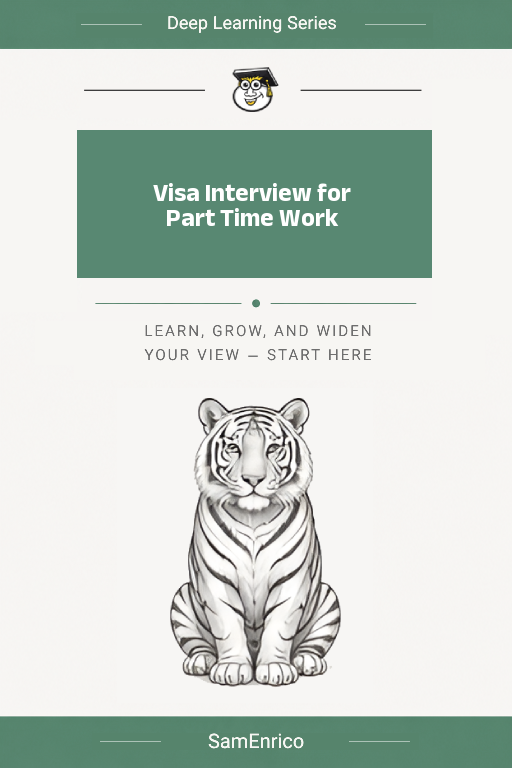
Non-FictionStudent's ShortcutWork Rights
Visa Interview for Part Time Work eBook
Explain your understanding of work hour limits dur
by Kruger Ranee
Explain your understanding of work hour limits during studies without appearing financially desperate.
Formats
Free sample
Chapter 1: The Twenty Lie...--–- The number sits on every international student’s tongue like a half-truth waiting to escape. Twenty. It rolls off easily, convincingly, almost like a password that grants admission to the club of the compliant. But here is the first and most dangerous misunderstanding that this book will shatter: knowing the number twenty is not the same as understanding the rule. Visa officers do not merely want to hear you recite a digit.
They want to witness a specific kind of comprehension—the kind that separates a student who read a pamphlet from a student who has internalized the legal architecture of their visa status.Walk into any student lounge on any university campus that hosts international students, and you will hear the same confident declaration: “I can work twenty hours a week.” Ask a follow-up question—twenty hours when? Under what authorization? With what consequences for crossing the line?—and the confidence crumbles. The number floats in isolation, detached from the regulatory framework that gives it meaning. This chapter is not about memorizing twenty.
This chapter is about understanding why twenty exists, how twenty operates across different jurisdictions, what twenty permits and what twenty forbids, and—most critically—how to speak about twenty in your visa interview so that the officer hears preparation rather than parroting.The Origin of the Limit: Why Twenty and Not Thirty or Forty The twenty-hour rule did not emerge from an arbitrary administrative decision. It emerged from a fundamental legal principle that governs all non-immigrant student visas across virtually every developed country: the principle of primary purpose. When a government issues a student visa, it makes a calculated bet. It bets that the applicant’s primary reason for entering the country is education, not employment, not immigration, not economic opportunity. The twenty-hour limit operationalizes that bet.Legislators and immigration authorities arrived at twenty hours through decades of observation and adjustment.
Studies consistently show that students who work more than twenty hours per week during academic terms experience measurable declines in academic performance. Attendance falters. Assignment completion drops. Retention rates fall. The twenty-hour threshold represents the point at which employment, for the average student, begins to compete seriously with education rather than simply coexist alongside it.But the legal logic runs deeper than academic outcomes.
Governments also care about labor markets. Allowing international students to work unlimited hours would create a parallel labor force competing with citizens and permanent residents. The twenty-hour limit ensures that student employment remains supplementary—filling small gaps in campus staffing or low-skilled off-campus roles—without distorting local labor markets. When you understand this dual purpose (academic integrity plus labor market protection), your answers about work hours naturally become more sophisticated. You stop saying “I know it’s twenty hours” and start demonstrating that you understand why.The Hard Cap Versus the Soft Understanding Here is a distinction that appears in no official government document but matters enormously in your interview: the difference between the hard cap and the soft understanding.
The hard cap is the number. Twenty hours per week during the academic term. No flexibility. No exceptions. No “just this once.” The soft understanding is the behavioral expectation that you will stay well below the cap to prioritize your studies.Visa officers are not robots programmed to reject anyone who says “twenty hours” with insufficient enthusiasm.
They are human evaluators making judgment calls about your reliability as a future visa holder. A student who says “I plan to work exactly twenty hours every week” sounds different from a student who says “If I work at all, I would stay well under the limit to protect my study time.” The first student sounds like someone testing the boundaries. The second student sounds like someone who understands that the visa is for studying.This distinction becomes even more critical when you consider enforcement realities. Immigration authorities rarely deport students for working twenty-one hours in a single week. The enforcement mechanism is cumulative and pattern-based.
Working twenty-one hours occasionally might go unnoticed. Working twenty-five hours regularly will eventually trigger alerts—especially if your employer reports hours electronically, as most universities and many off-campus employers now do. But the visa officer is not an enforcer; the visa officer is a gatekeeper. And the gatekeeper’s question is not “Will this student violate the rule by one hour?” The gatekeeper’s question is “Does this student understand that the rule exists for a reason?”The Anatomy of a Single Week: How Twenty Hours Actually Functions To speak credibly about work hours in your interview, you must understand how twenty hours translates into lived experience. A standard academic week includes approximately fifteen classroom hours for a full-time course load.
Add two hours of study per classroom hour (a conservative estimate; many programs require more), and you reach thirty to forty-five hours of academic commitment. Add commuting, meals, errands, exercise, and sleep. Where do twenty work hours fit?They do not fit comfortably. They fit in the margins—evenings, weekends, the small gaps between obligations. A student working twenty hours while carrying a full course load typically experiences one of three outcomes: sleep deprivation, grade decline, or both.
This is not a moral judgment; it is a mathematical reality. The twenty-hour limit exists not because twenty hours is easy but because twenty hours is the maximum the system can tolerate before collapse.Your interview answer should reflect this reality. Not by complaining about difficulty (never complain to a visa officer) but by demonstrating that you have thought realistically about trade-offs. A student who says “I understand that twenty hours is the absolute maximum, so I would aim for ten to fifteen hours to ensure my academics come first” sounds radically different from a student who says “I can work twenty hours no problem.” The first student sounds mature. The second student sounds naive or, worse, deceptive.The Break Period Exemption: Where Twenty Becomes Forty Every student visa regime includes a critical exception that many applicants misunderstand: during scheduled academic breaks, the hour limit typically expands to full-time work (forty hours per week or equivalent).
This exception is not a loophole. It is a deliberate feature of the regulatory design, based on the recognition that students have no classes to attend during breaks and may use the time to earn additional money or gain more intensive work experience.But the exception comes with three traps. First, “scheduled academic breaks” are defined by your school’s official academic calendar, not by your personal schedule. Taking a week off to travel does not constitute a break. The winter break listed in the university catalog does.
Second, some countries restrict break-period work to on-campus employment only, while others permit off-campus work during breaks under the same authorization rules as term-time work. Third, the transition between term-time limits and break-period limits is not automatic. You must maintain full-time enrollment status leading into the break and be registered for the upcoming term after the break. Drop below full-time status, and you may lose work authorization entirely.In your interview, mentioning the break-period exception can demonstrate sophisticated knowledge—but only if you get the details right for your specific destination…
This is the end of the free sample. Get the eBook to keep going. Buy now
About this book
Details
- Author
- Kruger Ranee
- Publisher
- SamEnrico
- Language
- English
- Genre
- Non-Fiction, Student's Shortcut, Work Rights
- Released
- 2026-05-30
- Pages (approx.)
- 153
- Available as
- eBook, Audiobook

Read better in the ZLOADR app
Your eBooks on your phone or tablet. Sign in with your SamEnrico account and start reading.
More by Kruger Ranee
 Disabled Adult ConnectionKruger Ranee$11.99
 Fixed Mindset Detox GuideKruger Ranee$11.99
 Panel Moderation SkillsKruger Ranee$11.99
 Forgiveness After Friendship BetrayalKruger Ranee$11.99
 Self Esteem for Neurodivergent WorkersKruger Ranee$11.99
 Road Rage Support GroupKruger Ranee$11.99
 Business Credit for Law FirmsKruger Ranee$11.99
 The Lion of Castile: El Cid and the Birth of ChivalryKruger Ranee$11.99
 Behind the Purple ShroudsKruger Ranee$11.99
 The Silver Conspiracy: How Buenos Aires' Elite Rigged the Market (1880s)Kruger Ranee$11.99
 How to Start a Copper Plate Engraver (artistic) Business (Beginners Guide)Kruger Ranee$11.99
 A Collector's Handbook to the Jaguar E-type 3.8-litre RoadsterKruger Ranee$11.99
You may also like
 Hong Kong Handover 1997Dunn Johnnie$11.99
 Zumba For Postnatal Recovery CourseNeal Christian$11.99
 Zumba for BeginnersLadner Nikia$11.99
 YouTube Comment Mining GuideHumes Pandora$12.99
 Worry Box MeditationCarlin Rudy$11.99
 Workplace Stress MeditationNguyen Lynn$11.99
 Workplace Stress and Sleep RepairHawley Ivory$11.99
 Workplace Perfectionism CureDelaney Jeffry$11.99
 Workplace Injustice Anger GuideWallen Isabelle$11.99
 Work Addiction and Burnout LinkGreenwood Ester$11.99
 Women in Yoga and WellnessBeattie Galina$11.99
 Women in Stand Up ComedyChun Evangeline$11.99