
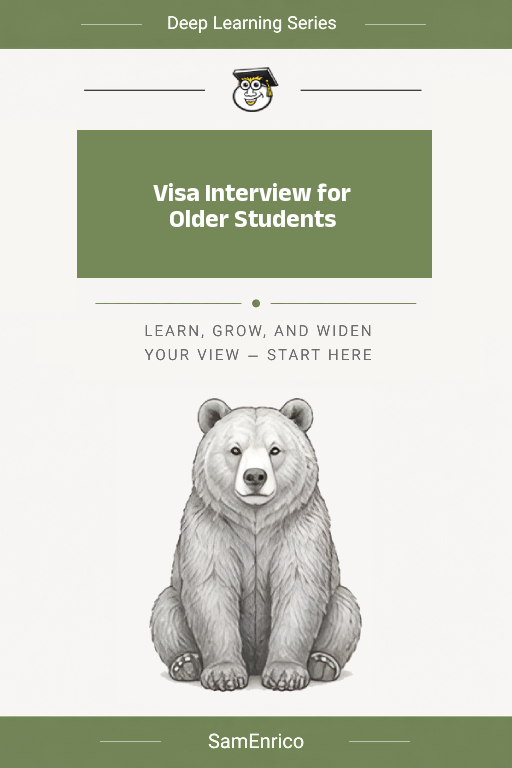
Non-FictionStudent's ShortcutMature
Visa Interview for Older Students eBook
Address age-related concerns and justify studying
Address age-related concerns and justify studying abroad as a mature student.
Formats
Free sample
Chapter 1: The Burden of Proof–- At forty-seven, Maria had done everything right. She had raised two children, managed a successful catering business for fifteen years, and saved enough money to finally pursue the master's degree in hospitality management she had deferred for two decades. When she stepped up to the consular window in her home country, she carried a thick folder of documents: bank statements, property deeds, letters from her current employer, and the acceptance letter from a respected American university. She was confident, prepared, and honest. She had no intention of immigrating.
She simply wanted to learn, return, and expand her business.The officer glanced at her passport, then at her face, then back at her passport. He asked three questions: "Why do you want to study now?" "Who will run your business while you are gone?" "Do you have family in the United States?" Maria answered each one clearly and truthfully. The officer typed for thirty seconds. Then he handed her a white slip of paper. Denied.
Section 214(b). Failure to demonstrate non-immigrant intent.Maria was not a criminal. She was not a risk. She was not poor, uneducated, or desperate. She was simply older than the typical student applicant—and in the eyes of the consular officer, that made her guilty until proven innocent.This chapter dismantles the unspoken bias that ruins the visa applications of thousands of qualified older students every year.
You will learn why consular officers presume you want to immigrate, why your age triggers that presumption, and—most importantly—how to flip the script so that your age becomes your greatest asset rather than your biggest liability.The Invisible Accusation Every applicant for a non-immigrant visa to the United States, Canada, Australia, the United Kingdom, and the Schengen countries faces the same legal hurdle: the presumption of immigrant intent. Under US law specifically, Section 214(b) of the Immigration and Nationality Act states that every person applying for a non-immigrant visa is presumed to be an intending immigrant until they prove otherwise. Similar presumptions exist in Canadian, Australian, British, and European law, though the specific statutes have different names.Here is what that actually means: the consular officer does not start neutral. They do not assume you are telling the truth. They do not give you the benefit of the doubt.
Instead, they start with the assumption that you plan to overstay your visa, disappear into the country, and never leave. Your job is not to explain why you want to study. Your job is to prove, with evidence, that you have more reasons to return home than to stay abroad.For an eighteen-year-old applying to university, this presumption is relatively easy to overcome. A teenager has no career to protect, no property to maintain, no spouse waiting at home, no pension vesting in five years, and no aging parents who need care. The officer looks at an eighteen-year-old and sees someone who is likely to return because they have nothing keeping them abroad—and because their parents are paying for their ticket home.For an older student, the exact same facts trigger the exact opposite suspicion.
An older applicant typically has savings, work experience, family ties, and property. To an officer, those assets do not look like reasons to return. They look like resources that would make it easy to disappear. A teenager has nothing to lose. You have everything to lose—and that paradox is the central challenge of your visa interview.Let me say that again because it is counterintuitive and infuriating: the very things that make you a stable, responsible, successful adult—your career, your savings, your family, your property—are the things that make a consular officer suspect you of wanting to immigrate.
The officer thinks: "This person has money. They have work experience. They have family who might already be abroad. They could easily find a job here and never leave." The officer does not think: "This person has built a life worth returning to."This is the burden of proof that older students carry. It is unfair.
It is illogical. But it is the law, and you must overcome it.Why Age Triggers Suspicion (The Psychology of the Consular Officer)To defeat your enemy, you must understand your enemy. In this case, your enemy is not the consular officer as a person. Most consular officers are overworked, underpaid, and genuinely trying to apply the law consistently. Your enemy is the institutional bias embedded in the training they receive and the quotas they are expected to meet.Consular officers process dozens—sometimes hundreds—of applications every day.
They have minutes, sometimes seconds, to make a decision that will change a person's life. To manage this workload, they rely on mental shortcuts called heuristics. One of the most common heuristics is this: typical students are young. Atypical students are suspicious.The typical student applicant is between eighteen and twenty-four years old. They are applying for a bachelor's or master's degree immediately after completing their previous degree.
They have limited work experience, limited savings, and limited ties to their home country beyond their parents. They are unlikely to overstay because they have no independent means of supporting themselves abroad.When you deviate from this profile, you trigger what psychologists call "anomaly detection." The officer's brain flags you as different, and different is dangerous. The officer then looks for evidence to confirm their suspicion. This is confirmation bias in action: once the officer suspects you might want to immigrate, they will interpret everything you say and everything you present through that lens.This is why older students receive higher denial rates than younger students across almost every visa category. The data is not published consistently, but immigration lawyers who track denial patterns report that applicants over thirty-five are denied at significantly higher rates than applicants under twenty-five, even when controlling for country of origin, program type, and financial resources.Let me give you a specific example.
In 2019, a study of US F-1 visa denial rates by country showed that applicants over thirty from certain high-risk countries faced denial rates exceeding sixty percent, compared to denial rates under thirty percent for applicants under twenty-five from the same countries. The only variable that changed was age. The older applicants had more money, stronger work histories, and clearer career plans. None of it mattered. They were older, so they were denied.This is the reality you face.
But it is not the end of the story.The Flip: Why Age Is Actually Your Greatest Asset Here is the secret that successful older applicants understand and unsuccessful ones miss: the same facts that trigger suspicion can be reframed to prove your case. You cannot change your age. You cannot erase your work history. You cannot pretend you have no savings or no family. But you can change the story those facts tell.The reframe is simple but powerful: instead of apologizing for having more to lose, you prove that you have too much to lose to ever consider overstaying your visa.A teenager has no career to abandon.
You have a career that would be destroyed if you overstayed. A teenager has no property to forfeit. You have…
This is the end of the free sample. Get the eBook to keep going. Buy now
About this book
Details
- Author
- Lewandowski Cinthia
- Publisher
- SamEnrico
- Language
- English
- Genre
- Non-Fiction, Student's Shortcut, Mature
- Released
- 2026-06-01
- Pages (approx.)
- 159
- Available as
- eBook, Audiobook

Read better in the ZLOADR app
Your eBooks on your phone or tablet. Sign in with your SamEnrico account and start reading.
More by Lewandowski Cinthia
 Retirement Connection GuideLewandowski Cinthia$11.99
 Recovering from Work FailureLewandowski Cinthia$11.99
 Road Rage and TeensLewandowski Cinthia$11.99
 Letting Go of Sibling RivalryLewandowski Cinthia$11.99
 Red Cloud War LeaderLewandowski Cinthia$11.99
 Business Credit and EIN GuideLewandowski Cinthia$11.99
 Rhetorical Devices For SpeakersLewandowski Cinthia$11.99
 Habit Formation for Language LearningLewandowski Cinthia$11.99
 Turner's Storm: How J.M.W. Turner Paved the Way for Abstract ArtLewandowski Cinthia$11.99
 The Spy of Olympus: Hermes and the Stolen FireLewandowski Cinthia$11.99
 Service Providers Guide to Alterations, Sewing & DecoratingLewandowski Cinthia$11.99
 How to Produce an International Display WorksLewandowski Cinthia$11.99
You may also like
 Hong Kong Handover 1997Dunn Johnnie$11.99
 Zumba For Postnatal Recovery CourseNeal Christian$11.99
 Zumba for BeginnersLadner Nikia$11.99
 YouTube Comment Mining GuideHumes Pandora$12.99
 Worry Box MeditationCarlin Rudy$11.99
 Workplace Stress MeditationNguyen Lynn$11.99
 Workplace Stress and Sleep RepairHawley Ivory$11.99
 Workplace Perfectionism CureDelaney Jeffry$11.99
 Workplace Injustice Anger GuideWallen Isabelle$11.99
 Work Addiction and Burnout LinkGreenwood Ester$11.99
 Women in Yoga and WellnessBeattie Galina$11.99
 Women in Stand Up ComedyChun Evangeline$11.99