
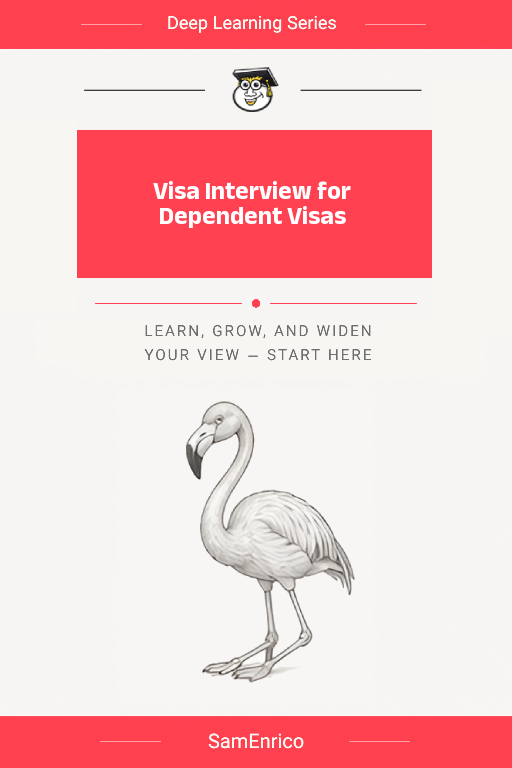
Non-FictionStudent's ShortcutDependent
Visa Interview for Dependent Visas eBook
Prepare for F-2 (US), PBS Dependent (UK), or Schen
Prepare for F-2 (US), PBS Dependent (UK), or Schengen family member visa interviews.
Formats
Free sample
Chapter 1: The Tied Visa--–- The waiting room smelled of stale coffee and anxiety. On the left, a young woman in a business suit clutched a folder of academic credentials—her student visa interview was about qualifications. On the right, a husband sat alone, his only evidence a wedding photograph and six months of chat logs. He was not applying for his own status. His entire future hinged on someone else’s.
That is the dependent visa paradox: you are judged not by what you have achieved, but by who you love.This chapter establishes the fundamental psychological shift required for dependent visa applicants. Unlike student or work visa applicants who must prove qualifications—degrees, job offers, language scores—dependents must prove connection: a genuine, ongoing relationship with the principal visa holder. You will learn why consular officers treat dependents differently, how to reframe your mindset from “begging for permission” to “proving an existing right,” and the single most important communication framework that applies whether you are applying for an F-2 (US), PBS Dependent (UK), or Schengen family visa.The Fundamental Difference: Connection vs. Qualification Every visa interview is built on a core question. For the principal applicant—the student, the worker, the researcher—that question is: Are you qualified?
Do you have the university admission letter? The job offer? The minimum salary? The language test score? These are objective, documentable facts.
They can be measured, verified, and judged on a relatively straightforward scale.For the dependent, the core question is entirely different: Is your relationship real? This is subjective, emotional, and impossible to prove with a single document. A marriage certificate can be bought. Joint bank accounts can be fabricated. Photographs can be staged.
The consular officer knows this. Their job is not to verify your documents—those are checked before the interview. Their job is to verify you. To look into your eyes and decide whether the story you tell matches the paper you carry.This distinction explains everything about why dependent visa interviews feel different. They are not colder or harder arbitrarily.
They are different because the legal standard is different. Under US immigration law, the F-2 dependent must prove that the principal’s status is legitimate and that the dependent has no independent immigrant intent. Under UK PBS Dependent rules, the dependent must prove that the relationship is genuine and subsisting, and that maintenance funds are available without accessing public funds. Under the EU Free Movement Directive (2004/38/EC), family members of EU citizens have a right to facilitation—but they must still prove the family relationship itself.One former visa officer, interviewed anonymously for this book, put it bluntly: “I could tell within sixty seconds whether a marriage was real. The documents just confirmed what I already knew from watching them walk in together.” That is the power of the dependent visa interview.
It is not a document review. It is a human judgment.The 5C Principle: Your Framework for Every Answer Throughout this book, you will encounter the 5C Principle. It is adapted from classic US visa guides but updated for the modern, post-COVID, digital-native interview environment. The 5Cs are: Clear, Concise, Credible, Consistent, and Composed. Each one serves a specific purpose in defusing officer suspicion.Clear Do not hide behind jargon or evasive language.
If the officer asks, “Where did you meet your spouse?” do not answer, “We were introduced through a mutual social network.” Answer, “We met at a friend’s wedding in Mumbai in 2019.” Clarity means names, dates, places. It means the officer never has to ask a follow-up question to understand your basic answer. Clarity also means speaking in complete sentences and avoiding vague pronouns like “there” or “it” without antecedents.Concise The single biggest mistake dependent applicants make is oversharing. When nervous, people talk too much. They offer details that were not requested.
They explain things that need no explanation. A concise answer takes ten seconds, not two minutes. It answers the exact question asked and then stops. If the officer wants more, they will ask. Consular officers conduct dozens of interviews daily.
Every extra word you speak is a word that could introduce inconsistency or suspicion.Credible Your answers must be believable. That does not mean they must be boring or generic. It means they must align with common sense and human behavior. If you claim to speak daily with your spouse but cannot name their favorite food, that is not credible. If you claim to have a traditional arranged marriage but cannot explain who introduced you, that is not credible.
Credibility is built on small, specific, verifiable details that no forger would think to invent.Consistent Consistency operates on two levels. First, your answers must be internally consistent: you do not say you met in 2019 and then later say you met in 2020. Second, your answers must be consistent with your documents: your verbal description of your wedding should match the photographs you submitted. Inconsistency is the single fastest path to a denial under Section 214(b) for US visas or general refusal for Schengen. Officers are trained to spot discrepancies between what you say and what your file shows.Composed Finally, you must remain composed under pressure.
Visa officers sometimes ask aggressive or repetitive questions specifically to provoke an emotional reaction. If you become defensive, angry, or tearful, that signals guilt or instability—neither of which helps your case. Composure means steady breathing, neutral tone, and the ability to say “I don’t know” or “I don’t remember” without panic. It means treating the officer as a professional counterpart, not an adversary.These five principles appear throughout this book. In Chapter 4, you will see how they apply to non-verbal communication and virtual interviews.
In Chapter 8, every sample answer is tagged with a “5C Check” showing which principles it exemplifies. In Chapter 9, the principles become your toolkit for defusing red flag scenarios. For now, simply remember the acronym: 5C.The EU Free Movement Directive: Your Rights as a Family Member Before diving into system-specific rules, you need to understand one piece of law that applies uniquely to Schengen family members—and that fundamentally changes the power dynamic of your interview. The EU Free Movement Directive (2004/38/EC) is not obscure legal trivia. It is the single most powerful tool available to any dependent visa applicant worldwide.Here is what the Directive says, in plain language: If you are a family member of an EU citizen (spouse, registered partner, dependent child, or dependent parent), and you are traveling with that EU citizen to a member state other than their home country, you have a right to enter.
The visa is not a privilege granted at the consulate’s discretion. It is a formality. The consulate must issue it quickly, often free of charge, and with minimal bureaucracy.This has real, practical effects. For example, if your spouse is a German citizen and you are applying to join them in France, the French consulate cannot apply the same scrutiny as they would to a tourist from India or China. They cannot demand proof of ties to your home country.
They cannot ask you to demonstrate that you will leave. They can only verify that the family relationship is genuine…
This is the end of the free sample. Get the eBook to keep going. Buy now
About this book
Details
- Author
- Madden Marica
- Publisher
- SamEnrico
- Language
- English
- Genre
- Non-Fiction, Student's Shortcut, Dependent
- Released
- 2026-06-01
- Pages (approx.)
- 135
- Available as
- eBook, Audiobook

Read better in the ZLOADR app
Your eBooks on your phone or tablet. Sign in with your SamEnrico account and start reading.
More by Madden Marica
 New City Connection PlanMadden Marica$11.99
 Business Credit for LandlordsMadden Marica$11.99
 Habit Formation for ParentingMadden Marica$11.99
 Forgiveness for AnxietyMadden Marica$11.99
 Overcoming Work Insecurity HandbookMadden Marica$11.99
 Road Rage ConsequencesMadden Marica$11.99
 Presentation For IntrovertsMadden Marica$11.99
 Vine Deloria Native TheologyMadden Marica$11.99
 The Siege of Formosa: Dutch Defiance in the East (1661-1662)Madden Marica$11.99
 The Golden Age of Timbuktu: Where Scholars Shaped the WorldMadden Marica$11.99
 Service Providers Guide to PET InsuranceMadden Marica$11.99
 How to Produce Interior and Exterior Alkyd PaintMadden Marica$11.99
You may also like
 Hong Kong Handover 1997Dunn Johnnie$11.99
 Zumba For Postnatal Recovery CourseNeal Christian$11.99
 Zumba for BeginnersLadner Nikia$11.99
 YouTube Comment Mining GuideHumes Pandora$12.99
 Worry Box MeditationCarlin Rudy$11.99
 Workplace Stress MeditationNguyen Lynn$11.99
 Workplace Stress and Sleep RepairHawley Ivory$11.99
 Workplace Perfectionism CureDelaney Jeffry$11.99
 Workplace Injustice Anger GuideWallen Isabelle$11.99
 Work Addiction and Burnout LinkGreenwood Ester$11.99
 Women in Yoga and WellnessBeattie Galina$11.99
 Women in Stand Up ComedyChun Evangeline$11.99