
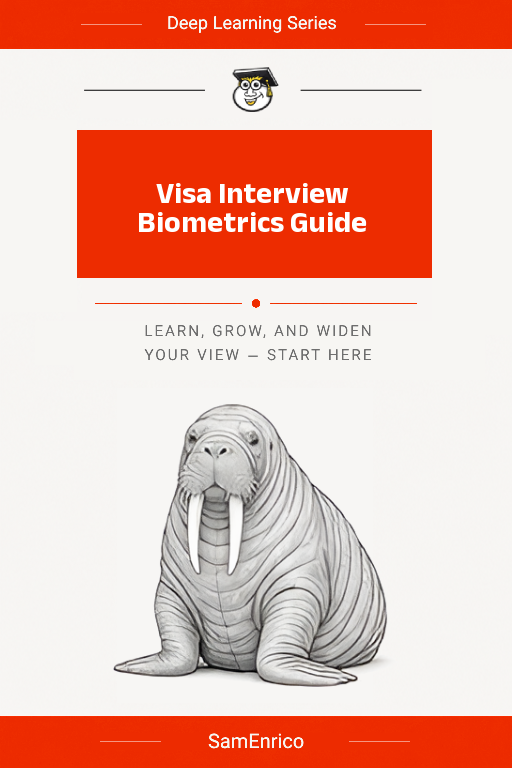
Non-FictionStudent's ShortcutBiometrics
Visa Interview Biometrics Guide eBook
Prepare for fingerprinting and photograph collecti
by Little Damon
Prepare for fingerprinting and photograph collection at visa application centers.
Formats
Free sample
Chapter 1: The Fingerprint Fear...--–- The first time Maria saw the biometrics appointment letter, her hands went cold. Not because she had anything to hide—she was a university professor with a clean record and a valid job offer from a tech firm in Toronto. But somewhere in her mind, the word “fingerprints” had fused with “interrogation.” She imagined a cold room, bright lights, an officer studying her every move, judging her worthiness to enter Canada. She spent three sleepless nights memorizing her own employment history, rehearsing answers to questions no one would ever ask. When she finally walked into the visa application center, the technician smiled, scanned her prints in ninety seconds, and said, “You’re all set.” Maria had lost three nights of sleep over nothing.This chapter exists to ensure you never become Maria.The biometrics appointment is the most misunderstood step in the entire visa process.
Applicants routinely confuse it with the consular interview, treat it as a test of character, and arrive burdened with anxiety that serves no purpose. The reality is far simpler and far less intimidating. Biometrics collection—fingerprinting and photograph capture—is an administrative security procedure, not an evaluation of your worthiness to enter a country. Understanding this distinction is the single most important factor in walking through the appointment with confidence and speed.The Big Picture: What Biometrics Actually Are Biometrics are measurable physical characteristics that are unique to each individual. For visa purposes, this means two things: your fingerprints and your facial features captured in a digital photograph.
Every major country—the United States, Canada, the United Kingdom, Australia, and the Schengen states—has adopted biometric collection as the gold standard for identity verification. The reason is simple: documents can be forged, passports can be stolen, but your fingerprints and facial structure cannot be replicated with any practical reliability.When you provide your biometrics, the visa center is not building a file on your personality, your intentions, or your moral character. They are building a mathematical template of your physical identity. Your fingerprints are converted into a digital code that can be matched against databases in seconds. Your photograph is analyzed by facial recognition algorithms that measure the distance between your eyes, the shape of your jaw, and the contour of your cheekbones.
This data is then stored in a secure system and linked to your visa application.The process is not invasive. It is not painful. It is not an interrogation. It is, in the words of one former USCIS technician who now consults on this book, “about as exciting as renewing a driver’s license.” The only difference is that the stakes feel higher because the outcome—a visa approval or denial—matters so much.The Two Core Goals: Identity and Security Every biometrics appointment in every country serves exactly two purposes, and understanding these purposes will eliminate 90 percent of your anxiety.Goal One: Prove you are who you say you are (Identity Verification).When you submit a visa application, you provide a name, a date of birth, a passport number, and supporting documents. But paper can be stolen or fabricated.
Biometrics close that loophole. By matching your fingerprints against the identity documents you submitted, the visa officer can be confident that the person who applied is the same person standing in the visa center. This prevents identity theft, passport fraud, and the use of stolen documents.Goal Two: Prove you are not a security risk (Background Screening).Your fingerprints are run through criminal databases—the FBI’s Next Generation Identification system in the United States, the RCMP’s Canadian Police Information Centre, Interpol’s global database, and similar systems in other countries. The purpose is not to find reasons to deny you. The purpose is to ensure that you do not have a criminal record that would make you inadmissible under that country’s immigration laws.
Most people have no such record, and for them, this step is a silent, automatic pass.The critical insight is this: the biometrics technician does not evaluate whether you pass or fail. They simply collect the data. The background check happens hours or days later, in a computer system, without human review unless a match is found. The technician at the counter has no more power over your visa approval than the clerk who scans your groceries has power over the price of milk.Debunking the Myths: What This Appointment Is NOTThe immigration advice industry is filled with misinformation about biometrics appointments. Some of this comes from confusion with the consular interview.
Some comes from outdated procedures that no longer exist. And some comes from pure fear-mongering designed to sell consultation services. Let us clear the record completely.Myth One: This is part of the visa interview.This is the most common and most harmful misconception. In almost every country, the biometrics appointment and the visa interview are completely separate events. The biometrics appointment happens at a different location (an Application Support Center or Visa Application Centre), with different staff (technicians, not consular officers), and for a different purpose (data collection, not evaluation).
In many cases—such as US visa renewals or certain Canadian work permits—there is no interview at all. The biometrics appointment is the only in-person step. Confusing the two is the fastest way to create unnecessary panic and to waste time preparing for questions that will never come.Myth Two: The technician can approve or deny your visa.Absolutely false. Biometrics technicians are trained to collect fingerprints and photographs. They are not trained in immigration law.
They have no access to your application file beyond the basic information needed to confirm your identity. They cannot see your employment history, your financial documents, or your travel itinerary. They certainly cannot approve or deny your visa. When a technician says “you’re all set,” they mean “I have successfully collected your biometrics”—not “your visa is approved.” The approval decision comes later, from a consular officer who never meets you in person for most visa categories.Myth Three: If your fingerprints are rejected, your visa is denied.A rejected fingerprint scan has nothing to do with your visa eligibility. It means the scanner could not get a clear reading—usually due to moisture, dryness, or improper pressure.
When this happens, the technician will simply try again. If multiple attempts fail, you may receive a second appointment notice to try again another day. This is a technical failure, not a judgment on your character or your application. Countries have entire systems in place to accommodate applicants with permanent fingerprinting issues (scarring, missing fingers, certain medical conditions). These systems are not designed to punish you.
They are designed to work around physical limitations.Myth Four: You should dress formally to impress the officer.This myth comes from confusing biometrics with a job interview or a consular interview. There is no officer to impress. The technician does not care if you are wearing a suit or a t-shirt, as long as your face is fully visible for the photograph. In fact, formal clothing can work against you if it includes metal accessories (belts, jewelry, watches) that trigger security alarms and slow down the…
This is the end of the free sample. Get the eBook to keep going. Buy now
About this book
Details
- Author
- Little Damon
- Publisher
- SamEnrico
- Language
- English
- Genre
- Non-Fiction, Student's Shortcut, Biometrics
- Released
- 2026-06-01
- Pages (approx.)
- 124
- Available as
- eBook, Audiobook

Read better in the ZLOADR app
Your eBooks on your phone or tablet. Sign in with your SamEnrico account and start reading.
More by Little Damon
 Habit Formation for Smoking CessationLittle Damon$11.99
 Road Rage and HealthLittle Damon$11.99
 Compuscan Business Credit GuideLittle Damon$11.99
 Presentation Rehearsal TechnologyLittle Damon$11.99
 Self Esteem for High Pressure JobsLittle Damon$11.99
 Empty Nest ReconnectionLittle Damon$11.99
 Forgiveness After Childhood AbuseLittle Damon$11.99
 Charles Eastman Dakota DoctorLittle Damon$11.99
 The Aztec Ballgame Champions: The First Rules of Ultra in MesoamericaLittle Damon$11.99
 Hiawatha's Song: The Great Peacemaker's JourneyLittle Damon$11.99
 A Collector's Handbook to the Jaguar 4.2 Series ILittle Damon$11.99
 Service Providers Guide to Pooper ScoopersLittle Damon$11.99
You may also like
 Hong Kong Handover 1997Dunn Johnnie$11.99
 Zumba For Postnatal Recovery CourseNeal Christian$11.99
 Zumba for BeginnersLadner Nikia$11.99
 YouTube Comment Mining GuideHumes Pandora$12.99
 Worry Box MeditationCarlin Rudy$11.99
 Workplace Stress MeditationNguyen Lynn$11.99
 Workplace Stress and Sleep RepairHawley Ivory$11.99
 Workplace Perfectionism CureDelaney Jeffry$11.99
 Workplace Injustice Anger GuideWallen Isabelle$11.99
 Work Addiction and Burnout LinkGreenwood Ester$11.99
 Women in Yoga and WellnessBeattie Galina$11.99
 Women in Stand Up ComedyChun Evangeline$11.99