
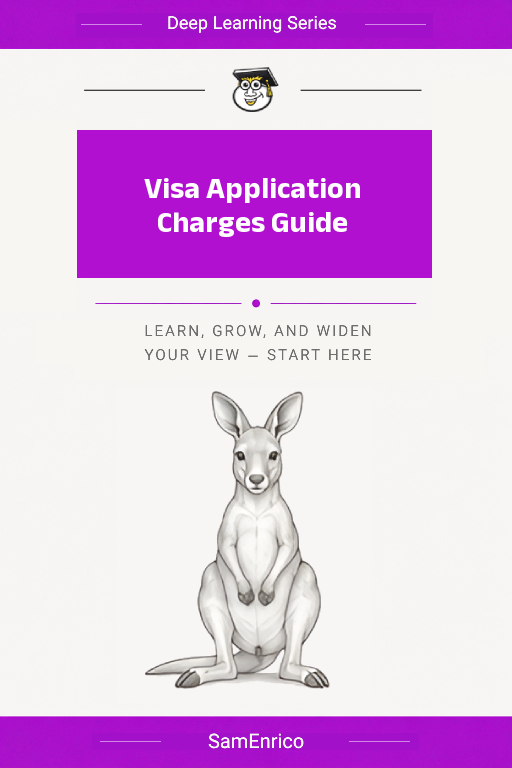
Visa Application Charges Guide eBook
Budget for Australian PR application fees as a stu
Budget for Australian PR application fees as a student. This workbook covers costs for main applicants and dependents in the migration system.
Formats
Free sample
Chapter 1: The $10,000 Blind Spot-- Every year, more than 700,000 international students begin their Australian journey with a singular focus: getting that acceptance letter, booking the flight, and securing their Student Visa. They budget meticulously for tuition, rent, and living expenses. They celebrate when the visa grant arrives. And then, two or three years later, they sit at a kitchen table in Melbourne or Sydney, staring at a laptop screen, completely blindsided. The visa application form on their screen shows a number that is two, sometimes three times higher than what they had saved.
Their partner, who came as a dependent, now costs an additional 2,300.Theirchild,whowasbornduringtheirstudies,requiresaseparatechargeof2,300. Their child, who was born during their studies, requires a separate charge of 2,300.Theirchild,whowasbornduringtheirstudies,requiresaseparatechargeof1,160. The health checks, police certificates, English tests, and skills assessments add thousands more. And the date on the calendar—March 1st or July 1st—determines whether they pay the old price or a new, dramatically higher one. This book exists because that kitchen table scenario happens to thousands of families every year.
It happens because the Australian immigration system does not want you to know the full cost of your journey upfront. It hides the true price in layers, exceptions, indexation cycles, and fine print. This chapter reveals the single biggest reason applicants overpay: they only budget for the visa they are applying for today, not the cascade of visas they will need tomorrow. The $10,000 blind spot isn't one fee—it's the gap between what you think you will pay and what you actually will pay when you include dependents, prerequisites, contingencies, and timing mistakes.Think of the Visa Application Charge, or VAC, as the advertised price on a car. It looks reasonable.
It fits your spreadsheet. But by the time you add mandatory insurance, delivery fees, taxes, registration, and the "optional" upgrades that are actually required for the model you need, the final number bears little resemblance to the sticker price. The Australian Department of Home Affairs publishes a Visa Pricing Table divided into categories like "study," "work," and "live," but this table is deliberately simplified -1. It shows the Base Application Charge for a single applicant. It hints at additional charges for family members.
What it does not do is warn you that the 2,000Student Visayoupaidlastyearhasbeenreplacedbya2,000 Student Visa you paid last year has been replaced by a 2,000Student Visayoupaidlastyearhasbeenreplacedbya4,600 Graduate Visa this year, or that your partner's lack of English skills will cost you an extra $4,000 in fees that a skilled couple could have avoided entirely.This chapter establishes the foundational framework that the rest of this workbook will build upon. We begin not with a fee table, but with a concept: The Total Cost Taxonomy. Every dollar you will spend on Australian migration falls into one of five distinct tiers. Most applicants only prepare for Tier 1. The ones who succeed prepare for all five.
By the end of this chapter, you will understand exactly where your money is going, why most students under-budget by 40 to 60 percent, and how this workbook will save you from becoming another kitchen table statistic.The Five Tiers of Migration Costs Before we examine specific visa subclasses or application strategies, we must understand the complete landscape of migration expenses. The Australian immigration system is not designed to be transparent about total costs. It reveals fees incrementally, like a video game unlocking new levels only after you have committed to the previous one. This section names and defines each tier so that you can recognize every charge before it appears on your screen.Tier 1: Visa Application Charges (VACs) – This is the government fee you pay to lodge a visa application. It includes the Base Application Charge for the primary applicant, the Additional Applicant Charge for family members, and in some cases, a Subsequent Entrant Charge if you add dependents after the initial lodgement.
These charges are set by regulation, indexed annually, and are completely non-refundable regardless of whether your visa is granted or refused. Most applicants assume Tier 1 is the only cost. This assumption is the root of the blind spot.Tier 2: Mandatory Government Ancillary Costs – These are fees required by the Department of Home Affairs but paid to third-party providers. They include the visa medical examination (conducted by clinics like BUPA or Medibank), police certificates from every country where you have lived for 12 months or more in the last 10 years, and biometrics collection fees. While these are not technically "visa application charges," you cannot receive a visa without paying them.
The Department's own website states that "you might also have to pay for health checks, police certificates and biometrics" -7. That word "might" is misleading. For almost all permanent residency pathways, you absolutely will.Tier 3: Prerequisite Third-Party Costs – Before you can even apply for most skilled or graduate visas, you must obtain assessments, tests, and credentials from independent authorities. These include English language tests (IELTS, PTE, TOEFL), skills assessments from bodies like VETASSESS, ACS, Engineers Australia, or ANMAC, and in some cases, Professional Year programs or NAATI credentialing for community language points. These costs often exceed the visa application charge itself.
For example, a trades worker undergoing the Trades Recognition Australia Job Ready Program can pay over $3,400 in assessment fees before submitting a single visa application form -9.Tier 4: Professional Services Costs – Most applicants, particularly those with complex circumstances or dependents, hire a Registered Migration Agent (MARA registered) or immigration lawyer. These professionals charge fees that vary wildly based on the complexity of your case, ranging from 1,500forastraightforward Student Visaextensionto1,500 for a straightforward Student Visa extension to 1,500forastraightforward Student Visaextensionto8,000 or more for a complex permanent residency application involving health waivers or character issues. Additionally, you may need NAATI accredited translations of foreign documents (marriage certificates, birth certificates, police clearances), statutory declarations, and in some cases, professional photography or legal evidence compilation for partner visa applications.Tier 5: Contingency and Economic Costs – This is the tier that almost nobody plans for. It includes the indexation buffer—the annual July 1st fee increase that adds 3 to 4 percent to most VACs each year, and special mid cycle hikes like the 106 percent increase to the Subclass 485 visa that took effect on March 1, 2026 -2. It includes currency fluctuation buffers for applicants sending money from countries like India, China, or Nepal—exchange rates can shift by 3 to 5 percent between budgeting and payment day.
And it includes what this book calls the Family Buffer: an emergency fund of 15 to 20 percent above total estimated VACs for unexpected costs, health issues that require additional medical testing, appeal fees if your visa is refused, or worst case scenario, flights home for dependents.A single applicant who only budgets for Tier 1 might think their migration will cost 4,910(the Subclass189skilledvisafeeasof July2025).Buttheapplicantwhobudgetsforallfivetiersknowstherealcostiscloserto4,910 (the Subclass 189 skilled visa fee as of July 2025). But the applicant who budgets for all five tiers knows the real cost is closer to 4,910(the Subclass189skilledvisafeeasof July2025).Buttheapplicantwhobudgetsforallfivetiersknowstherealcostiscloserto8,000 to 10,000onceskillsassessments,Englishtests,medicalexams,policechecks,agentfees,andcontingenciesareadded[citation:9].Afamilyoffourbudgetingonlyfor Tier1mightsee10,000 once skills assessments, English tests, medical exams, police checks, agent fees, and contingencies are added [citation:9]. A family of four budgeting only for Tier 1 might see 10,000onceskillsassessments,Englishtests,medicalexams,policechecks,agentfees,andcontingenciesareadded[citation:9].Afamilyoffourbudgetingonlyfor Tier1mightsee9,825 in VACs and assume they are prepared. The informed family budgets 15,000to15,000 to 15,000to18,000 total -9. That $10,000 blind…
This is the end of the free sample. Get the eBook to keep going. Buy now
About this book
Details
- Author
- Hawkins Pearl
- Publisher
- SamEnrico
- Language
- English
- Genre
- Non-Fiction, Student's Shortcut, Fee Planning
- Released
- 2026-06-01
- Pages (approx.)
- 160
- Available as
- eBook, Audiobook

Read better in the ZLOADR app
Your eBooks on your phone or tablet. Sign in with your SamEnrico account and start reading.
More by Hawkins Pearl
 TM for Busy ProfessionalsHawkins Pearl$11.99
 Gout Arthritis ManagementHawkins Pearl$11.99
 Therapy Social Media PressureHawkins Pearl$11.99
 Bathroom Toxin Elimination PlanHawkins Pearl$11.99
 Appetite Loss After GriefHawkins Pearl$11.99
 Mindfulness For Caregivers MBSRHawkins Pearl$11.99
 Carnegie Quotes GuideHawkins Pearl$11.99
 Breath for HomelessnessHawkins Pearl$11.99
 Sarcopenia Fall Prevention PlanHawkins Pearl$11.99
 The Ghosts of Vukovar: Siege of the Iron CityHawkins Pearl$11.99
 Letters from the Sky: The Love That Defied the BlitzHawkins Pearl$11.99
 The Fire Below: Unveiling the Indian Ocean's Volcanic SecretsHawkins Pearl$11.99