
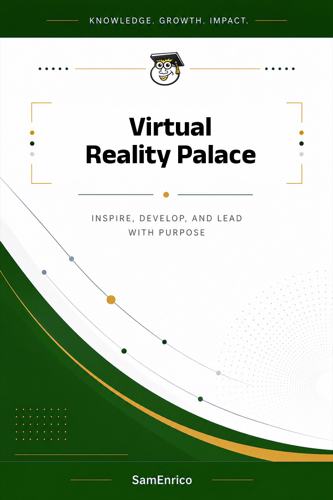
Non-FictionSelf-HelpTechnology
Virtual Reality Palace eBook
Use VR tools to walk through digital memory palace
by Sewell Judie
Use VR tools to walk through digital memory palaces.
Formats
Free sample
Chapter 1: The Digital Dementia Epidemic...--–- The average human being today carries in their pocket a device more powerful than the supercomputers that guided astronauts to the moon. And that same device is quietly, systematically, destroying the most fundamental human faculty: the ability to remember.Your smartphone is not your friend. It is not a neutral tool. It is a relentless outsourcing machine, and the asset it is most efficiently outsourcing is your own biological memory. You no longer need to remember phone numbers, because your phone remembers them.
You no longer need to remember directions, because your GPS remembers them. You no longer need to remember birthdays, anniversaries, grocery lists, or even the name of the person you were just introduced to thirty seconds ago, because your phone—or your calendar, your contacts, your notes app—remembers it for you.And your brain, being an exquisitely efficient organ, has responded exactly as any organ would respond to a function it no longer performs: it has atrophied.This is not a moral failing. It is not laziness. It is neuroplasticity working exactly as designed. The brain rewires itself based on what you ask it to do.
If you ask it to offload memory to an external device thousands of times per day, it will happily comply. The neural pathways that once maintained sharp, reliable recall will be pruned away, their resources reassigned to the tasks you actually perform—scrolling, swiping, filtering notifications, toggling between fourteen open tabs, and responding to the dopamine hit of a new message.The result is a quiet epidemic that researchers have begun to call Digital Dementia. It is not Alzheimer's. It is not clinical memory loss. It is something more insidious precisely because it is invisible and universal.
It is the slow, voluntary surrender of your memory to machines that do not care whether you grow weaker.But here is the truth that the technology industry does not want you to understand: you can take it back. You can rebuild. And the same technology that weakened your memory can become the most powerful training ground for strengthening it beyond anything your ancestors could have imagined.This book is about that transformation.The Paradox of Infinite Information Consider a number. A simple, staggering number: the average person today encounters more information in a single day than a person in the fifteenth century encountered in their entire lifetime. This is not hyperbole.
Researchers at the University of California, San Diego, calculated that Americans consumed approximately 34 gigabytes of information per day outside of work in 2008. By 2024, that number had more than doubled. You are swimming in an ocean of data so vast that your evolutionary hardware—a brain designed for small tribes, open savannahs, and the immediate demands of survival—is hopelessly overwhelmed.And yet, despite this flood of information, you remember almost none of it.You have read thousands of news articles. You have watched hundreds of documentaries. You have sat through countless meetings, lectures, presentations, and conversations.
And if I asked you to recall, right now, the specific details of any one of them beyond a vague summary, you would struggle. The information passed through you like water through a sieve. It was never encoded. It was never stored. It was never yours.This is not because your memory is broken.
It is because you have never been taught how to use it.The Forgotten Superpower Twenty-five hundred years ago, long before the printing press, long before the internet, long before anyone had ever heard the words "cognitive load" or "working memory," the Greek poet Simonides of Ceos attended a banquet. He recited a lyric poem in honor of his host, a wealthy nobleman named Scopas. Then, as the story goes, Simonides was called outside to meet with two young men. While he was gone, the roof of the banquet hall collapsed, crushing every guest inside. The bodies were mangled beyond recognition.
No one could identify the dead.But Simonides could.He closed his eyes and walked through the banquet hall in his mind. He remembered where each guest had been sitting. He remembered the positions they occupied around the table. He called out names—this one here, that one there—and the families of the dead were able to bury their loved ones properly.In that moment of catastrophe, Simonides discovered something profound about the human brain. He realized that we remember spaces and images with astonishing fidelity, while we struggle to remember abstract facts and arbitrary lists.
Your brain can recall the layout of your childhood home—every room, every piece of furniture, the angle of the light in the afternoon—with near-perfect accuracy, even if you have not lived there in thirty years. But you cannot remember the three things your boss asked you to do this morning.This is not a bug. It is a feature. Your brain evolved to navigate physical space, to remember where the water was, where the predators hid, where the edible plants grew. Spatial memory was a matter of life and death.
Abstract memory—lists, numbers, names, categories—was a late addition, a thin layer of cognitive frosting on an ancient neural cake.Simonides took this insight and turned it into a technique. He called it the Method of Loci—the method of places. If you wanted to remember a speech, a list, or any body of information, you would build a mental palace. You would imagine a familiar building, walk through it in your mind, and place vivid images representing each piece of information at specific locations along the path. To recall, you would simply walk through the palace again, see the images, and translate them back into the information you needed.For two thousand years, this technique was the secret weapon of orators, scholars, and philosophers.
Cicero used it to memorize his speeches. Medieval monks used it to memorize entire books of scripture. Renaissance scholars used it to master multiple fields of knowledge simultaneously. It was not magic. It was cognitive engineering—the deliberate exploitation of the brain's native architecture.And then, somewhere along the way, we forgot.
We invented writing. We invented printing. We invented digital storage. And we decided that we no longer needed to remember.The Cost of External Memory Every time you reach for your phone to check a fact, to confirm an appointment, to retrieve a name, you are making a choice. You are choosing external memory over internal memory.
And each choice, individually, is harmless. But ten thousand choices—the average smartphone user checks their device ninety-six times per day, according to a study by Asurion—reshape your brain.The neuroscience is clear. The hippocampus, the seahorse-shaped structure deep in your brain that is responsible for spatial memory and the consolidation of new learning, shrinks when it is not used. Studies of London taxi drivers, who are required to memorize the city's twenty-five thousand streets and countless landmarks, have shown that their hippocampi are significantly larger than those of bus drivers, who follow fixed routes. The brain grows what it uses and prunes what it ignores.Your phone is a hippocampal atrophy machine.But there is another cost, one that is harder to…
This is the end of the free sample. Get the eBook to keep going. Buy now
About this book
Details
- Author
- Sewell Judie
- Publisher
- SamEnrico
- Language
- English
- Genre
- Non-Fiction, Self-Help, Technology
- Released
- 2026-06-10
- Pages (approx.)
- 129
- Available as
- eBook, Audiobook

Read better in the ZLOADR app
Your eBooks on your phone or tablet. Sign in with your SamEnrico account and start reading.
More by Sewell Judie
 Parental Stress Physical SymptomsSewell Judie$11.99
 Fractional Self Hypnosis GuideSewell Judie$11.99
 REIT Preferred SharesSewell Judie$11.99
 Driving Calm SuggestionSewell Judie$11.99
 The ED Recovery GuideSewell Judie$11.99
 Pet Loss and Appetite ChangesSewell Judie$11.99
 ED and Masturbation HabitsSewell Judie$11.99
 The Red Army's Gold: How Stalin Funded the Eastern FrontSewell Judie$11.99
 Grace in Motion: The Black Pioneers Who Defined BalletSewell Judie$11.99
 How to Produce Riveting ToolsSewell Judie$11.99
 A Collector's Handbook to the Alta 2-litreSewell Judie$11.99
 German Post Study Work Visa GuideSewell Judie$12.99
You may also like
 Hong Kong Handover 1997Dunn Johnnie$11.99
 Zumba For Postnatal Recovery CourseNeal Christian$11.99
 Zumba for BeginnersLadner Nikia$11.99
 YouTube Comment Mining GuideHumes Pandora$12.99
 Worry Box MeditationCarlin Rudy$11.99
 Workplace Stress MeditationNguyen Lynn$11.99
 Workplace Stress and Sleep RepairHawley Ivory$11.99
 Workplace Perfectionism CureDelaney Jeffry$11.99
 Workplace Injustice Anger GuideWallen Isabelle$11.99
 Work Addiction and Burnout LinkGreenwood Ester$11.99
 Women in Yoga and WellnessBeattie Galina$11.99
 Women in Stand Up ComedyChun Evangeline$11.99