
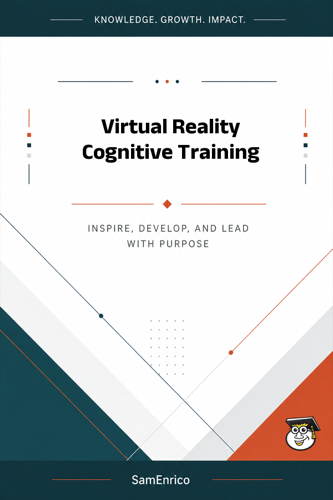
Non-FictionHealth & WellnessDigital Therapeutics
Virtual Reality Cognitive Training eBook
Use immersive environments for spatial memory and
by Hooper Altha
Use immersive environments for spatial memory and navigation practice.
Formats
Free sample
Chapter 1: The Vanishing Navigator...--The first time I watched a fifty-two-year-old man get lost returning from his own mailbox, I thought I was witnessing a stroke.It was a Tuesday afternoon in the fall of 2022. I was conducting a small pilot study on aging and spatial cognition at a university lab that will remain anonymous to protect the participant’s privacy. The man—let us call him David—had volunteered for what he believed was a simple memory test. He had no history of neurological disease. He was a retired civil engineer, sharp in conversation, capable of discussing bridge load calculations and municipal water systems with precision.
He had driven himself to the appointment without incident, using his phone’s GPS as he always did.The test was straightforward: navigate a virtual neighborhood on a screen using only a keyboard and mouse. Find the coffee shop. Find the library. Find your way back to the start. David completed the first two tasks slowly but correctly.
Then came the third instruction: “Return to the starting point without using the map.”He froze.His hand hovered over the keyboard. He turned left, then right, then left again. After thirty seconds of hesitation, he said something I have never forgotten: “I don’t know where I am. I don’t know how I got here. I don’t know how to get back.”This was not a man with dementia.
This was a man whose brain had been trained, over a decade of exclusive GPS use, to outsource navigation entirely. His hippocampus—the seahorse-shaped structure deep in the brain responsible for spatial memory and, critically, for encoding new episodic memories—had learned that it no longer needed to do its job. The phone would remember. The phone would guide him. And when the phone went silent, so did his internal compass.David’s face in that moment was not confused.
It was something closer to betrayed. He had trusted his technology, and his technology had returned the favor by quietly, invisibly, allowing a fundamental human capacity to wither.This book is the story of how that happens, why it matters more than you think, and what you can do about it using a tool that sounds like science fiction but sits on shelves at Best Buy: virtual reality.The Silent Epidemic You Have Never Heard Of Let us begin with a number that should stop you cold. According to a 2018 survey by the Pew Research Center, eighty-one percent of American adults own a smartphone. Of those, seventy-seven percent report using turn-by-turn navigation apps at least occasionally. Among drivers under thirty, the number exceeds ninety percent.
If you are reading these words on a device—and you almost certainly are—there is a better than even chance that you have not navigated a new route from memory in the past year.This is not a moral failing. It is not laziness. It is the natural consequence of living in an age of unprecedented cognitive convenience. Why memorize a route when your phone will not only remember it but also recalculate in real time when you miss a turn? Why build a mental map when a blue dot on a screen shows you exactly where you are, down to the meter?The answer, it turns out, is that the brain interprets these questions as permission to stop investing resources in navigation.
And the brain is ruthlessly efficient. Neural tissue is expensive to maintain—it consumes twenty percent of your body’s energy despite accounting for only two percent of its mass. Any function that goes unused is subject to what neuroscientists call “use-dependent atrophy.” If you stop using your leg muscles, they shrink. If you stop using your spatial memory systems, they do the same.But here is the part that should concern you: the hippocampus—the very region that atrophies from GPS overuse—is also the brain’s gateway to forming new long-term memories. It is not just your sense of direction that is at risk.
It is your ability to remember where you parked, yes, but also your ability to remember what you ate for breakfast, the name of the person you met yesterday, and the plot of the movie you watched last week. Spatial memory and episodic memory share the same neural infrastructure. When you damage one, you weaken the other.The Taxi Driver Study That Changed Everything To understand what we are losing, we must go back to one of the most famous experiments in modern neuroscience. In the late 1990s, researchers at University College London led by Dr. Eleanor Maguire recruited a group of London taxi drivers.
Not just any taxi drivers—these were drivers who had completed “The Knowledge,” a legendary training regimen that requires memorizing 25,000 streets, 20,000 landmarks, and the most efficient routes between any two points in a six-mile radius of Charing Cross. The test takes an average of three to four years to pass. Only about half of trainees succeed.Maguire’s team placed these drivers into MRI scanners and measured their brains. The results were astonishing. Compared to control subjects of similar age and education, the taxi drivers had significantly larger posterior hippocampi—the region associated with spatial memory and navigation.
More remarkably, the increase was proportional to experience. Drivers who had been on the job longer had larger hippocampi. The brain had literally grown in response to demand.This was neuroplasticity made visible. The adult brain, long thought to be fixed after childhood, had reshaped itself in response to intense spatial training. The taxi drivers were not born with larger hippocampi.
They built them, street by street, corner by corner.But there is a second finding from the same study that receives far less attention. When the taxi drivers retired and stopped navigating daily, their hippocampal volume began to decrease. The gains were reversible. Use it or lose it applied in both directions.Now here is the question Maguire’s study did not ask, but that subsequent research has begun to answer: what happens when you replace active navigation with passive GPS guidance?The GPS Studies You Were Not Meant to See In 2017, a team of neuroscientists at Mc Gill University led by Dr. Véronique Bohbot published a study that should have made headlines.
They scanned the brains of healthy young adults who reported frequent GPS use and compared them to infrequent users. The results were clear: frequent GPS users showed reduced gray matter density in the hippocampus. Their brains had physically changed in response to their reliance on turn-by-turn directions.Let that land. Young adults. No dementia.
No stroke. No head trauma. Just years of letting a phone tell them when to turn. And their hippocampi had shrunk.A follow-up study by the same group placed participants into a virtual navigation task while scanning their brains with functional MRI. Some participants navigated using spatial strategies—“I need to go north, then look for the red building.” Others navigated using stimulus-response strategies—“When I see the red building, I turn left.” The second group was effectively using a mental GPS, following learned associations rather than building cognitive maps.
Their brains showed reduced activity in the hippocampus and increased activity in the caudate nucleus, a region associated with habit…
This is the end of the free sample. Get the eBook to keep going. Buy now
About this book
Details
- Author
- Hooper Altha
- Publisher
- SamEnrico
- Language
- English
- Genre
- Non-Fiction, Health & Wellness, Digital Therapeutics
- Released
- 2026-06-06
- Pages (approx.)
- 146
- Available as
- eBook, Audiobook

Read better in the ZLOADR app
Your eBooks on your phone or tablet. Sign in with your SamEnrico account and start reading.
More by Hooper Altha
 The Anger Trigger Log WorkbookHooper Altha$11.99
 EQ Remote Team ManagementHooper Altha$11.99
 Mindfulness For OverworkersHooper Altha$11.99
 Kelsea Ballerini Pop Country GuideHooper Altha$11.99
 The Vanishing Hour: How 1977’s NYC Blackout Rewrote Time ItselfHooper Altha$11.99
 Gold Beneath the Ashes: The Untold Story of the 1936 Berlin Olympics’ Forgotten ChampionHooper Altha$11.99
 Understanding Frontometaphyseal DysplasiaHooper Altha$17.99
 Andesine MiningHooper Altha$11.99
 Instagram Pivot ManualHooper Altha$12.99
 Volume Discount AdjustmentHooper Altha$12.99
 How to Start a Bacteria Bed Tile Business (Beginners Guide)Hooper Altha$11.99
You may also like
 Hong Kong Handover 1997Dunn Johnnie$11.99
 Zumba For Postnatal Recovery CourseNeal Christian$11.99
 Zumba for BeginnersLadner Nikia$11.99
 YouTube Comment Mining GuideHumes Pandora$12.99
 Worry Box MeditationCarlin Rudy$11.99
 Workplace Stress MeditationNguyen Lynn$11.99
 Workplace Stress and Sleep RepairHawley Ivory$11.99
 Workplace Perfectionism CureDelaney Jeffry$11.99
 Workplace Injustice Anger GuideWallen Isabelle$11.99
 Work Addiction and Burnout LinkGreenwood Ester$11.99
 Women in Yoga and WellnessBeattie Galina$11.99
 Women in Stand Up ComedyChun Evangeline$11.99