
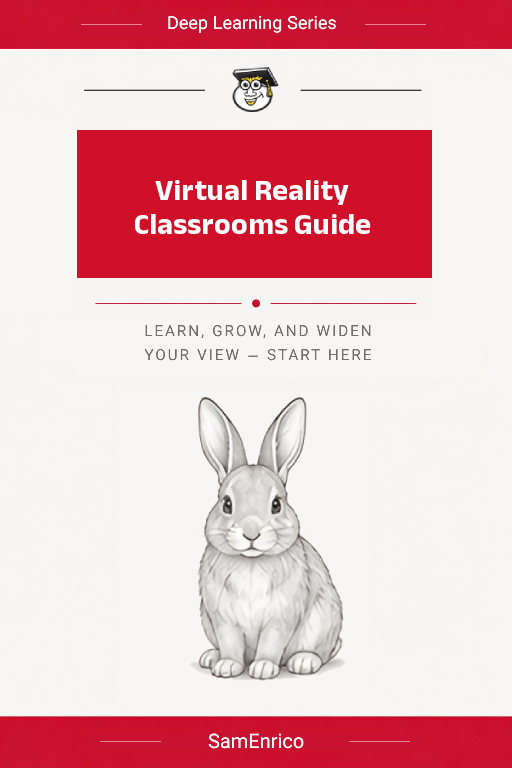
Non-FictionForecast & OutlookVR Education
Virtual Reality Classrooms Guide eBook
Discover immersive VR environments for field trips
Discover immersive VR environments for field trips, lab simulations, and historical recreations without leaving school.
Formats
Free sample
Chapter 1: The Boredom Crisis--Every morning, 56 million students walk into American classrooms. And every morning, a staggering percentage of them mentally check out before the second bell rings.The numbers are not ambiguous. According to the Gallup Student Poll, which has surveyed over 500,000 students across all 50 states, nearly half — 47 percent — report feeling bored in school every single day. Among high school students, that figure climbs to 58 percent. Let that land for a moment.
More than half of our teenagers are not engaged. They are not curious. They are not leaning forward. They are sitting in desks, staring at clocks, and waiting for the release bell.Educators feel this every day. You feel it.
You have planned the perfect lesson. You have differentiated the handout. You have connected the content to state standards. You have done everything right by the metrics that have governed American education for a century. And still, you look out at twenty-five faces, and fifteen of them are somewhere else.
Their bodies are in the room. Their minds are on Tik Tok, on video games, on the argument they had with a friend, on anything except the quadratic equation or the causes of World War I.This is not a failure of teacher effort. It is a failure of the fundamental agreement between schools and students. That agreement used to be simple: you pay attention, we give you information, and that information will lead to a better life. For generations, that bargain held.
Students trusted that what happened in the classroom mattered to their future, even when it was boring.That trust has shattered.The Dopamine Gap: Why Your Phone Is Winning To understand why students are so profoundly disengaged, you have to understand the neurological environment they inhabit for the other sixteen hours of their day. The average teenager spends seven and a half hours on screens outside of school — not including academic work. That is more time than they spend sleeping, more time than they spend with their families, and exponentially more time than they spend attending to direct instruction.Those seven and a half hours are not passive. They are engineered by some of the most sophisticated psychological manipulation systems ever created. Tik Tok, Instagram, You Tube, and every major gaming platform employ teams of neuroscientists and behavioral psychologists whose sole job is to maximize engagement.
They optimize for dopamine release — the neurotransmitter associated with pleasure, reward, and anticipation. A like triggers dopamine. A new notification triggers dopamine. A variable reward schedule (will the next swipe be interesting? maybe.
maybe not. keep swiping to find out) triggers more dopamine than a predictable reward.This is the environment students swim in every waking hour. Their brains are wired for high-frequency, high-intensity, variable-reward stimulation.Then they walk into your classroom.The board is static. The handout is black and white. The teacher speaks at a steady, predictable pace.
The reward for attention is a grade that will arrive in two weeks, if at all. From a neurological perspective, this is the difference between mainlining espresso and drinking decaf. The classroom cannot compete. It is not designed to compete. And that is the problem.This is what I call the Dopamine Gap — the chasm between the intensity of stimulation students receive outside school and the intensity they receive inside it.
The Gap is not a character flaw in students. It is not a symptom of laziness or entitlement. It is a neurological reality. You cannot lecture your way across the Gap. You cannot threaten or cajole or incentivize your way across it.
The only way across is to fundamentally change the nature of the learning experience itself.What VR Does That Textbooks Cannot This is where virtual reality enters the conversation, not as a shiny gadget but as a neurological intervention.Let me be precise about what I mean. When a student puts on a VR headset, several things happen simultaneously that are impossible in a traditional classroom environment.First, attention becomes involuntary. In a typical classroom, sustaining attention is an effortful act. The student must consciously choose to listen, to look at the board, to ignore distractions. That choice requires cognitive resources.
After about ten minutes of sustained effortful attention, mental fatigue sets in, and the mind wanders. In VR, attention is captured by the environment itself. When you are standing on the rim of the Grand Canyon, you do not have to try to pay attention. Your visual system, your vestibular system, and your spatial cognition are all engaged automatically. The environment commands attention.
This is not a matter of willpower. It is a matter of design.Second, the cost of switching contexts drops to zero. In a traditional classroom, moving from abstract concept to concrete example requires mental translation. The student hears the definition of "photosynthesis" and must hold that abstract string of words in working memory while trying to map it onto something real. In VR, the student can literally stand inside a plant cell.
They can watch photons strike a chloroplast. They can zoom out to see the leaf, zoom in to see the ATP synthase spinning. The abstraction is not a prerequisite; it is the conclusion drawn from direct observation.Third, memory encoding is multi-sensory and therefore stronger. Cognitive science has known for decades that information encoded through multiple sensory channels is recalled more reliably than information encoded through a single channel. Reading about the Colosseum engages only vision (and the internal auditory channel of subvocalization).
A VR experience of ancient Rome engages vision, spatial awareness, proprioception (the sense of your body's position), and often auditory input. The more channels engaged, the more neural pathways are created, and the more retrieval paths are available later. This is not opinion. This is settled neuroscience.The Four Affordances: I ARG for VRJeremy Bailenson, the founding director of Stanford University's Virtual Human Interaction Lab, has spent two decades studying how VR affects learning and behavior. His framework for understanding what VR makes possible is essential reading for any educator considering this technology.
I have condensed his four core affordances into a memorable acronym: I ARG — Identity, Agency, Replay, and Gravity.Let me walk you through each one, because understanding these four concepts will transform how you think about every VR activity you design.Identity: The Power of Becoming Someone Else In VR, students are not confined to their physical bodies. They can embody avatars that are older, younger, of a different gender, of a different race, or not human at all. This is not a gimmick; it is a profound pedagogical tool.Consider a lesson on the Civil Rights Movement. A traditional approach involves reading primary sources, watching documentary footage, and discussing historical events. A VR approach could place a white student in the body of a Black teenager sitting at a segregated lunch counter in 1960.
The student looks down and sees different skin. They look around and see hostile faces. They hear the murmurs, the threats. They experience, in a visceral way, the psychological weight of that moment.Research on this effect is startling. In one study, participants who embodied an elderly avatar in VR showed reduced implicit age bias after just a few minutes…
This is the end of the free sample. Get the eBook to keep going. Buy now
About this book
Details
- Author
- Rooney Tashina
- Publisher
- SamEnrico
- Language
- English
- Genre
- Non-Fiction, Forecast & Outlook, VR Education
- Released
- 2026-05-28
- Pages (approx.)
- 158
- Available as
- eBook, Audiobook

Read better in the ZLOADR app
Your eBooks on your phone or tablet. Sign in with your SamEnrico account and start reading.
More by Rooney Tashina
 Webinar Email AutomationRooney Tashina$11.99
 Tree Dream Symbolism HandbookRooney Tashina$11.99
 Norwegian EV Exemption SummaryRooney Tashina$11.99
 Methamphetamine Sobriety Survival ManualRooney Tashina$11.99
 From Ashes to Ashes: The Phoenix of the Titanic’s Unsinkable SpiritRooney Tashina$11.99
 Understanding Hyposmia Nasal Hypoplasia HypogonadismRooney Tashina$17.99
 FarrierRooney Tashina$11.99
 TikTok Ads Policy PrimerRooney Tashina$12.99
 How to Start a Press Cloth Business (Beginners Guide)Rooney Tashina$11.99
You may also like
 Hong Kong Handover 1997Dunn Johnnie$11.99
 Zumba For Postnatal Recovery CourseNeal Christian$11.99
 Zumba for BeginnersLadner Nikia$11.99
 YouTube Comment Mining GuideHumes Pandora$12.99
 Worry Box MeditationCarlin Rudy$11.99
 Workplace Stress MeditationNguyen Lynn$11.99
 Workplace Stress and Sleep RepairHawley Ivory$11.99
 Workplace Perfectionism CureDelaney Jeffry$11.99
 Workplace Injustice Anger GuideWallen Isabelle$11.99
 Work Addiction and Burnout LinkGreenwood Ester$11.99
 Women in Yoga and WellnessBeattie Galina$11.99
 Women in Stand Up ComedyChun Evangeline$11.99