
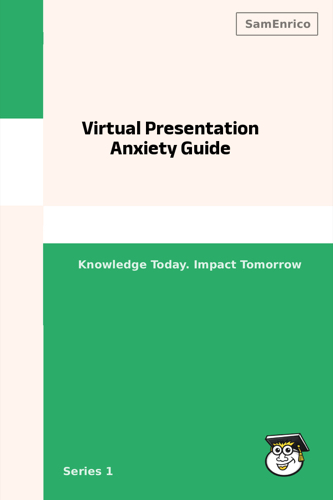
Non-FictionMental WealthVirtualRemote
Virtual Presentation Anxiety Guide eBook
Manage fear for Zoom, Teams, and other online spea
by Scanlon Gino
Manage fear for Zoom, Teams, and other online speaking settings.
Formats
Free sample
Chapter 1: The Mirror Trap--–- You are not bad at virtual presentations. You are having a normal reaction to an unnatural situation. The difference is everything.Let me describe a scene and see if it feels familiar.It is 9:55 AM. You have a Zoom presentation at 10:00. You have prepared for three days.
Your slides are beautiful. Your data is solid. You know this material better than you know your own phone number. You are ready.Then you click the link.The grid loads. There you are, front and center, in a small rectangle that feels like a magnifying glass held up to every flaw you have ever suspected about yourself.
Is that really what your face looks like? Why is your lighting so harsh? Is your hair doing that thing again? You have not even spoken yet, and already you feel the heat rising in your chest.Someone says, "Good morning." Their voice sounds distant and tiny through your headphones. You try to smile.
Your face feels like it belongs to someone else. You watch yourself smile on the screen, and it looks forced. Because it is forced. Because now you are performing for two audiences at once: the twelve people on the call and the mirror that is reflecting back every micro-expression you make.Your turn comes. The silence stretches out like a rubber band about to snap.
You say something. You are not sure what. Words are coming out, but you are no longer the one choosing them. Your voice sounds thin. Your mouth is dry.
You can feel your heart beating in your temples.And then it is over. Someone else is speaking. You exhale. But the shame is already settling in. You knew this material.
You were ready. So why did that happen? Why do you keep doing this to yourself?Here is the answer you have been looking for, and it is not the one you expect.You are not broken. You are not unusually weak or anxious or incapable. You are having a completely normal human reaction to a situation that your brain was never designed to handle.
The problem is not your confidence. The problem is the rectangle.Welcome to the Mirror Trap.The Paradox That Explains Everything Let me start with a question that sounds simple but is not. When you present in person, how many people are watching you?The obvious answer is however many people are in the room. Twelve. Twenty.
Fifty. But that is not correct. At least not neurologically.When you stand in front of a live audience, your brain does something remarkable. It compresses the crowd. You see a sea of faces, yes, but your visual system and your amygdala work together to process those faces as a single entity: "the audience." You are not tracking twelve individual threat assessments.
You are tracking one group. This is why experienced speakers can look out at a thousand people and feel only moderate anxiety. Their brains have learned to see a crowd as a single organism.Now compare that to a Zoom grid.On a virtual call, your brain cannot compress the faces. They are separated into individual boxes, each with its own name, its own expression (or lack thereof), its own potential for judgment. You are not looking at an audience.
You are looking at twelve separate judges. And your brain, which evolved to assess threats one at a time in a savanna, is now trying to assess twelve threats simultaneously while also processing a third input: your own face.This is the paradox of virtual presentations. You are alone in a room. There is no one physically present. But you are also hyper-visible in a way that has never existed in human history.
You are performing for a grid of faces while simultaneously watching yourself perform. No wonder you feel anxious. No wonder your voice shakes. No wonder your mind goes blank.You are asking your brain to do something it was never designed to do.The Neuroscience of the Self-View Window Let me take you inside your skull for a moment.Deep in your brain, tucked behind your eyes, sits a small almond-shaped cluster of neurons called the amygdala. Its job is simple: detect threats and activate your body's emergency response system.
The amygdala does not reason. It does not negotiate. It reacts. And it reacts fast—faster than your conscious mind can even register.When your amygdala decides something is dangerous, it triggers a cascade of hormones, including cortisol and adrenaline. Your heart rate spikes.
Your breathing becomes shallow. Blood rushes to your large muscles. Your digestive system shuts down. Your pupils dilate. Your palms sweat.
This is the fight-or-flight response, and it is designed to save your life when a predator is chasing you.Here is the problem. Your amygdala cannot tell the difference between a predator and a bad Zoom call. It only knows one thing: threat or no threat. And when you are staring at a grid of faces plus your own face in a high-definition rectangle, your amygdala reads threat. Not moderate threat.
Full threat.Why? Because your brain has a specialized circuit for self-evaluation called the medial prefrontal cortex. This is the part of your brain that monitors how you are being perceived by others. In small doses, it is helpful. It helps you adjust your behavior to fit social situations.
But when you can see your own face in real time, the medial prefrontal cortex goes into overdrive. It starts generating a constant stream of micro-assessments: Does my face look normal? Why am I squinting? Is that a nervous tic? Do I look as anxious as I feel?Each micro-assessment sends a new signal to your amygdala.
Each signal says, "Something is wrong." And your amygdala, ever vigilant, responds with another tiny burst of cortisol. By the end of a five-minute presentation, you have flooded your system with more stress hormones than your ancestors experienced during an actual predator chase.This is not weakness. This is biology.Why "Just Relax" Never Works I want to address something that has probably been said to you many times. Someone has told you to "just relax" or "take a deep breath" or "stop overthinking it." And when you tried, it did not work. In fact, it probably made you feel worse, because now you were anxious about being anxious.Here is why that advice fails.Your amygdala does not respond to language.
It does not speak English. It does not understand "calm down" or "it will be fine." The amygdala speaks only one language: sensation. Temperature. Movement. Sound.
Sight. Breath. You cannot reason with your amygdala any more than you can reason with your own heartbeat.This is the single most important concept in this entire book, so I want you to pause here and really absorb it.You cannot think your way out of a racing heart.Let me say that again. You cannot think your way out of a racing heart. The physiological response happens too fast and operates below the level of conscious control.
By the time you notice your heart pounding, the amygdala has already triggered the full cascade. Trying to calm yourself…
This is the end of the free sample. Get the eBook to keep going. Buy now
About this book
Details
- Author
- Scanlon Gino
- Publisher
- SamEnrico
- Language
- English
- Genre
- Non-Fiction, Mental Wealth, Virtual, Remote
- Released
- 2026-06-10
- Pages (approx.)
- 102
- Available as
- eBook, Audiobook

Read better in the ZLOADR app
Your eBooks on your phone or tablet. Sign in with your SamEnrico account and start reading.
More by Scanlon Gino
 Alcohol Withdrawal InsomniaScanlon Gino$11.99
 Divorce and Domestic ViolenceScanlon Gino$11.99
 Mande Epic Sunjata KeitaScanlon Gino$11.99
 Moving Aging Parents to Smaller HousingScanlon Gino$11.99
 The Celtic Games: Britain’s Forgotten Gladiators and the Birth of Athletic ExcellenceScanlon Gino$11.99
 Understanding Polysyndactyly Trigonocephaly Agenesis of Corpus CallosumScanlon Gino$17.99
 Center DirectorScanlon Gino$11.99
 HARO for Small Business OwnersScanlon Gino$12.99
 Timeshare and Vacation Club SpendingScanlon Gino$12.99
 A Beginners Guide to Evo (Volume 1)Scanlon Gino$11.99
You may also like
 Hong Kong Handover 1997Dunn Johnnie$11.99
 Zumba For Postnatal Recovery CourseNeal Christian$11.99
 Zumba for BeginnersLadner Nikia$11.99
 YouTube Comment Mining GuideHumes Pandora$12.99
 Worry Box MeditationCarlin Rudy$11.99
 Workplace Stress MeditationNguyen Lynn$11.99
 Workplace Stress and Sleep RepairHawley Ivory$11.99
 Workplace Perfectionism CureDelaney Jeffry$11.99
 Workplace Injustice Anger GuideWallen Isabelle$11.99
 Work Addiction and Burnout LinkGreenwood Ester$11.99
 Women in Yoga and WellnessBeattie Galina$11.99
 Women in Stand Up ComedyChun Evangeline$11.99