
Non-FictionSelf-HelpRemote Work
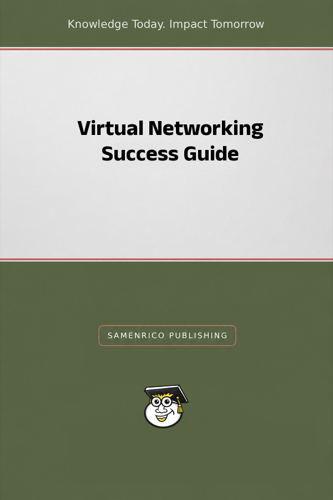
Virtual Networking Success Guide eBook
Build relationships through Zoom, Slack, and onlin
Build relationships through Zoom, Slack, and online professional communities.
Formats
Free sample
Chapter 1: The Empathy Algorithm--–- You just sent a message that ruined someone’s day, and you have no idea it happened.The message was not angry. It did not contain a curse word, a threat, or even a criticism. In fact, you wrote it quickly between meetings, thought nothing of it, and moved on. But on the other end of that Slack thread, a colleague read your words, felt their stomach drop, and spent the next twenty minutes replaying the exchange in their head. They showed the message to a work friend.
They asked, “Is it just me, or were they being short with me?” They decided you are difficult to work with. And they will remember that feeling the next time you ask for a favor.This is the invisible crisis of virtual communication. And it is happening right now, inside your company, between you and people you actually like.Welcome to the problem of digital body language. It is the single greatest barrier to virtual networking, and almost no one is talking about it. Books about Zoom teach you how to mute your microphone.
Books about Slack teach you how to create channels. But none of them teach you how to stop accidentally alienating the very people you need to build relationships with. That changes now.The Illusion of Clarity We suffer from a dangerous cognitive bias called the transparency illusion. In face-to-face conversation, you naturally assume the other person can see your facial expressions, hear your tone of voice, and read your body language. When you smile while saying something teasing, they know you are joking.
When you lean in while asking a question, they know you are engaged.But here is the trap. That assumption does not turn off when you switch to text. You still feel your own friendly intentions. You still hear your own gentle tone in your head. So you type “Sure.” and assume the other person hears it the way you meant it: warm, agreeable, slightly enthusiastic.They do not.They see “Sure.” and they hear a shrug.
They see a period at the end of a word and they read finality, even annoyance. According to communication research summarized in the book PING (2025), text-based communication strips away approximately seventy percent of the social cues that humans rely on to interpret meaning. What remains is ambiguous, cold, and dangerously easy to misinterpret.Consider this simple exchange. A manager writes to an employee: “Do you have the report?” The employee thinks: They are impatient. They think I am late.
I am in trouble. The manager, meanwhile, was just typing quickly because they had a meeting starting in two minutes and genuinely needed to know where the file was. No anger. No judgment. Just efficiency.By the time the manager returns from their meeting, the employee has already drafted a defensive response, shown it to two colleagues, and decided that their manager is “difficult.” All from four words.This is not fragility.
This is human psychology. We are hardwired to scan for threats, and ambiguous text is a threat. When we cannot see a face, we assume the worst. It is an ancient survival mechanism applied to a modern problem.The Empathy Algorithm: A Four-Step Filter The solution is not to stop using text. That is impossible.
The solution is to install a mental filter between your intention and your keyboard. I call this the Empathy Algorithm. It is a four-step checklist that takes approximately five seconds to run but will save you weeks of misunderstood messages and burned bridges.Step One: Intent. What do you actually want from this interaction? Most people skip this step entirely.
They type reactively. But if you pause for one second and name your intent, the entire message changes. Are you trying to get information? Are you trying to build rapport? Are you trying to delegate a task?
Each intent demands a different tone. A request for information can be direct. A request for rapport requires warmth. Delegation requires clarity plus acknowledgment of the other person’s workload. If you do not know your intent, your reader will invent one for you, and they will probably guess wrong.Step Two: Tone Translation.
Read your message out loud, but not in your own voice. Read it in the voice of a tired, stressed, slightly defensive coworker. How does it sound now? If you cringe, rewrite it. This step is uncomfortable because it forces you to hear your words as others might hear them, not as you intend them.
But discomfort is the price of clarity.Step Three: Receiver’s State. What is happening on the other side of that screen? Are they in back-to-back meetings? Are they known to be stressed about a deadline? Did they just get back from vacation?
The same message that lands well on a calm Tuesday morning will land like a bomb on a frantic Friday afternoon. The Empathy Algorithm asks you to consider the receiver’s emotional state before you hit send. If you cannot gauge their state, assume they are busier and more stressed than you think. Then soften accordingly.Step Four: Softener Addition. This is the tactical layer.
Based on the first three steps, what single word, phrase, or punctuation mark can you add to make the message land softer? A “thanks” at the end. A “no rush” in the middle. A single exclamation point to signal warmth. An emoji to clarify tone.
These are not fluff. They are the difference between a message that builds a relationship and a message that damages one.Let us see the Empathy Algorithm in action.A manager needs a file from an employee. Old message: “Do you have that file?” New message after running the algorithm: “No rush at all, but when you have a moment, could you share that file? Thanks so much.” Both messages ask for the same thing. The second message acknowledges the employee’s time (“no rush at all”), uses a softening phrase (“when you have a moment”), and adds gratitude (“thanks so much”).
The response rate to the second message is significantly higher. More importantly, the relationship is preserved and even strengthened.The Exclamation Point Economy Punctuation is not neutral in text. Every period, every question mark, every exclamation point carries emotional weight. Most professionals do not believe this. They think punctuation is grammar.
But in virtual communication, punctuation is body language.Let us start with the exclamation point. In professional writing before the age of Slack and email, exclamation points were rare. They were considered informal, even juvenile. That has changed. In the fast-paced, text-heavy world of virtual work, the exclamation point has become the primary signal of warmth and enthusiasm.Research cited in PING suggests that messages containing exactly one exclamation point are perceived as significantly warmer and more approachable than messages without any.
A single “Great!” or “Thanks!” or “Looking forward to it!” tells the reader that you are happy, not merely acknowledging.But there is a catch. Three or more exclamation points flip the signal entirely. “Great!!!” reads as manic, unstable, or sarcastic. One is warm. Two is pushing it.
Three is a red flag.Here is the practical rule. Use one exclamation point per message when you want to convey…
This is the end of the free sample. Get the eBook to keep going. Buy now
About this book
Details
- Author
- Willoughby Eun
- Publisher
- SamEnrico
- Language
- English
- Genre
- Non-Fiction, Self-Help, Remote Work
- Released
- 2026-06-11
- Pages (approx.)
- 110
- Available as
- eBook, Audiobook

Read better in the ZLOADR app
Your eBooks on your phone or tablet. Sign in with your SamEnrico account and start reading.
More by Willoughby Eun
 Self Hypnosis For Exam PreparationWilloughby Eun$11.99
 Hope for the Tired CarerWilloughby Eun$11.99
 Menstrual Health for Shift WorkersWilloughby Eun$11.99
 College Stress Survival HandbookWilloughby Eun$11.99
 Silicon Samurai: The Untold Story of Japan's First Tech BillionaireWilloughby Eun$11.99
 The Frozen Odyssey: The Lost Expedition of the MahanadyaWilloughby Eun$11.99
 Danegeld TaxWilloughby Eun$11.99
 Voiceover Pricing GuideWilloughby Eun$12.99
 Australian Privacy Breach GuideWilloughby Eun$12.99
 Understanding Ebola Virus DiseaseWilloughby Eun$17.99
 How to Become a Cargo AgentWilloughby Eun$11.99
You may also like
 Hong Kong Handover 1997Dunn Johnnie$11.99
 Zumba For Postnatal Recovery CourseNeal Christian$11.99
 Zumba for BeginnersLadner Nikia$11.99
 YouTube Comment Mining GuideHumes Pandora$12.99
 Worry Box MeditationCarlin Rudy$11.99
 Workplace Stress MeditationNguyen Lynn$11.99
 Workplace Stress and Sleep RepairHawley Ivory$11.99
 Workplace Perfectionism CureDelaney Jeffry$11.99
 Workplace Injustice Anger GuideWallen Isabelle$11.99
 Work Addiction and Burnout LinkGreenwood Ester$11.99
 Women in Yoga and WellnessBeattie Galina$11.99
 Women in Stand Up ComedyChun Evangeline$11.99