
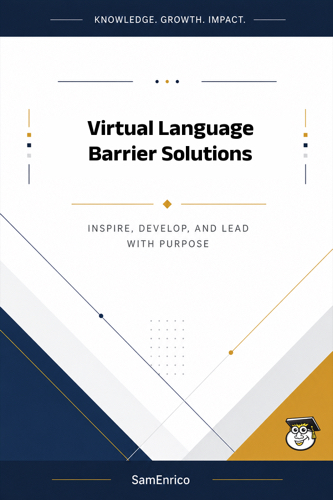
Virtual Language Barrier Solutions eBook
Communicates across non native speakers remotely.
by Neely Luise
Communicates across non native speakers remotely.
Formats
Free sample
Chapter 1: The Fluency Trap–- Most people believe that if you can speak English fluently – quickly, without hesitation, with a rich vocabulary – you are a good communicator. Most people are wrong.Consider two professionals. Maria is a software engineer from São Paulo. She learned English in school and through years of subtitled American TV. She speaks slowly.
She pauses to find words. She sometimes says “make a photo” instead of “take a photo.” She asks people to repeat themselves constantly. By any traditional measure, her English is “intermediate” at best.Now consider James. He was born in London. He has a master’s degree from a British university.
He speaks at 180 words per minute, uses idioms like “get the ball rolling” and “circle back,” deploys acronyms like “EOD” and “ROI” without a second thought, and assumes everyone understands his sarcasm. By any traditional measure, his English is “native” and therefore “fluent.”Who is the better communicator in a global remote team?The answer, which surprises most people, is Maria. And this chapter will explain why.The Great Misunderstanding The single most damaging assumption in global remote work is that fluency equals effective communication. This assumption is baked into hiring practices (we reject qualified candidates for not having “perfect English”), into meeting dynamics (we let native speakers dominate), and into our own self-assessments (non-native speakers feel inadequate; native speakers feel entitled).But fluency and effective communication are not the same thing. In fact, they often work against each other.Fluency, as linguists define it, is the ability to produce language smoothly, quickly, and without hesitation.
It is about speed and automaticity. A fluent speaker can retrieve words rapidly, construct sentences without pausing, and maintain a steady flow of speech.Effective communication, on the other hand, is the ability to convey your meaning accurately and confirm that it has been understood. It is about clarity and verification. An effective communicator adapts their language to the listener, checks for understanding, and invites clarification.Here is the critical insight that changes everything: A highly fluent speaker is often a terrible communicator in cross-language settings. Why?
Because their speed and automaticity become liabilities. They speak too fast. They use expressions that don’t translate. They assume shared context that doesn’t exist. And because they never struggle with language themselves, they have no empathy for those who do.Conversely, a less fluent speaker is often a better communicator.
Because they know the struggle, they slow down. Because they have been misunderstood, they check for understanding. Because they have felt the shame of not knowing a word, they create psychological safety for others.Maria from São Paulo asks “Can you repeat that?” without embarrassment. James from London says “Never mind” when someone doesn’t understand him, leaving the other person feeling stupid.Who is the better communicator? Maria.
Every time.The Cognitive Load You Cannot See To understand why fluency is a trap, you must first understand cognitive load – the amount of mental effort being used in working memory.Every conversation demands cognitive resources. You must hear words, recognize them, parse grammar, infer meaning, remember what was said earlier, formulate a response, and monitor the other person’s reactions. Native speakers do all of this automatically, with very little conscious effort. It is like breathing – you don’t think about it until something goes wrong.For non-native speakers, every single one of those tasks requires conscious effort. The cognitive load is dramatically higher.Let’s break down what happens inside Maria’s brain during a typical 30-second interaction on a Zoom call:Second 0-2: James says, “Let’s put a pin in that and circle back after we touch base on the Q3 deliverables.”Second 2-5: Maria’s brain processes the sounds.
She recognizes most of the words individually. But “put a pin in that” – she has never heard this idiom. She knows what a pin is. She knows what “in that” means. Together, they make no literal sense.
Her brain spends extra cycles trying to parse it.Second 5-8: She gives up on the idiom and tries to guess meaning from context. James said “circle back” earlier in the sentence – that’s another idiom she doesn’t know. “Touch base” – another one. By the time she gets to “Q3 deliverables,” she has spent so much energy on the idioms that she almost misses that “Q3” probably means “quarter three,” which she knows from her finance team.Second 8-12: James has moved on. But Maria is still three seconds behind.
She is still processing the first sentence. She cannot listen to the second sentence while processing the first. So she misses everything James says next.Second 12-15: James finishes speaking and says, “Does that make sense?” Maria panics. She doesn’t know what “that” refers to because she missed half of it. Should she say no?
That would be embarrassing. She has been told that admitting confusion makes her look incompetent. So she nods and says, “Yes, sounds good.”Second 15-30: The meeting continues. Maria is now permanently three seconds behind. She stops trying to understand everything and starts scanning for keywords.
She hears “deadline,” “Friday,” and “Maria” in the same sentence. She assumes James is asking her for something by Friday. She doesn’t know what. She will have to guess. Or ask a colleague after the meeting.
Or pretend she understood and hope for the best.This is not a failure of Maria’s English. This is a failure of James’s communication. And it is happening millions of times every day in remote meetings around the world.The cognitive load of speaking a second language all day is exhausting in ways that native speakers cannot see and rarely imagine. Here is what that load includes:Constant translation. Even when you are fluent, your brain is mapping incoming English words to concepts in your first language.
This takes milliseconds – but milliseconds add up. Over an hour-long meeting, a non-native speaker processes thousands of extra micro-translations.Delayed response time. Because of that translation loop, non-native speakers typically need 2-3 seconds longer to formulate a response. In a fast-paced meeting, those seconds never come. By the time they are ready to speak, someone else has jumped in.The rehearsal loop.
Before speaking, non-native speakers often rehearse their sentence silently. This takes additional cognitive resources. It also means that if the conversation shifts while they are rehearsing, they have to abandon their prepared sentence and start over.Fear of mistakes. The amygdala – the brain’s fear center – activates more strongly in non-native speakers when they speak. They are not just communicating; they are managing anxiety about grammar, pronunciation, word choice, and social judgment.Code-switching fatigue.
Switching between languages throughout the day – from English work calls to family conversations in your native language – is metabolically expensive. It is like running intervals all day instead of a steady jog.The impression management tax. Non-native speakers are constantly aware that they are being judged by their language. They worry that a grammatical error will be interpreted as a sign of low competence. They worry that an accent will be heard as a lack of intelligence.
So they expend extra energy trying to sound “correct” – energy that could have been used on the actual content…
This is the end of the free sample. Get the eBook to keep going. Buy now
About this book
Details
- Author
- Neely Luise
- Publisher
- SamEnrico
- Language
- English
- Genre
- Non-Fiction, Self-Help, Language
- Released
- 2026-06-05
- Pages (approx.)
- 136
- Available as
- eBook, Audiobook

Read better in the ZLOADR app
Your eBooks on your phone or tablet. Sign in with your SamEnrico account and start reading.
More by Neely Luise
 The Developer Deep WorkNeely Luise$11.99
 Foggy Morning BridgeNeely Luise$11.99
 Senior Advocacy ConfidenceNeely Luise$11.99
 Flow in Sales NegotiationNeely Luise$11.99
 Self Talk for AthletesNeely Luise$11.99
 Sunrise Field RelaxationNeely Luise$11.99
 Football Player's Self HypnosisNeely Luise$11.99
 The Underground Warriors: The Birth of Vale Tudo and the Fighters Who Defied the WorldNeely Luise$11.99
 The Bard's Deceivers: How 18th-Century Actors Fooled EuropeNeely Luise$11.99
 How to Produce Diaper PailsNeely Luise$11.99
 How to Become a Counter FormerNeely Luise$11.99
 Vultures: Nature’s Cleanup CrewNeely Luise$11.99
You may also like
 Hong Kong Handover 1997Dunn Johnnie$11.99
 Zumba For Postnatal Recovery CourseNeal Christian$11.99
 Zumba for BeginnersLadner Nikia$11.99
 YouTube Comment Mining GuideHumes Pandora$12.99
 Worry Box MeditationCarlin Rudy$11.99
 Workplace Stress MeditationNguyen Lynn$11.99
 Workplace Stress and Sleep RepairHawley Ivory$11.99
 Workplace Perfectionism CureDelaney Jeffry$11.99
 Workplace Injustice Anger GuideWallen Isabelle$11.99
 Work Addiction and Burnout LinkGreenwood Ester$11.99
 Women in Yoga and WellnessBeattie Galina$11.99
 Women in Stand Up ComedyChun Evangeline$11.99