
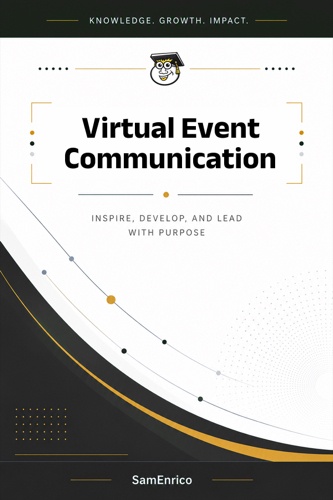
Virtual Event Communication eBook
Engages attendees before, during, and after.
Engages attendees before, during, and after.
Formats
Free sample
Chapter 1: The Ninety-Day Conversation--–- The event lasted four hours. Forty-seven people showed up out of three hundred registrants. The chat log contained eleven messages, three of which were technical complaints. The recording received zero views in the following week.When I asked the organizer what went wrong, she did not blame the platform, the speakers, or the topic. She blamed the attendees.
“They just weren’t engaged,” she said. “People don’t pay attention anymore.”That organizer was both right and completely wrong. She was right that attention has fractured. She was completely wrong about the cause. The attendees did not fail the event.
The event failed the attendees—not because of bad content or boring slides, but because the organizer treated the four-hour broadcast as the entire experience. She spent weeks planning the middle and nothing at all on the edges.This chapter dismantles that broken assumption and replaces it with a single, actionable truth: A virtual event is not a one-day broadcast. It is a ninety-day conversation.The Great Misunderstanding of Virtual Events When physical events moved online in the early 2020s, organizers made a reasonable but catastrophic error. They took the structure of a physical conference—a two or three day gathering with sessions, breaks, and networking—and poured it directly into a video conferencing platform. The agenda looked the same.
The session lengths remained unchanged. The speaker format stayed identical.The problem is that physical and virtual events operate under completely different psychological rules.In a physical venue, attendees have already made a significant commitment. They traveled. They paid for a hotel. They are wearing a badge.
The cost of walking away is high—both financially and socially. Even a mediocre session benefits from what behavioral economists call the sunk cost fallacy: I have already invested two hours and two hundred dollars to be here, so I might as well stay.In a virtual environment, the cost of walking away is zero. The attendee is sitting in their home office, wearing comfortable clothes, with their email inbox one click away. The moment a session feels irrelevant, slow, or confusing, their cursor drifts to another tab. This is not rudeness.
It is rational behavior. The virtual attendee is constantly calculating: Is this the best use of my attention right now?Most virtual event organizers pretend this calculation does not exist. They build events assuming captive attention, then express surprise when attention wanders. This is like building a restaurant with no walls and wondering why diners leave before dessert.The solution is not to blame attendees or to beg for their attention. The solution is to build an architecture of communication that earns attention repeatedly, before, during, and after the event.
This architecture is what I call the Ninety-Day Engagement Lifecycle.The Ninety-Day Engagement Lifecycle Defined The Ninety-Day Engagement Lifecycle is a framework that treats the live event not as the main attraction but as the middle peak of a much longer arc. The lifecycle consists of four distinct phases, each with its own goals, tactics, and communication styles.Phase One: Anticipation (Days -90 to -30)The goal of Phase One is not to sell tickets. It is to build a narrative that makes attendance feel inevitable rather than optional. During these sixty days, prospective attendees are not yet committed. They are browsing, comparing, and deciding whether to invest their time.
Communication during this phase must be low-pressure and high-value. You are not selling an event. You are selling a transformation that happens to involve an event.Successful Phase One communication includes problem-awareness content (blog posts, Linked In articles, short videos) that establishes the stakes of the topic, speaker reveals that build authority and curiosity, and social proof that answers the unspoken question “Is this for people like me?” Email cadences during this phase are weekly at most, and every single email must deliver standalone value. If an email is only useful to someone who has already registered, it is sent too early.Phase Two: Activation (Days -30 to -1)Phase Two is where passive interest converts into active participation. The attendee has registered—or is very close to registering—but registration is not the same as engagement.
Registering for an event takes fifteen seconds. Showing up and paying attention takes hours. Phase Two exists to bridge this gap.During these thirty days, communication shifts from why you should come to how you will participate. This is the phase where pre-event engagement sessions (which we will cover in Chapter 4) begin. Attendees receive homework, pre-reading, and interactive polls that shape the event agenda.
They are placed into small groups or matched with other attendees who share their interests. By the time the live event arrives, a Phase Two attendee has already invested time, formed connections, and developed a sense of ownership over the experience.This is not optional. Data from hundreds of virtual events shows that attendees who complete at least one pre-event engagement activity are three times more likely to attend the live event and five times more likely to stay for more than sixty minutes. The investment does not need to be large. A five-minute poll, a ten-minute pre-read, or a thirty-minute “Know Before You Go” session is enough to trigger the psychological principle of commitment consistency: people who have taken a small action in support of an experience are far more likely to take larger actions later.Phase Three: The Live Event (Day 0)The live event itself is Phase Three.
Notice its placement: it is not the beginning or the end. It is the middle. This reframing is essential because it changes how you allocate your resources. Most organizers spend ninety percent of their time and budget on Phase Three. The Ninety-Day Lifecycle suggests spending forty percent on Phase One, forty percent on Phase Four, and only twenty percent on Phase Three itself.Why such a small allocation to the live event?
Because the live event is the one phase you cannot fully control. Internet connections fail. Speakers run late. Polls malfunction. By the time the live event arrives, your most important work—building anticipation, activating commitment, and gathering data—is already done.
The live event is where you harvest what you have planted, not where you plant new seeds.That does not mean the live event is unimportant. It means your preparation determines your success. An event with strong Phase One and Phase Two will succeed even with minor technical problems. An event with weak Phase One and Phase Two will fail even with flawless production.Phase Four: Extension (Days +1 to +90)Phase Four is the most underutilized phase in virtual events. Most organizers send a “thank you” email with a recording link, then close the books.
This is like throwing a dinner party, watching guests leave, and never speaking to them again.Phase Four extends the value of the event across ninety days. It includes immediate follow-up (within twenty-four hours) that capitalizes on post-event emotion, tactical follow-up (within thirty days) that uses behavioral data to personalize content, and sustained community nurturing (within sixty to ninety days) that keeps the conversation alive until the next event.The economic case for Phase Four is straightforward. Acquiring a new…
This is the end of the free sample. Get the eBook to keep going. Buy now
About this book
Details
- Author
- Shifflett Toby
- Publisher
- SamEnrico
- Language
- English
- Genre
- Non-Fiction, Self-Help, Events
- Released
- 2026-06-08
- Pages (approx.)
- 152
- Available as
- eBook, Audiobook

Read better in the ZLOADR app
Your eBooks on your phone or tablet. Sign in with your SamEnrico account and start reading.
More by Shifflett Toby
 Abandoned Cart RecoveryShifflett Toby$12.99
 Flow in FirefightingShifflett Toby$11.99
 The Focus Habit HandbookShifflett Toby$11.99
 Positive Self Talk WorkbookShifflett Toby$11.99
 Vineyard Sunset RelaxationShifflett Toby$11.99
 The Senior Advance DirectiveShifflett Toby$11.99
 Mountain Lake Serenity GuideShifflett Toby$11.99
 Self Hypnosis for Achilles TendonitisShifflett Toby$11.99
 The Last Letter of the Titanic’s Unsung Hero: A Forgotten Story of CourageShifflett Toby$11.99
 The Last Broadcast: The Fall of Saigon in Real TimeShifflett Toby$11.99
 How to Produce Detergent and SOAPShifflett Toby$11.99
 A Collector's Handbook to the Wolseley 1500Shifflett Toby$11.99
You may also like
 Anger for Event PlannersMasterson Buster$11.99
 Outsourcing for Event PlannersParkinson Mitch$11.99
 Delegation for Event PlannersYost Carlota$11.99
 The Assertiveness for Event Planners GuideFerry Daysi$11.99
 Remote Holiday Party GuideFlynn Georgetta$11.99
 Wedding Planner High Stress GuideMartin Sonya$11.99
 The Mindful Wedding Planning GuideAntonio Booker$11.99
 EQ For Wedding PlannersLoyd Wesley$11.99
 The Event Planner Stress GuideMcdade Brandee$11.99
 Parenting Stress and Birthday PartiesHolder Cleopatra$11.99
 Event Planner Crisis MgmtLentz Zenaida$11.99
 Eisenhower Matrix for Event PlannersHunt Clayton$11.99